



The Houthis project readiness for war, but in reality lack the resources to sustain it and are increasingly focused on maintaining control within Yemen rather than fighting external enemies.
The Houthis are running on fumes

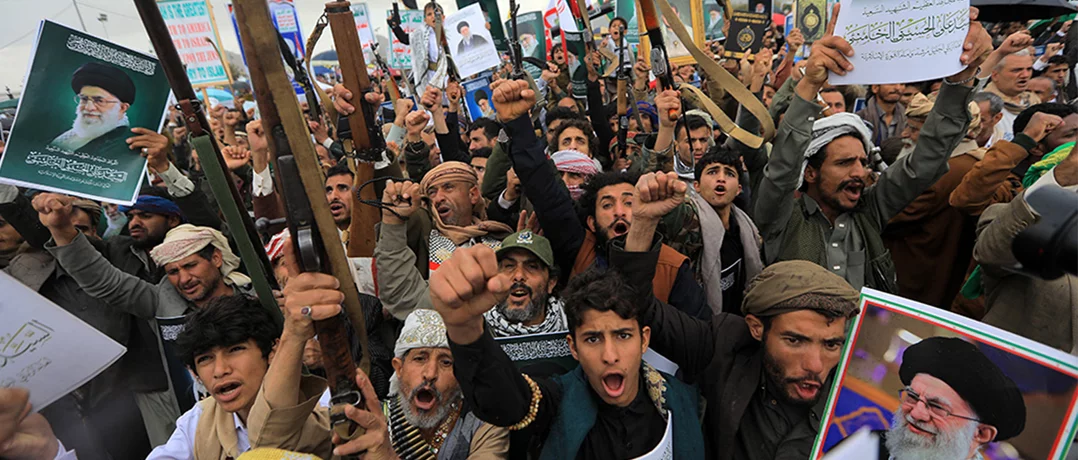
If you listen to Abd al-Malik al-Houthi's speeches every week, as I do, you would think the group is about to open a second front against America and Israel. The language is apocalyptic. The promises are absolute. Rallies fill al-Sabeen Square in Sanaa. Fighters parade through every governorate. The movement that spent two years disrupting global shipping and launching ballistic missiles at Israel has told its followers, repeatedly and without qualification, that it stands ready to act "at any moment."
But suppose they act. What does that war actually look like, and what would it take to sustain it?
Take the Red Sea campaign, which the Houthis said they launched in support of Gaza. Since November 2023, the group has carried out more than 100 attacks on commercial vessels in the Red Sea, but that campaign consumed their weapons at a fairly high rate, exposed critical infrastructure, and invited sustained American and Israeli strikes on launch sites, storage facilities, and fuel tanks at Ras al-Issa. By 2025, the numbers had begun to decline and came to a momentary halt. Whether the Houthis stopped firing due to ceasefires, truces, or depleted stocks is debatable, but what is clear is that the tempo never returned to its 2024 levels and the arsenal that sustained it struggled to be replenished.
If we examine their attacks against Israel, the Houthis had launched approximately 40 ballistic missiles and more than 320 drones according to the IDF, but roughly a fifth to a quarter of the ballistic missiles failed en route, more than 100 drones were intercepted, and only two struck populated areas. By early September, Israeli media reported 80 ballistic missiles and at least 31 drones launched since the resumption. Despite these failures, the movement publicly treated the campaign as a success because it forced nationwide alarms and disrupted Israeli air traffic. But in doing so, they were also making a bet that a few Israeli lives and fear are worth more than Yemeni security or Israeli retaliation.
The cost of that campaign was not only material. Israeli airstrikes in 2025 killed the Houthi prime minister, about a dozen cabinet members, and Chief of the General Staff Muhammad al-Ghamari. The political leadership was easily replaced, but Ghamari was important because of the role he played in establishing the Houthis' missile systems and weapons-production infrastructure. He was trained by Hezbollah and the IRGC, and his expertise could not be replaced by appointing a brother-in-law.
Sustained pressure on the movement and naval interdictions choked whatever remained of the resupply line. The July 2025 seizure of over 750 tons of Iranian-origin materiel showed how much the group relied on imports to sustain its production capacity. So while the Houthis can still launch, every launch depletes their limited reserves and reveals positions that have already been mapped, and the surviving commanders saw what happened to the last ones who generated those signatures. The critical bottleneck is not finished weapons but the components needed to build them: seekers, guidance electronics, and engines. Each requires an import, and every import requires smuggling. The scale of that smuggling is visible in what has been caught. The U.S. Treasury has designated Chinese firms for supplying machining tools and manufacturing equipment to the Houthis, and an Oman-based logistics company was sanctioned for transferring cruise missile components into Yemen.
The Houthis' supply chain has also been interrupted repeatedly. In October 2025, Yemeni authorities seized 58 containers at the Port of Aden with about 2,500 tons of drone manufacturing equipment. For every shipment intercepted, others have gotten through, but the current environment is more vigilant than before, the seas around Yemen are more surveilled than ever, and Iran's own situation does not allow it to sustain smuggling or production capacity for all of its proxies at once. The Houthis are trying to build domestic production capacity because they know smuggling cannot be relied on forever, but that is a project measured in years, and a war tomorrow requires components not in the warehouse today. With Iran under sustained bombardment, the pipeline that built the Houthis' arsenal is not functioning.
But none of this matters as much as the fuel, because fuel is what keeps the Houthi state alive. Iranian oil enters Yemen through a network of front companies with direct ties to the IRGC, arriving at Houthi-controlled ports at Hodeidah and Ras Isa and sold domestically at inflated prices. The UN Panel of Experts estimated the Houthis collected approximately $4 billion from customs duties on fuel imports alone between 2022 and 2024, with total income from the fuel sector reaching roughly $5.5 billion. Houthi leaders have also been negotiating future oil deals with Russian government representatives.
That fuel supply has been under pressure well before the current war with Iran. Israeli strikes have hit those ports and their fuel infrastructure, the Trump administration ended the general license allowing petroleum offloading at Houthi ports in April 2025, and Treasury has sanctioned the terminals, port managers, and vessels still making deliveries. The war on Iran now threatens the source itself, and any Houthi escalation from here does not just risk airstrikes on missile sites but invites a scenario in which fuel restrictions tighten further, deliveries stop entirely, and the one thing keeping the Houthi state functional disappears. Without fuel, there are no salaries, no revenue, and no state to administer, which is what running on fumes actually means.
Along with fuel, the Houthis are sustained by broader networks, having spent years building smuggling and logistics channels into the Horn of Africa that have become central to their survival. The UN Panel of Experts on Yemen in its October 2025 final report found that cooperation with al-Shabaab now involves weapons smuggling, technical training, and logistical support as part of a deliberate strategy to expand regional influence. In recent years, Somalia has been "increasingly" used as a transit hub for weapons destined for the Houthis, with multiple routes running through Somali ports, and a captured Houthi operative confessed in February 2025 to five arms smuggling runs between Yemen and Somalia in late 2024.
Adding to this is a cooperation with al-Qaeda that has gone largely undetected for years. The same UN report confirmed that the ceasefire between the Houthis and al-Qaeda in the Arabian Peninsula remains in effect, with both parties exchanging prisoners as recently as March 2025, and that collaboration includes the training of AQAP operatives and intelligence coordination. These networks move components, money, and fighters, and act as the connective tissue between the Houthi state and the outside world.
So suppose they launch, and they fire what they have, and they hit a ship, or a base, or a city. What happens on day two? Can the Houthis either defend their position or sustain an attack? What happens to their plans of taking over the rest of Yemen, a plan in which they have mobilized manpower and built an army from a collection of tribes, loyalists, and through coercion of the rest who live under their control? Can they sustain the retaliation that follows, and the bitter reality that such retaliation cannot escape collateral damage, a brutality that Yemenis never asked for?
While the world waits for a Houthi missile aimed outward, the weapons the Houthis are actually using are pointed at Yemenis. Taiz, Yemen's third-largest city, has been under Houthi siege for over nine years, and Houthi forces attacked army positions west of the city this week. In Hajjah, an artillery attack on a village killed at least ten people, including six children, as they gathered for iftar. Houthi landmines continue to kill civilians across the country. The ground force the movement has been assembling through mass conscription is not designed to fight America or Israel but to hold territory and subjugate the population living on it. The movement that told the Arab world it was fighting for Palestine is spending its remaining capacity on controlling Yemenis and serving a patron that is itself on fire.
But the Houthis may still fire, not to enter a war but to exit one with their reputation intact. If negotiations involving Iran begin to advance, the Houthis will feel pressure to launch something, because sitting it out entirely is not an option for a movement that told its fighters this was a divine cause, and not an option in front of an Iranian network watching to see which of its proxies still function. A strike timed to that moment would not mean they have rebuilt anything. It would mean they are spending what little they have left to avoid looking already finished.
The Houthis appear to be gambling that the war on Iran will be short, that the regime will survive under Mojtaba Khamenei, that the IRGC will rebuild, and that the smuggling networks and fuel pipelines will eventually resume. Their entire posture is built on holding on rather than fighting, and waiting for the supply lines to come back. But there is one resource the Houthis are not running low on, and that is ideology. The speeches will continue and the apocalyptic framing will intensify. The media apparatus will keep producing images of strength, unity, and divine purpose. When the missiles are depleted and the fuel stops flowing, ideology is what fills the gap, and it is the last thing a movement like this runs out of, and the most dangerous, because it can sustain a war against a population long after it has lost the capacity to fight anyone else.
