



Lebanon’s decision to grant FIFA president Gianni Infantino citizenship revives long-standing disputes about naturalization laws, motives, and constitutional legitimacy.
The Infantino naturalization debate

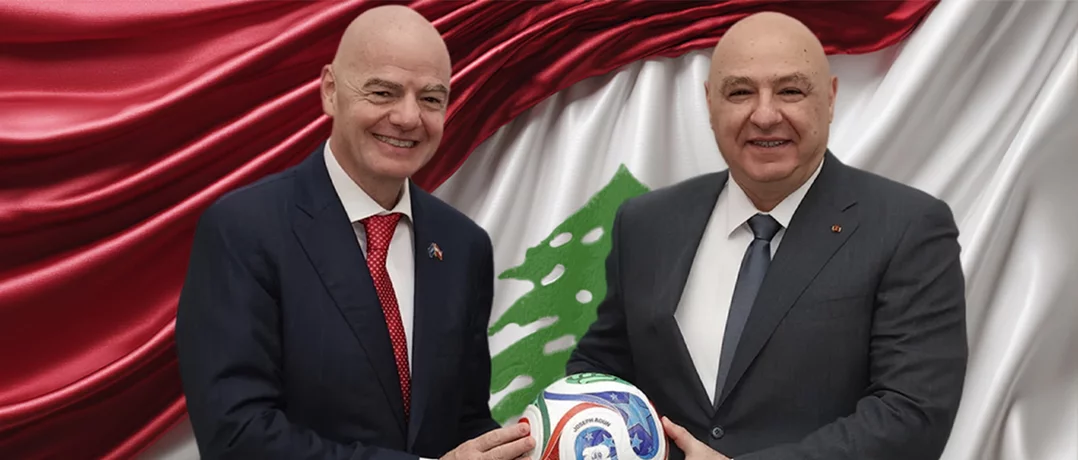
On 25 November 2025, President General Joseph Aoun granted Lebanese citizenship to Gianni Infantino, the president of the International Federation of Association Football (FIFA), the world governing body of association football (founded in Paris in 1904).
In its statement, the Lebanese Football Association (LFA) noted that Infantino, who landed for a two-day official visit, was granted citizenship in a symbolic gesture that affirms “Lebanon’s appreciation for his role in developing the game and his continued support for Lebanese football.”
However, it is worth noting that President Aoun “asked Infantino to complete the necessary legal documents and paperwork for the final signing of the Lebanese citizenship decree at a later date, in accordance with the applicable constitutional procedures.”
Who is Gianni Infantino?
Gianni Infantino was born in 1970 to Italian parents who had emigrated to Switzerland, making him simultaneously an Italian Swiss citizen. He is married to Leena al-Ashkar, a Lebanese who worked for the LFA.
Infantino became the Deputy General Secretary of the Union of European Football Associations (UEFA) and also the Secretary General of UEFA in 2007 and 2009, before becoming the 9th president of FIFA in 2016, the first Italian to hold this position. He later went on to win the presidency for two consecutive rounds (in 2019 and 2023), overseeing several FIFA World Cups (including the one held in Qatar in 2022).
The dilemma of naturalization in Lebanon
The issue of naturalization has always been a contentious and controversial topic in Lebanon. This was especially true during the Syrian occupation (1990-2005) where Lebanese authorities (including the President of the Republic) issued various orders and decrees to grant citizenship for certain foreign individuals but persisted with the Syrian withdrawal.
In 1994, decree Mo. 5247 was issued by President Elias Hrawi, which granted citizenship to over 150,000 people (the majority of whom were of Muslim as well as Syrian and Palestinian origins). The numbers were quite shocking and revealed a hidden political agenda for demographic engineering in the country. The Maronite League had filed an appeal before the State Council (Majlis al-Shura, which is Lebanon’s highest administrative court) at the time, which has not yet issued its decision on the matter.
The 1994 decree was not the exception. After the Syrian occupation ended, President General Michel Suleiman issued various naturalization decrees in 2013 and 2014. Likewise, in 2018, President General Michel Aoun issued a new decree, which was signed by Prime Minister Saad Hariri and Interior Minister Nouhad al-Machnouk, including names directly linked to the Assad regime and others subject to international sanctions. At the time, the General Security claimed that it had not reviewed their files to provide a “security” opinion on them. The matter sparked a wave of criticism, resulting in deputies from the Progressive Socialist Party (PSP) and the Lebanese Forces (LF) filing an annulment appeal before the State Council to cancel the decree, however, to no avail.
Interestingly, at the end of Aoun’s term in 2022, a source in the presidential palace revealed that the former president had left a list of 5,000 names that were supposed to be granted citizenship under a new decree (although the latter was never issued).
From here, all of the aforementioned decrees were not presented for public debate, nor did they go through oversight mechanisms; rather, they were quietly passed behind the scenes. It was mainly political considerations (sometimes even sectarian as well) that were taken when deciding who should be granted Lebanese citizenship.
Whose constitutional authority is it to grant Lebanese citizenship?
The question, however, remains: who holds the authority to issue naturalization decrees?
Lebanon has recently reignited a long-standing debate over the legal foundation of presidential naturalization decrees. While naturalization by decree has been practiced for nearly a century, the legal framework governing this power is far from straightforward. The complexity stems from a series of laws and amendments enacted during the Mandate era and the early years of the Republic.
The core of the controversy lies in Article 3 of Decision No. 15 of 1925, which originally authorized the Head of State to grant Lebanese nationality under specific conditions. Although this article was repealed in 1939 with the adoption of a stricter naturalization law, that same law was itself annulled in 1940. This sequence created uncertainty over whether the original article was automatically revived.
Over the decades, successive governments continued issuing naturalization decrees under the assumption that Article 3 had indeed been reinstated. This interpretation was later affirmed by Lebanon’s State Council, which ruled that the article remained valid and formed the legal basis for modern decrees. In its Decision No. 484 (2003), the Council stated that “the matter of nationality differs from that of naturalization, which is limited to granting nationality to an applicant who meets the legal conditions, noting that this authority is vested in the Head of State pursuant to Article 3 of Decision No. 15.” It was later reiterated in its Decision No. 488 (2014), asserting that “Regarding the legal basis of Naturalization Decree No. 5247/1994, it appears that it was issued pursuant to Decision No. 15/1925, and hence implicitly its Article 3, as it is the only article governing naturalization. This article remains in force after the repeal of the 27 May 1939 nationality law that had abolished it, by virtue of Legislative Decree No. 48/1940.”
Thus, the administrative judiciary seems to have settled the issue by affirming that the repeal of the 1939 law resulted in the revival of the article under discussion (Article 3 of the Decision No. 15 of 1925), hence granting the Lebanese presidency the right to issue naturalization decrees, which was what successive presidents relied on.
The meaning and purpose behind Gianni Infantino’s naturalization decree
The LFA claimed that the citizenship was granted in a symbolic gesture that affirms “Lebanon’s appreciation for his role in developing the game and his continued support for Lebanese football.” Indeed, the association noted that the decision was in line with the “strong relationship between Lebanon and FIFA, and with the projects that Infantino has supported over the past years to strengthen the Lebanese football infrastructure.”
In addition, Infantino emphasized that what Lebanon needs is “a 'state-of-the-art' football stadium. A stadium where the national team can play its home games, a stadium where Lebanon will be proud and will be happy,” which is why he announced that “we will work on building a stadium with international standards, which we will offer to Lebanon and the Lebanese Football Association, headed by Hashem Haidar, who is doing tremendous work under the most difficult circumstances.”
Despite these statements, one must ask: why was the Lebanese citizenship given to Infantino? If it is related to his wife’s origin, there exists several other cases where successful foreigners are married to Lebanese women; thus, the FIFA president’s case does not differ from theirs. If it is related to his contribution to the Lebanese state, then no remarkable one was offered by Infantino.
From here, the possible reason for his naturalization lies in his future contribution to Lebanon. The proclaimed promising stadium that Infantino announced that the FIFA would be fully funding would elevate the country’s football sector, thus its worldwide standing. This comes at a time that the Lebanese presidency and government are working on restoring Lebanon’s image and role, both regionally and internationally, relying on its soft power (especially when it comes to fields it excels in: sports, tourism, education and medicine) as well as foreign support. The latter can only be achieved one trust in the Lebanese state (domestically and internationally) is regained.
Nevertheless, yesterday’s decree, along with previous ones, compel us to revisit the standards and criteria that Lebanese authorities must rely on to issue naturalization decrees, to ensure transparency, fairness and competency.
-
-

-
The Beiruter
-
