

The assassination of Iran’s Supreme Leader Ali Khamenei closes a four-decade era defined by centralized clerical rule, security-state governance, and a regional strategy built on ideological resistance and proxy power.
The Khamenei legacy: 4 decades of absolute authority
The Khamenei legacy: 4 decades of absolute authority
By The Beiruter | March 01, 2026

Reading time: 6 min
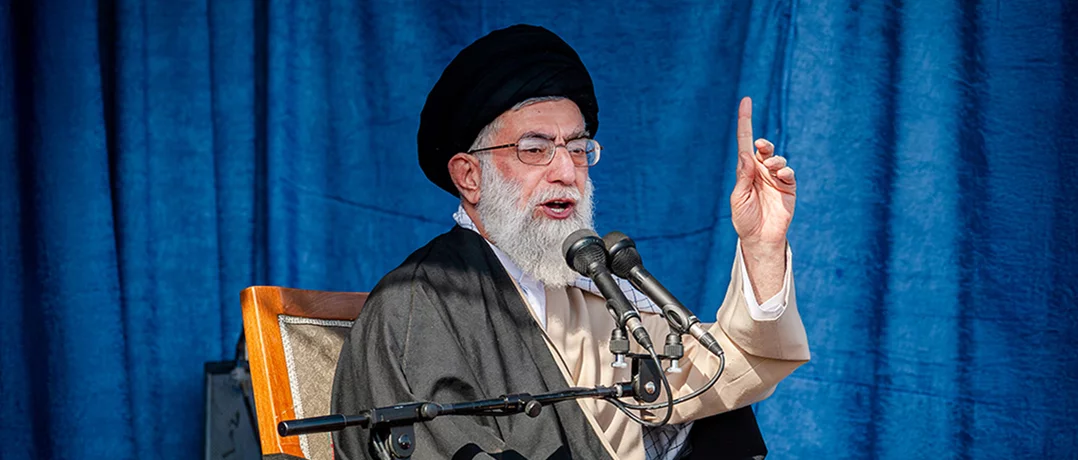
For nearly 4 decades, Ayatollah Ali Khamenei stood at the center of Iran’s political universe. As the second supreme leader of the Islamic Republic, he wielded authority that transcended elected offices and shaped every major decision in the State.
His assassination at 86 in joint US-Israeli air strikes on Tehran not only closed a defining chapter in Iran’s post-revolutionary history but also exposed the structural fragility of a system built around a single arbiter. To assess his legacy, one must examine the religious foundations that shaped him, the revolutionary pathway that elevated him, and the governing philosophy that consolidated his control at home while projecting influence abroad.
Upbringing and religious foundations
Born on 19 April 1939 in Mashhad, Iran, a city sacred to Shiite Muslims, Khamenei grew up in a clerical household of modest means.
In Qom, he encountered the teachings of Ruhollah Khomeini, whose doctrine of Wilayat al-Faqih (the guardianship of the Islamic jurist) advocated clerical rule as a religious necessity. The political repression of the 1960s, coupled with the Shah’s modernization campaigns and Western orientations, deepened Khamenei’s ideological opposition to the monarchy. He was detained multiple times and endured periods of internal exile. These experiences forged both his revolutionary credentials and his enduring suspicion of Western-backed governance.
Rise to power: Presidency and assassination attempts
The 1979 revolution transformed Khamenei from dissident cleric to state actor. He joined the Revolutionary Council and became Tehran’s Friday prayer leader, a highly visible platform in the new Islamic order. His oratory skills and loyalty to Khomeini strengthened his standing among revolutionary elites.
Violence soon marked his ascent. In June 1981, a bomb hidden in a tape recorder exploded during a speech, severely injuring him and permanently impairing his right arm. The attack elevated his status as a survivor of revolutionary struggle. A second attempt in 1985 targeted him during Friday prayers, underscoring the turbulence of the period.
Following the assassination of President Mohammad-Ali Rajai in August 1981, Khamenei was elected president with overwhelming support. His 2 terms (1981-1989) unfolded amid the Iran–Iraq War (1980-1988) and intense factional competition. Although ultimate authority rested with Khomeini, Khamenei navigated institutional rivalries, including strained relations with Prime Minister (PM) Mir-Hossein Mousavi. These tensions foreshadowed later struggles between executive governance and clerical supremacy.
Succession to Khomeini and constitutional transformation
Khomeini’s death in June 1989 initiated a decisive constitutional moment. At the time, Khamenei lacked the highest clerical rank traditionally required for supreme leadership. A swift constitutional revision removed the requirement that the leader be a senior source of emulation (marja’), thereby enabling his elevation.
The Assembly of Experts first selected him as interim leader and later confirmed him permanently after a national referendum endorsed the amendments. This transformation recalibrated the Islamic Republic’s power structure. Where Khomeini had relied on personal charisma, Khamenei relied on institutional engineering; embedding authority within security bodies and supervisory councils to reinforce his position.
As supreme leader, Khomeini became notable symbolic figure to many Shiites in the region (as others follow other clerics, such as Iraq’s Grand Ayatollah Ali al-Sistani), whose authority and approach were considered to of divine nature; this means that his policies and decisions were not to be negotiated or opposed, but supported and executed.
Consolidation of power and domestic control
Over the following decades, Khamenei gradually centralized power. The Islamic Revolutionary Guard Corps (IRGC) expanded beyond a military institution into an economic and political powerhouse. By empowering the Guards and aligning closely with security institutions, he ensured that the ultimate levers of authority remained insulated from electoral shifts.
Reformist waves, particularly under President Mohammad Khatami in the late 1990s, tested this framework. While reformists advocated political openness and engagement with the West, key institutions overseen by the supreme leader constrained their initiatives. The disputed 2009 presidential election and subsequent unrest marked a turning point, with security forces suppressing demonstrations and reinforcing a securitized political climate.
Economic pressures compounded political tensions. International sanctions, combined with structural inefficiencies, fueled inflation and unemployment. Periodic protests over living standards and social freedoms signaled widening discontent, particularly among younger generations. Supporters credited Khamenei with preserving regime stability, while critics argued that his governance deepened the gap between state and society as well as violated fundamental human rights.
Foreign policy approach
Khamenei’s foreign policy rested on ideological “resistance” and strategic deterrence. As he represented the hardline wing inside Iran, he consistently portrayed the United States (US) as Iran’s principal adversary and regarded normalization as incompatible with revolutionary identity. While he permitted negotiations leading to the 2015 nuclear agreement, he framed compromise as tactical rather than transformative.
Regionally, his strategy emphasized “strategic depth;” building alliances with non-state actors and sympathetic governments to deter adversaries. Iran’s nuclear program, missile development, and regional partnerships became central pillars of this doctrine. Although proponents described these measures as defensive necessities, the resulting confrontations intensified sanctions and diplomatic isolation. They also meddled in the internal affairs of regional countries, including Lebanon and Syria, contributing to their destabilization.
Relations with and influence on regional proxies
A cornerstone of Khamenei’s regional architecture was his enduring partnership with regional allies and proxies. These include the Houthis in Yemen (establish in 1997), Iraqi factions, Hamas in Palestine (established in 1987), and, most notably, Hezbollah in Lebanon (established in 1982). The latter, with Iranian backing, evolved into a significant political and military actor, both in Lebanon and the wider Middle East.
Khamenei viewed these proxies as both ideological allies and strategic assets, representing a forward line of deterrence against Israel and Western influence, as well as a symbol of transnational Shiite solidarity. Given the supreme leader’s religious symbolism and authority, these groups are obedient to his decisions, with little to no room for maneuver. This was evident through their participation in this current regional conflict following Khamenei’s death, with no given interest for their countries. Their entrenchment in domestic politics and their military engagements reflected Tehran’s determination to advance its own interests and influence in the so-called “Fertile Crescent” (encompassing itself, Iraq, Syria, and Lebanon). This relationship strengthened Iran’s regional posture but also entangled the countries which were associated with Tehran in broader geopolitical rivalries, amplifying domestic and regional volatility.
-
-

-
The Beiruter
-
