



Raymond Morkos and Hala Haikal are preserving Lebanon’s centuries-old copper and brass craft as traditional metalworking faces a shrinking market.
The last coppersmiths of Lebanon

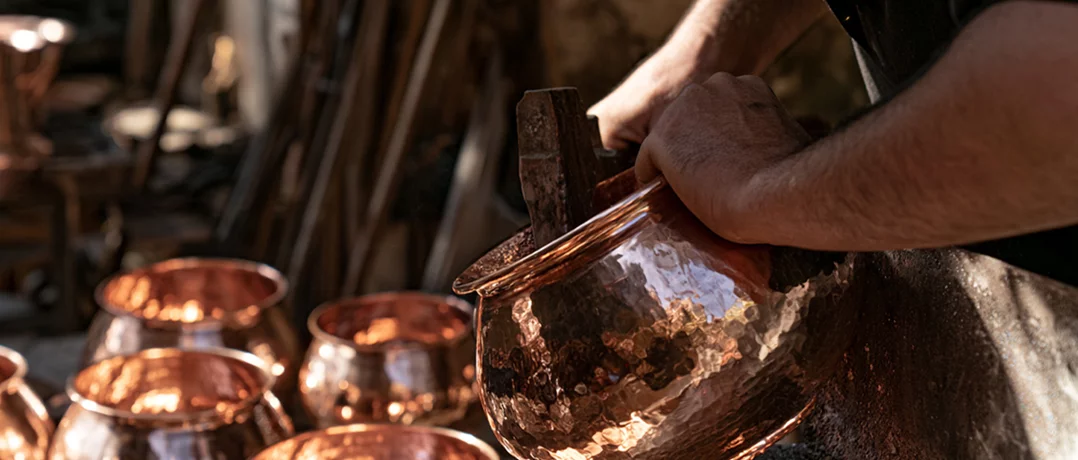
Before stainless steel and aluminum filled Lebanese kitchens, copper and brass were the metals of daily life, shaped by hand into trays, pots, lanterns, and ceremonial vessels that moved from workshop to market to household table. The craft traces its roots to the Bronze Age, flourishing for centuries in souks such as Tripoli's Nahasin Street, where the rhythmic clang of hammer on metal once filled the old city from morning until dusk.
Over time, the trade spread to Beirut, Zahleh, and Sidon, each town developing its own workshops and specialties. Today, as imported, machine-made goods flood the market, only a handful of artisans continue to practice the craft in its traditional form, passing down techniques of hammering, annealing, and engraving that have changed little in generations.
Among them are Raymond Morkos and Hala Haikal, two veteran coppersmiths whose workshops still echo with the sound their predecessors would recognize.
Raymond Morcos, a lifetime behind the anvil
Morkos, now in his seventies, began working copper as a boy and has run his own workshop for most of his adult life. He recalled the earliest lesson his father gave him before handing him a hammer of his own. "He taught me that copper is extremely precise and fragile," Morkos told The Beiruter. "Every strike you make stays in the metal. You cannot hide a mistake in this craft, you can only correct it with more work."
He walked through the process from its raw beginning, flat copper or brass discs, often imported, arrive at the workshop and are first cut roughly to size. From there, the real labor begins. "The metal starts hard and stubborn," Morkos explained. "We heat it over the fire until it glows, then let it cool slowly. This is called annealing. Without it, the metal would crack the moment we tried to shape it."
Only once softened can the piece be worked, hammered patiently from a flat disc into a curved bowl or tray, the craftsman striking in careful, overlapping rings to avoid thinning the metal unevenly. “You are convincing the metal to transform into something else." For pieces intended to hold food, he added, a final layer of tin is melted and spread across the interior. "This step is not decoration. Without the tin lining, the copper would poison the food. It is a safety measure disguised as tradition."
Hala haikal, the art beneath the hammer
Where Morkos emphasized the discipline of shaping, Haikal, who has overseen her family's workshop for more than fifty years, focused on what came after, the engraving that transforms a plain metal surface into something resembling lace. "Hammering gives the piece its body," she told The Beiruter, tracing a finger along the floral pattern etched into a brass tray. "Engraving gives it its soul. Without this, it is only a container. With it, it becomes a piece someone wants to keep."
Haikal described a process that relies on a small hammer and a set of fine chisels, each shaped differently to produce dots, lines, or curved petals. The design, she explained, is rarely drawn out in advance for an experienced engraver. "My hand already knows the pattern before my eyes finish seeing the space," she remarked. "I learned by watching, then by failing many times, then slowly by succeeding. There is no shortcut through that process."
She also spoke of repoussé and chasing, techniques of pushing and refining a design from both sides of the metal to create raised, sculptural detail, as among the most demanding skills in the trade. "You are working blind, in a sense," Haikal continued. "You push from behind, not knowing exactly how the front will look until you turn the piece over. Only experience tells your hands how hard to press."
Despite the physical toll of decades spent bent over hammer and anvil, Haikal expressed no regret about the path she chose. "People ask if my hands hurt," she said, with a laugh. "I tell them my hands remember every piece they made. That is not pain, that is a kind of proof."
The challenges facing Lebanon's copper and brass trade are impossible to ignore, dwindling apprenticeships, and a shrinking market for handmade metalware. Yet, there remains something in hammered copper that mass production cannot replicate, the slight irregularities, the faint hammer marks, the proof of a human hand behind every curve. A trade that once defined entire neighborhoods continues, insisting that some things are still worth making by hand exactly as they always were.
-
-

-
The Beiruter
-
