



From Tripoli to international competitions, Fayha National Choir has pioneered Arabic a cappella while building an ensemble that brings together singers across Lebanon’s religious, geographic and social divides.
The Lebanese choir pioneering Arabic acappella
The Lebanese choir pioneering Arabic acappella
By The Beiruter | August 22, 2026

Reading time: 7 min
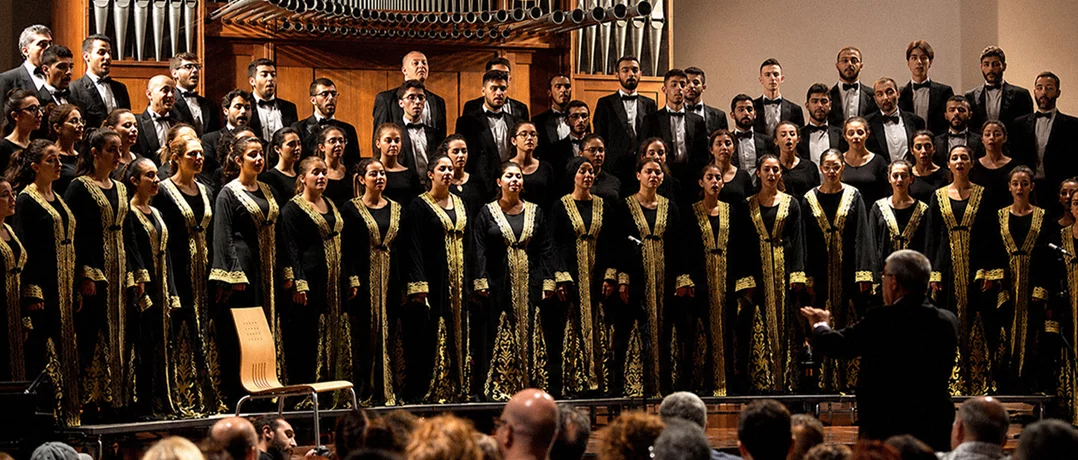
At a Fayha National Choir rehearsal, there are rules. Arrive late and a singer may be left outside until the next break. When the choir travels, the bus departs precisely on schedule. On tour, nobody starts eating until Maestro gives the word. And should anyone disagree with him, there is a procedure for that, too. “Rule No. 1: Maestro is always right,” Maestro Barkev Taslakian told The Beiruter during a rehearsal. “Rule No. 2: If Maestro is wrong, return to Rule No. 1.” “I am a half dictator,” he added. The humor belies the seriousness with which Taslakian runs the choir he has spent more than two decades building. Warm and exuberant in rehearsal, Fayha is also exacting. Singers memorize roughly 200 songs, perform without scores and may be asked onstage for a piece they have not sung in years. That rigor underpins Fayha’s musical project. Since its founding in Tripoli in 2003, the choir has pioneered an approach to Arabic a cappella built around the particular sounds and rhythms of the language. The result is one of Lebanon’s most accomplished musical ensembles: a choir that has won international competitions, performed in more than 40 countries and carried Arabic music from Tripoli to stages and ensembles around the world. When Fayha began, choral singing occupied a different place in Lebanon. “In Lebanon, choral used to only be in churches,” Taslakian said. Christian communities had longstanding choral traditions, but those traditions were often connected to religious institutions. Tripoli, a majority-Muslim city, offered different terrain for an ensemble trying to establish collective singing outside that setting. But building an Arabic a cappella tradition also required solving problems embedded in the language itself. Arabic contains sounds that Taslakian believes require their own approach to a cappella arrangement. Consonants such as the qaf, hamza, khā and ‘ayn can interrupt a musical line, while syllables pronounced quickly in speech may need to extend across several notes. The answer was not to make Arabic conform to a European choral tradition, he said, but to develop techniques suited to the language itself. “We develop new techniques and new pronunciation to reach the feelings in Arabic music,” Taslakian said. Over time, Fayha turned that experimentation into a repertoire. The choir acquires rights to traditional Arabic songs and produces arrangements that can be performed by other ensembles, including singers who do not speak Arabic. Its music has been sent to more than 350 non-Arab choirs, with Fayha members also helping ensembles learn Arabic pronunciation. “We sing Armenian, English, Italian and German, but we focus on Arabic music,” said Roula Abou Baker, Fayha's manager, who joined as a singer in 2004. Traditional Arabic music remains at the center of its repertoire, even as Fayha adapts it to a cappella performance and distributes its arrangements internationally. The approach eventually took Fayha far beyond Tripoli. The choir placed second at an international competition in Warsaw in 2005 and returned two years later to win first place. Since then, it has performed in more than 40 countries, often entering international competitions as the only Arab choir among ensembles representing countries with far older choral traditions. Taslakian insists the prizes were never the purpose. “We don't go to get first prize, but to deal with other cultures,” he said, before adding with a smile, “We just happen to frequently win first place.” Producing that level of precision requires a rehearsal culture that even Fayha's members acknowledge is unusual. The rules begin with punctuality. Taslakian remembers one tenor arriving four minutes late to the final rehearsal before an international trip. He handed the singer back his passport and visa and told him he could no longer travel. Other rules govern the relationships within the ensemble. Soloists are discouraged from treating their role as a marker of status, while members who have problems with one another may find themselves assigned to the same room when the choir travels. Taslakian's involvement extends well beyond rehearsals. When one young member considered leaving school to work, Taslakian made continuing his education a condition of remaining in Fayha. The choir rallied around him, helping with his studies. He eventually became an engineer. “There are firm ground rules with little room for negotiation and a lot of room for explanation,” Amir said. Midway through the rehearsal, Taslakian began taking an unusual roll call. “Who is Alawite here?” Then Sunni. Maronite. Druze. Orthodox. Shiite. Each answer drew cheers from the room. When it became apparent that there was only one Shiite singer present, the others began chanting, “Shi'a! Shi'a!” The exchange was playful, but the diversity behind it is central to how Fayha operates. The choir now has branches in Tripoli, Beirut, the Chouf and Aley, with roughly 100 singers around the country. Some travel from the Bekaa or southern Lebanon to rehearse in Beirut, and members include people of Kurdish, Palestinian, Syrian and Iraqi backgrounds. Taslakian says 17 religions are represented across the choir's community. “I love to bring people together,” he said. Its members, he added, can be different “geographically, religiously, politically” and in almost everything else. “Before joining the choir, I knew almost nothing about Druze traditions,” Abou Baker said. Her family’s experience offers a small measure of how attitudes toward choral singing have changed in Tripoli. Abou Baker grew up singing alone in a city where she said opportunities for young musicians were limited and some families were reluctant to let their daughters perform. Her parents initially worried when she joined Fayha at 22. Then two of her sisters joined, followed by her brother. Eventually, their parents were traveling with the choir and helping sell its CDs. “Fayha has become my lifestyle and my family,” Abou Baker said. Fayha eventually began taking the model developed inside its rehearsals into communities dealing more directly with division and displacement. Since 2007, Fayha has worked with international organizations on projects involving Palestinian and Syrian refugees, Lebanese communities ,and public school students. After fighting between the Lebanese Army and Fatah al-Islam devastated the Nahr el-Bared Palestinian refugee camp in 2007, UNDP approached Fayha about establishing a Lebanese-Palestinian choir. The project brought together Palestinians returning to the reconstructed camp and Lebanese participants from five surrounding villages. Other projects followed. The Sonbola Choir involved more than 500 Syrian singers between 2014 and 2019, while another children's choir brought together more than 300. A joint project with UNESCO reached public school students across Lebanon. The projects also help sustain Fayha. Joining the choir costs nothing, and Fayha covers expenses including travel and clothing. With no regular sponsor, internationally funded social projects provide an important source of income. “Let them sing, let them dance,” Taslakian said. It is a social mission built on musical credibility. More than two decades after its founding in Tripoli, Fayha has carried a distinctly Lebanese experiment in Arabic a cappella onto international stages, proving its case not simply by promoting it, but by competing with it, winning with it and teaching choirs around the world to sing it.Finding an Arabic choral voice
The aim is to develop Arabic music, not to change or Westernize it.
The “half-dictator”
You would be hard-pressed to find a modern institution that operates the way this choir does.
A choir of Lebanon
Through Fayha, I came to know all the religions of Lebanon.
Let them sing, let them dance
We call for social cohesion through music and art.
-
-

-
The Beiruter
-
