



Lebanon’s Constitution marks 100 years of endurance amid deliberate implementation, recurring crises, institutional fragility, and ongoing struggles over statehood and reform.
The Lebanese Constitution: A century of endurance and crisis
The Lebanese Constitution: A century of endurance and crisis
By Anthony Chamoun | May 22, 2026

Reading time: 11 min
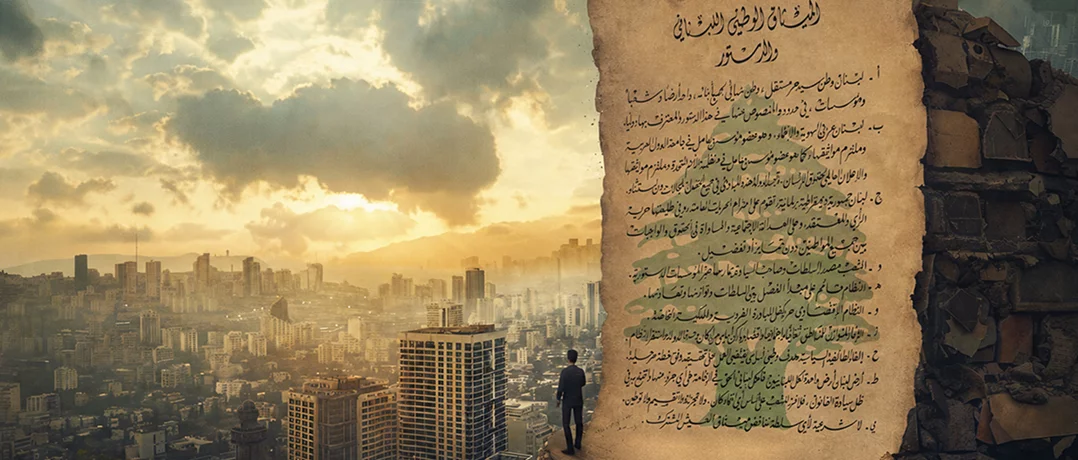
A constitution constitutes the fundamental legal and political framework upon which a state is established and governed. Beyond merely organizing public institutions, it embodies the collective principles, aspirations, and identity of a nation, while simultaneously defining the relationship between the state and its citizens.
A century ago, a foundational document was adopted by the founding fathers of Lebanon: The Lebanese Constitution. Ratified on 23 May 1926, the latter remains the oldest in the Arab World still in force, despite having undergone radical amendments over time as it sought to balance and reconcile the principles of modern statehood with the mosaic composition of Lebanese society.
As Lebanon concludes the centennial of its constitution’s existence, questions have arisen concerning its continued relevance and ability to adequately address the challenges of the contemporary era.
How did today’s Lebanese Constitution come to be?
Although the Lebanese Constitution was amended multiple times (including in 1929, 1947-1948, and 1976), we will only be highlighting the most influential and significant ones below.
The Establishment of the 1926 Lebanese Constitution and the First Republic
The Lebanese Constitution emerged under the French Mandate (1923-1943) in accordance with the obligations imposed on the mandatory power by the League of Nations (1920-1946). Following the arrival of High Commissioner Henri de Jouvenel in 1925, a constitutional committee, known as the “Committee of Thirteen,” was elected by the Representative Council to draft the constitutional framework of Greater Lebanon. The committee included the following:
Abboud Abdel Razzaq, Chebl Damous, Fouad Arslan, George Thabet, George Zwein, Michel Chiha, Moussa Nammour, Omar al-Daouk, Petro Trad, Rookoz Abu Nader, Sobhi Haidar, Youssef al-Zein, and Youssef Salem.
Influenced by the Constitution of the French Third Republic (1870-1940), the document nevertheless realized and incorporated Lebanon’s sectarian particularities through Article 95, which institutionalized sectarian representation in state institutions as a guarantee of peaceful coexistence amongst its pre-existing sects. The Constitution was thus drafted in French by Michel Chiha and translated into Arabic by Chebl Damous, officially transforming the country from direct French military administration into a constitutional republic.
 Michel Chiha (1891-1954) was a prominent Lebanese politician, recognized as one of the founding fathers of the Lebanese Constitution in 1926.
The 1927 amendment
The first amendment resulted from persistent conflicts between the Chamber of Deputies and the Senate over legislative powers. It thus abolished the bicameral system and merged both institutions into a single parliamentary chamber that we know today.
The 1943 amendment: The constitutional foundation of Lebanon’s independence
Adopted during the independence struggle under President Bechara el-Khoury and Prime Minister (P.M.) Riad al-Solh, the third amendment abolished all constitutional provisions linked to the French Mandate and affirmed Lebanon’s sovereignty, thus provoking a direct confrontation with the French authorities.
The 1990 amendment: The 1989 Taif Agreement and the rise of the Second Republic
One of Lebanon’s most consequential constitutional amendments was derived from the 1989 Taif Agreement, officially known as the “National Accord Document.” The Agreement in its entirety, including the provisions that were not incorporated into the Constitution, acquired binding legal force. Consequently, it established the foundations of the country’s “Second Republic,” as it shifted the system of governance from a strong presidential system to a more balanced parliamentary one.
The most prominent amendments introduced were the following:
Founding the Preamble of the Constitution
A new constitutional preamble was introduced, affirming Lebanon’s Arab identity (abandoning its earlier notion of recognizing the country as having “an Arab face”), its unity, and its finality as a homeland for all its citizens, while rejecting partition and permanent settlement. The Preamble outlines the philosophy and foundations upon which the Lebanese political system rests.
Reducing the powers of the President of the Republic in favor of the Council of Ministers
Prior to the Taif Agreement, the President of the Republic possessed extensive constitutional powers. Following the 1989 amendments, many of these powers were transferred to the Council of Ministers “collectively,” thereby strengthening the role of the government and the P.M., while rendering the President more of a symbolic figure of governance and of the “nation’s unity” rather than an effective ruler.
Ensuring parity between Muslims and Christians
The new amendments institutionalized Muslim-Christian parity, establishing equal representation in Parliament and in senior public offices, thus replacing the previous parliamentary representation ratio that favored Christians over Muslims (from a 6:5 ratio to a 50:50 arrangement).
Gradually abolishing consociationalism
The new constitution recognized the abolition of political sectarianism as a “fundamental national objective,” calling for the establishment of a national committee tasked with devising a gradual plan to achieve this goal.
Establishing the Constitutional Council
The new amendments established the Constitutional Council, tasked with monitoring the constitutionality of laws as well as adjudicating disputes and appeals arising from presidential and parliamentary elections.
Extending state sovereignty over all Lebanese territory
The 1989 National Accord Document affirmed state exclusivity of arms across all Lebanese territory, dissolving all Lebanese and foreign non-state armed actors and ensuring their disarmament.
Expanding administrative decentralization
The 1989 National Accord Document advocated broad administrative decentralization in order to promote local development and reduce excessive centralization.
 Lebanese Members of Parliament (M.P.s) convene in Taif, Saudi Arabia, during the 1989 negotiations that produced the Taif Agreement, the accord that formally ended the Lebanese War (1975-1990) and restructured Lebanon’s political system, thus establishing the Second Republic.
The limitations of the Lebanese Constitution and the need for reform
A century after its establishment, it has become imperative to re-examine the viability and effectiveness of the Lebanese Constitution. Although many of its provisions have, deliberately, not been fully implemented or consistently observed, more than 3 decades since its last amendment constitutes a sufficient period through which the Constitution’s structural limitations and practical shortcomings can be critically evaluated.
First, the absence of strict constitutional deadlines has been a persistent point of contention governing Lebanon’s Second Republic, especially concerning the process of forming a new government. Indeed, there are no definite timeframes for the President of the Republic to initiate binding parliamentary consultations, for the Prime Minister-designate to form his cabinet, or the President to approve or reject the proposed ministerial lineup. This ambiguity has resulted in numerous rounds of prolonged political vacuums and extended periods of caretaker governments. In this regard, Lebanon has known more than 2 years of caretaker governments between the 2009 parliamentary elections and 2018, with former P.M. Tamam Salam’s cabinet in 2014 taking up to an unprecedented 315 days to be formed.
Second, various loopholes exist within the current Constitution. On the one hand, the issue of the quorum required to elect the President of the Republic has been contending. While it is accepted that the first voting round requires a two-thirds quorum (86), there is a dispute regarding subsequent rounds, with some lawmakers maintaining that the two-thirds requirement persists, while others argue that, pursuant to Article 49 of the Lebanese Constitution, the quorum is reduced to an absolute majority (65) in the second and all following rounds.
Indeed, throughout the past 79 years of modern Lebanese history, Lebanon has never witnessed a smooth transfer of power from one president to another. The aforementioned problematic has only compounded this matter, resulting in numerous periods of presidential vacuums, most notably being the last 2 elections: 2014-2016 (with a vacuum period stretching almost 2 years and 5 months) and 2023-2025 (with a vacuum period stretching around 2 years and 3 months).
On the other hand, the concept of a caretaker government in Lebanon has long generated constitutional and political debate, particularly regarding the scope of its powers during periods of resignation. Although Article 64 of the Lebanese Constitution limits a resigned government to conducting affairs “in the narrow sense,” it provides no precise definition of this notion, thereby leaving its interpretation to jurisprudence and constitutional practice. This has resulted in tensions between various parties, sometimes surpassing political debates to incorporate sectarian ones as well (especially during former P.M. Najib Mikati’s term in 2021-2025). In light of Lebanon’s recurrent governmental deadlocks and prolonged cabinet formation processes, the principle of continuity of public services has emerged as a fundamental justification for maintaining limited executive activity during transitional periods.
Furthermore, the reduction in the President of the Republic’s powers was not simultaneously matched by clear conflict-regulation and constitutional mechanisms to resolve institutional disputes between political actors and the 3 branches of government. As a result, when political forces clash, no internal authority can effectively impose a settlement, pushing the State toward external mediation and reliance on regional or international actors to restore institutional functioning (such as the case during the 2008 Doha Agreement). In short, there exists no ruler or arbiter in Lebanon’s current political system.
Therefore, these loopholes must be addressed accordingly, and strict constitutional deadlines should be provided to ensure state continuity and prevent prolonged political tensions, vacuums, and paralysis.
Moreover, both the provisions included in the Constitution and the issues excluded require serious consideration. For instance, the gradual abolition of consociationalism, as stipulated in Article 95, does not seem to constitute either a realistic or a constructive path forward. A country’s political system must reflect its own social composition and the particularities of the society it governs. Given that sectarian communities have existed centuries before the establishment of the Lebanese State, and sectarian affiliations continue to shape political, social, and institutional dynamics till this very day, it becomes flawed to attempt to impose a political system detached from these societal realities.
Indeed, Michel Chiha argued that the philosophy of sectarianism in Lebanon is
to ensure fair political and social representation for participating sectarian minorities. The Lebanese balance, which is based on a sectarian foundation, is not an arbitrary balance; rather, it is the very principle of Lebanon’s existence.
In addition, the Constitution must address the form of governance most capable of ensuring Lebanon’s unity, stability, institutional continuity, and long-term viability as a state. The long-standing debate between unionists (which include those advocating for centralization or administrative decentralization) and federalists requires a comprehensive and consensual resolution that safeguards both the interests of the various communities and the cohesion of the State itself.
Failing to do so would merely aggravate tensions, reinforce perceptions of marginalization, and contribute to the further securitization of communal relations.
Finally, any amendment or reform must, as a prior condition, address the disarmament of all non-state armed actors within the country, while also preserving the foundational spirit of the 1943 National Accord.
Lebanon’s Constitution: Imperfect, unimplemented, yet indispensable
Although the Lebanese Constitution has often been criticized for its limitations, it nevertheless remains the cornerstone of Lebanon’s legal and political order. Acknowledging these flaws should not diminish the importance of preserving and respecting the Constitution itself. In fact, the Lebanese Constitution continues to provide the essential foundations necessary for maintaining state legitimacy, institutional continuity, and national coexistence (based on the 1943 National Accord).
Its Preamble affirms core principles that remain indispensable to Lebanon’s stability, including national sovereignty (Paragraph A), democratic parliamentary governance (Paragraph C), public freedoms (Paragraph C), equality before the law (Paragraph C), and the rejection of segregation, partition, or settlement (Paragraph I).
Equally important is its recognition of Lebanon as a pluralistic society founded upon coexistence and mutual participation among its various religious and social components (Paragraph J). In a country characterized by deep sectarian and political diversity, these constitutional guarantees remain vital safeguards against domination, exclusion, or unilateral rule.
There shall be no constitutional legitimacy for any authority which contradicts the pact of mutual existence.
Paragraph J of the Preamble of the Lebanese Constitution
Furthermore, the Constitution affirms Montesquieu’s principle of separation, balance, and cooperation among the legislative, executive, and judicial branches of government (Paragraph E), thereby providing an institutional framework capable of limiting the concentration of power.
It also protects fundamental liberties such as freedom of belief, expression, education, property ownership, and political participation (Paragraphs C, F, and G), all of which remain central to Lebanon’s democratic identity.
Notably, the Preamble enshrines the principle of popular sovereignty (Paragraph D) by recognizing the people as the ultimate source of authority and sovereignty, from which the legitimacy of governmental power is derived.
Moreover, although Paragraph B of the Preamble confirms the country’s Arab identity (which some Lebanese regard as not completely accurate, given their insistence on the previous notion of being “with an Arab face”), it nevertheless constitutionally abides the Lebanese State to the League of Arab State (L.A.S.) and the United Nations (U.N.), concerning their principles, charter, and agreements, as well as the 1948 Universal Declaration of Human Rights (U.N.D.H.R.); with the role of the renowned Lebanese philosopher and diplomat, Charles Habib Malik, being central in its drafting. This is particularly significant as it embeds both regional belonging and universal human rights values into the constitutional foundations of the Republic.
Even during periods of severe political crisis, the Constitution continues to function as the ultimate legal reference regulating state institutions and preserving constitutional legitimacy. Consequently, the solution to Lebanon’s recurring crises does not lie in disregarding the Constitution, but rather in ensuring its consistent application, strengthening its mechanisms, and addressing its deficiencies through constitutional and institutional reform.
To conclude, as Lebanon concludes the centennial anniversary of the proclamation of the Lebanese Republic, the importance of preserving and strengthening the Constitution becomes even more significant. It should therefore serve not merely as a symbolic commemoration of the past, but as an opportunity to reaffirm commitment to constitutional legitimacy, institutional reform, and the principles upon which Lebanon’s stability and national unity ultimately depend.
-
-

-
Anthony ChamounResearcher/WriterFocusing on Political Science and International Affairs.
-
