

Born Michel Dabaghi to Lebanese parents, Dr. Michael DeBakey revolutionized cardiovascular surgery and became one of medicine’s most influential pioneers.
The story of Dr. Michael E. DeBakey

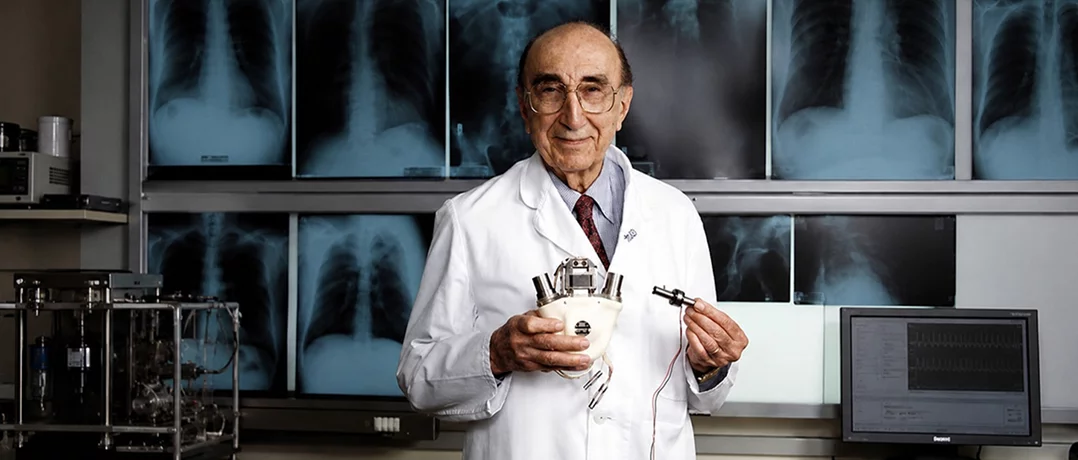
The father of modern cardiovascular surgery, Dr. Michael DeBakey, reshaped how the world treats heart disease. Few know the name he was actually born with, Michel Dabaghi, or that behind one of American medicine's most celebrated surnames sits a Lebanese immigrant story rarely told in full.
From Marjeyoun to Louisiana
Michael Ellis DeBakey was born on September 7, 1908, in Lake Charles, Louisiana, to Shaker Morris Dabaghi and Raheeja Zorba Dabaghi, Christian immigrants from Marjeyoun, Lebanon, who had not yet met one another before arriving separately in the United States. His father ran a chain of local drugstores and rice farms; his mother was a skilled seamstress. It was in her sewing lessons, teaching her son to knit, crochet, and stitch, that DeBakey later located the origins of the manual precision that would define his surgical career. His curiosity about medicine was sparked early too, through the physicians he met passing through his father's pharmacy.
The family surname, Dabaghi, was anglicized to DeBakey sometime after their arrival, a small linguistic shift that would, decades later, obscure the Lebanese identity of one of the most influential physicians in American history.
A student innovation that changed surgery forever
DeBakey's academic path ran through Tulane University, where he completed both his undergraduate and medical degrees, accelerating through his studies with unusual speed. Remarkably, one of his most consequential inventions arrived while he was still a medical student, the roller pump, a device designed to move blood mechanically through tubing. Decades later, that same mechanism became a core component of the heart-lung machine, the technology that made open-heart surgery possible for the first time in medical history, a contribution made before DeBakey had even begun his professional career.
DeBakey's surgical resume reads like a history of the field itself. In 1952, he performed the first successful repair of an abdominal aortic aneurysm in the United States. The following year, he completed the first thoracic aortic aneurysm repair. Facing a shortage of usable graft material, he improvised a solution that became legendary in medical circles, unable to source the nylon fabric he wanted, he instead sewed a synthetic vascular graft out of Dacron on his wife's home sewing machine, a direct echo of the skills his mother had taught him decades earlier.
That Dacron graft became a standard tool in vascular surgery worldwide. DeBakey went on to pioneer coronary artery bypass surgery, carotid endarterectomy, and some of the earliest work on artificial hearts and ventricular assist devices. His surgical instruments and cardiac pump designs remain in clinical use today, and his classification system for aortic dissection is still taught in medical schools around the world.
Beyond the operating room
DeBakey's influence extended well past his own hands. During World War II, he served in the Army's Surgical Consultants Division, helping develop the Mobile Army Surgical Hospital (MASH) system that transformed battlefield trauma care. In 1948, he joined Baylor University College of Medicine, where he served as Chairman of the Department of Surgery for 45 years and eventually became the institution's president and chancellor. There, he recruited surgeon Denton Cooley and helped build Houston's Texas Medical Center into a global hub for cardiovascular treatment and research.
Over a career spanning nearly eight decades, DeBakey received the Presidential Medal of Freedom, the National Medal of Science, the Congressional Gold Medal, and Russia's Lomonosov Gold Medal, among dozens of other honors, before his death in 2008 at age 99.
A legacy still claimed at home
Within Lebanese and Arab-American communities, DeBakey's heritage has never been incidental to his story, it has been central to it. As one scholar studying his legacy noted, DeBakey's Lebanese roots are almost always mentioned alongside his medical accomplishments, a source of enduring pride across the region his parents left behind. For a surgeon whose techniques transformed cardiovascular care around the world, recognizing the name Dabaghi behind DeBakey is an overdue correction, a reminder that one of modern medicine's most important legacies has Lebanese roots at its very foundation.
-
-

-
The Beiruter
-
