

Nearly a century following its adoption on 12 July 1927, Dr. Antoine Messarra reflects on Lebanon’s national anthem, urging citizens to transform its enduring values of unity, responsibility, and citizenship into practice.
The Lebanese national anthem as a living charter of citizenship
The Lebanese national anthem as a living charter of citizenship
By Anthony Chamoun | July 11, 2026

Reading time: 7 min
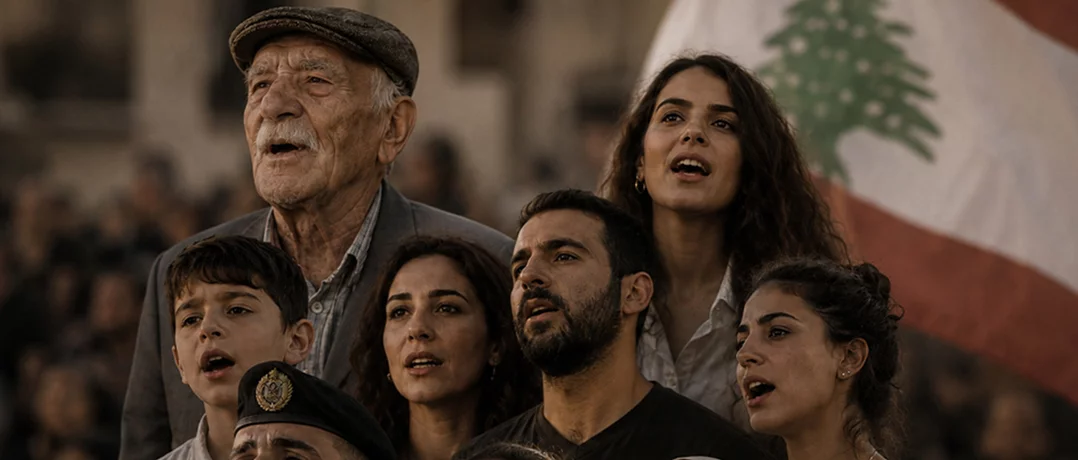
Every year on 12 July, Lebanon marks the anniversary of the adoption of its national anthem, a milestone that represents far more than the selection of patriotic lyrics and a musical composition. Officially adopted on 12 July 1927, the anthem emerged during a formative period in Lebanon’s state-building process, helping define the identity of the newly established republic alongside its constitution and national flag.
Nearly a century later, however, the anthem remains more than a ceremonial tradition. It continues to raise a fundamental question regarding Lebanon’s ability and success in preserving its national symbols and living by the principles they embody.
To better understand this foundational event, The Beiruter reached out to renowned Lebanese constitutional scholar Dr. Antoine Messarra, whose reflections provide a timely opportunity to revisit both the historical origins and the contemporary meaning of one of Lebanon’s most enduring national symbols.
Living the anthem, not simply singing it
Perhaps Dr. Messarra’s strongest message is that Lebanon’s challenge is not preserving the anthem itself but rather embodying its principles.
He warns that national symbols lose their purpose when they are celebrated ceremonially while ignored in practice. The anthem speaks of unity, dignity, sacrifice, and collective purpose, yet these ideals often remain disconnected from political reality.
Dr. Messarra also expresses concern over educational environments that prioritize sectarian or ideological narratives, even ones relating to foreign countries, over common national values, arguing that this contradicts the constitutional spirit upon which Lebanon was founded. For him, patriotism is ultimately measured not by emotional attachment alone but by daily commitment to the institutions and values represented by the national anthem. In this context, Dr. Messarra quotes Lebanese President Joseph Aoun, who, while receiving a delegation from the Arqoub and Hasbaya regions, told them
“Whoever wants a flag other than the Lebanese flag is free to go and live in another country.”
Understanding the anthem’s meaning
Dr. Messarra argues that the true significance of the anthem lies not in how often it is sung, but in whether its values are translated into everyday civic life. For him, the history of the anthem deserves greater public attention, but its deeper significance is even more important.
While we sing the national anthem during official ceremonies, we have neither fully understood its meaning nor applied its principles.
He notes that extensive historical documentation exists regarding the anthem’s creation, including studies by researcher Adonis Nehme and his own publications detailing the selection committees, competing entries, and decision-making process. Yet these historical facts, he argues, represent only one dimension of the anthem.
Indeed, the larger challenge lies in understanding its message. According to Dr. Messarra, many Lebanese faithfully sing the anthem during official ceremonies without fully appreciating its civic philosophy. In fact, among all the anthem’s verses, he repeatedly returns to one central message: “Our word and deed, aiming at perfection” (قَوْلُنا والْعَمَل في سَبيلِ الْكَمال). This opening expression encapsulates an ethical principle that should guide public institutions and national life.
Rather than remaining ceremonial language, Dr. Messarra believes this phrase should become a practical standard for governance, education, and public administration. He argues that Lebanon suffers not from a shortage of speeches, debates, or political declarations, but from a persistent inability to translate promises into action. Public life has become dominated by rhetoric while implementation remains elusive.
The reason is that, while we Lebanese and Arabs possess many admirable qualities, we also suffer from what one Arab writer once described as being a vocal phenomenon.
For that reason, he suggests that the anthem’s opening words should be displayed at the entrances of schools and public institutions as a daily reminder that citizenship is measured through responsibility rather than slogans.
The anthem, in his view, is therefore not merely patriotic literature but a civic code that calls upon citizens and officials alike to align commitments with concrete action. In this sense, for instance, Dr. Messarra notes that
Today, the framework agreement that was signed in Washington between the 3 parties (Lebanon, Israel, and the United States) should encourage us to move toward action.
The anthem and the crisis of national identity
Dr. Messarra also links the anthem to a broader challenge confronting Lebanese society: the fragile relationship between citizens and the state.
He argues that historical experiences, fragmented historical education, and inherited political mentalities have prevented many Lebanese from fully embracing the concept of the state as the primary framework for national life. Instead, public discourse frequently focuses on international and regional developments as well as external actors while overlooking Lebanon’s own responsibility for addressing its domestic challenges. Nevertheless, Dr. Messarra asks:
Where is the discussion about the responsibility of the Lebanese themselves in all of this?
Dr. Messarra believes that we still suffer from what he calls the “Ottoman Porte complex.” We continue waiting for the “Sublime Porte” to solve our problems for us. “You hear this constantly, and you see it in countless televised talk shows,” he states.
In this context, the anthem represents a call to reclaim citizenship through loyalty to public institutions rather than competing political or sectarian affiliations. For Dr. Messarra, strengthening national identity requires more than constitutional reforms; it demands a cultural transformation rooted in civic education.
Passing heritage to future generations
One of Dr. Messarra’s principal concerns is the gradual disappearance of Lebanon’s historical memory among younger generations. Throughout the world, younger generations are losing touch with their historical heritage. Today, the United States (U.S.), for instance, is commemorating 250 years of its history, yet many young Americans no longer know the country’s founding values, according to Dr. Messarra. Likewise, he believes that
Lebanese heritage is not being passed on to the younger generations.
He argues that the country’s heritage, including the story behind its anthem, flag, and constitutional development, often remains confined to academic circles instead of being integrated into school curricula.
Drawing on educational initiatives and programs conducted through Saint Joseph University of Beirut (USJ), Dr. Messarra explains that students became actively engaged when encouraged to discover Lebanon’s history themselves through research projects, local landmarks, and historical documents rather than memorizing textbook narratives.
Students from 30 schools across Lebanon participated in these programs, during which they discovered Lebanon’s heritage for themselves; including the history of the national anthem.
This participatory approach, he believes, allows young people to build a genuine connection with their national heritage and understand the origins of the symbols they encounter every day.
The birth of a national anthem
Following the adoption of the Lebanese Constitution on 23 May 1926 and the proclamation of the Lebanese Republic, the country’s political institutions sought to complete the symbols of statehood. Article 5 of the Constitution established the republic’s official flag, making it equally necessary to adopt a national anthem that would accompany the country’s transition from direct French administration toward a more autonomous political order.
The idea of a Lebanese anthem had existed even before the republic itself. When General Henri Gouraud proclaimed the State of Greater Lebanon on 1 September 1920 at the Pine Residence in Beirut, a patriotic hymn titled “Lebanon, Do Not Fear Death” was performed. Its lyrics were written by Father Maroun Ghosn and set to music by composer Bechara Ferzan. Although this became the country’s first official anthem during the early years of Greater Lebanon, it remained a temporary symbol.
Recognizing the need for a permanent national anthem, Member of Parliament (MP) Ibrahim al-Monzer proposed in 1924 that Lebanon, like other sovereign nations, should adopt an official anthem through a structured process.
Following the election of Charles Debbas as Lebanon’s first president in 1926, the government issued Decree No. 193 on 19 July 1926, launching a nationwide competition to select the anthem’s lyrics. A committee headed by the Minister of Public Education was tasked with evaluating submissions, while the winning poet would receive a prize of 100 Lebanese pounds (LBP).
The competition concluded in October 1926 with the selection of Rachid Nakhle’s poem. A second competition was then organized to choose the musical composition. On 12 July 1927, Decree No. 1855 officially approved the melody composed by Wadih Sabra, founder of Lebanon’s National Conservatory of Music. Together, Nakhle’s words and Sabra’s composition formed the anthem that remains in use today.
To conclude, as Lebanon commemorates the anniversary of the adoption of its national anthem on 12 July, the occasion serves as more than a historical remembrance. It is an invitation to reflect on the country’s unfinished nation-building project. Nearly 100 hundred years later, its lyrics continue to offer a vision of citizenship founded on responsibility, unity, and public service.
Nevertheless, as Dr. Antoine Messarra reminds us, the true tribute to the Lebanese national anthem is not found in ceremonial performances alone. It is found in transforming its words into lived reality, where “our word and deed” become the guiding principle of both the state and its citizens.
What matters most is that we live the meaning of the anthem and put its principles into practice.
Only then can the anthem fulfil the purpose for which it was originally composed: not simply to celebrate Lebanon, but to help build it.
-
-

-
Anthony ChamounResearcher/WriterFocusing on Political Science and International Affairs.
-
