Lebanon’s crisis reflects a deeper failure of moral leadership and social cohesion, where individual success outpaces collective responsibility and ethical restraint.




Lebanon’s crisis reflects a deeper failure of moral leadership and social cohesion, where individual success outpaces collective responsibility and ethical restraint.

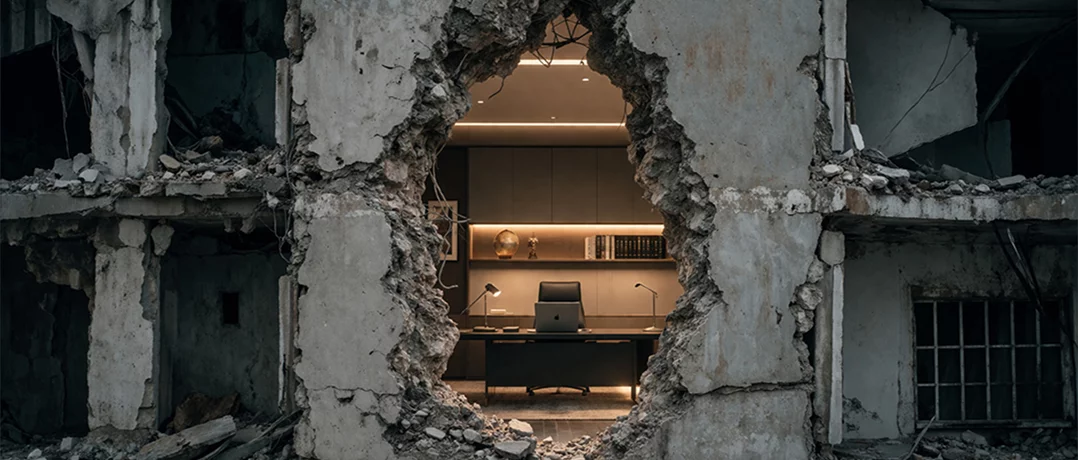
I recently attended a large meeting led by one of the most influential Christian leaders in Lebanon. At one point, one of the attendees praising the political consistency of the leader reminded him of something that had happened almost a decade earlier. He said to him,
I once came to you with a request for support on expanding the work of casinos in Lebanon, and your answer to me was: although it might be profitable, I cannot do that because I am a Christian.
At that moment, I stopped listening to almost everything else being said in the meeting. My mind stayed fixed on that sentence. It was one of those rare moments in Lebanon when one suddenly realizes how few leaders still think in such terms. Not in the language of profit, tactical gain, popularity, sectarian bargaining, or political convenience — but in the language of ethical limits. I lost focus on the rest of the meeting because I felt I had just encountered one of the very few remaining examples of moral self-restraint in leadership, one of those rare moments that reveal how very few leaders in our country still think first through the lens of conscience.
That moment stayed with me because it touched a question I have often asked myself: why is it that the Lebanese, who so often excel individually, struggle so deeply to act in synchrony at the social and national level? Why do we produce so many achievers, yet fail to produce a stable collective order? Why do we shine in fragments but falter as a whole?
Some people explain this by invoking a kind of Phoenician inheritance — the idea that an ancient mercantile culture favored individual initiative, private gain, and commercial success more than collective political construction, and that this has somehow passed down into our very nature. In other words, they suggest that Lebanese society is historically wired for individual success rather than social cohesion. I do not find that explanation convincing, at least not in any deterministic sense. Societies are not prisoners of ancestry, nor are they governed by some fixed cultural DNA. Human beings evolve through institutions, incentives, education, ethical norms, historical experiences, and the examples set by leaders. Entire habits once considered natural in certain societies have weakened or disappeared under new moral and social pressures, while new virtues have been cultivated through law, religion, and education. What is socially reproduced can also be socially corrected. I therefore believe there are deeper reasons for this Lebanese failure of social synchronization.
The Lebanese paradox is striking. At the individual level, Lebanese often excel: in business, medicine, academia, entrepreneurship, finance, engineering, the arts, and the professions, both at home and throughout the diaspora. Yet this same society has repeatedly failed to produce a durable collective agreement, strong institutions, and a viable state. The problem is not a lack of intelligence, talent, ambition, or adaptability. It is a failure of moral and social coordination. It is a failure of synchronization.
A nation is not built by talent alone. It is built on a shared rhythm of trust, restraint, and mutual obligation. It is built when people can align around rules, accept limits, cooperate across differences, and recognize that the common good is not the enemy of personal success. Lebanon’s tragedy is that it has produced many capable individuals but weak collective discipline. We have brilliance without cohesion, ambition without trust, and energy without convergence. That is why we often appear strong at the micro level and broken at the macro level.
I believe there are three major reasons for this.
The first is the absence of a serious social and ethical educational system. By this, I do not mean education in the narrow academic sense. Lebanon has many educated people and many schools of high academic quality. What is missing is a broad and credible formation around ethical reference points: honesty, responsibility, restraint, accountability, respect for the public good, and duty beyond the self. A society becomes coherent when a child hears roughly the same moral message from the home, the school, the religious institution, the media, and public life. In Lebanon, however, children often hear ideals but witness the opposite in practice.
They hear the language of values, patriotism, sacrifice, faith, and service, but they watch many elites — political, religious, social, and even intellectual — behave opportunistically, selectively, and often without moral consistency. They see people condemn corruption in theory while justifying it in practice when it benefits their own group. They see leaders invoke national unity while constantly deepening social division. They hear moral sermons, yet watch public figures act as though there are no real ethical boundaries beyond utility and power.
This is why the anecdote with which I began stayed with me so strongly. What struck me was not merely that the leader refused a profitable proposal. What struck me was how unusual such a refusal has become. In a healthy society, ethical self-restraint in leadership should not shock us. It should be expected. But in Lebanon, when a leader says, “I cannot do this because it violates what I believe is morally right,” the statement feels almost exceptional, as though it belongs to an older moral universe. That is precisely the problem. Ethical limits are no longer socially central; they have become rare personal exceptions.
When that happens, relativism spreads. The young begin to absorb a dangerous lesson: morality is flexible, and what is acceptable depends on context, influence, sect, or convenience. Gradually, what is socially normal comes to replace what is ethically right. If corruption is common, it ceases to feel corrupt. If hypocrisy is widespread, it ceases to scandalize. If public figures speak nobly but behave cynically, then children learn that virtue is ornamental, not binding. In such a climate, the role model collapses, and without credible role models, moral education becomes abstract and ineffective.
The second reason is that the educational and social culture in Lebanon has too often been built on negative competition rather than positive competition. Positive competition encourages excellence while preserving mutual respect. It pushes people to improve themselves without needing to destroy others. It allows one to admire merit, collaborate across differences, and understand that another person’s success does not diminish one’s own. Negative competition is very different. It trains people not merely to rise, but to rise by undermining others. It breeds envy, sabotage, pettiness, exclusion, gossip, and the quiet satisfaction of seeing others blocked.
This mentality begins early. Many children in Lebanon are raised in a culture of constant comparison: who ranked first, who entered the better school, who has the stronger connections, whose family has greater prestige, whose community is more powerful, who is ahead socially, professionally, or financially. Success becomes less about excellence itself and more about relative domination. Instead of learning that society rises when all improve, many internalize the idea that advancement is positional: for me to shine, someone else must be dimmed.
This is visible everywhere. It appears in academic jealousy, in the inability to celebrate another person’s success without resentment, in workplace politics where competence is often treated as a threat, and in public institutions where people sometimes prefer paralysis over allowing a rival camp to claim an achievement. In such a culture, cooperation is rarely stable because it is not grounded in trust. It is tactical, temporary, and often defined against someone rather than for something.
At the political level, this negative competition becomes even more destructive. Lebanon’s modern history has been marked by confessional bargaining, sectarian patronage, and elite competition structured less around building the state than around preventing the other side from gaining too much. The result is a zero-sum mentality in which every reform is seen as a loss for someone, every appointment as communal spoils, every institutional gain as a redistribution of sectarian advantage. This mentality has deep historical roots in the way Lebanese political life evolved: communal representation became necessary to maintain coexistence, but over time it also hardened identities and often weakened the emergence of a civic culture higher than sectarian calculation. What should have become pluralism hardened into fragmentation. What should have become a balance often became a mutual veto. A country cannot synchronize under such conditions because synchronization requires trust, and trust requires the belief that shared rules will not be used as weapons.
Positive competition builds civilization because it allows excellence to serve the whole. Negative competition destroys it because it turns achievement into rivalry and public life into obstruction. The first says, “Let us both become better.” The second says,
I would rather that neither of us rise if I cannot rise alone.
Too often, Lebanon has rewarded the second mentality.
The third reason, especially within Christian communities, is the reduction of sacrifice to liturgy rather than ethics. Christianity is centered on sacrifice, but sacrifice is not merely a ritual memory or a devotional symbol. It is an ethical command. Christ did not simply perform sacrifice as an act to be admired from a distance; He embodied self-giving, truth, restraint, love, humility, and obedience carried to the point of the Cross. Sacrifice, in Christianity, is therefore not just something to commemorate in church. It is a life model.Yet what often happens is that Christianity is practiced liturgically while its deepest ethical meaning is neglected.
What would sacrifice mean in the public life of Christians in Lebanon? It would mean refusing profit when profit violates moral truth. It would mean giving up illegitimate privilege. It would mean speaking honestly even when the truth is costly. It would mean placing the common good above sectarian advantage. It would mean accepting personal loss for the sake of justice, order, and the future of the nation. In this sense, the story I heard in that meeting was powerful precisely because it offered a glimpse of authentic ethical Christianity: not Christianity as banner, identity marker, or communal ornament, but Christianity as moral self-limitation.
To be clear, this is not a call for political naivete, nor for the unilateral practice of ethics in a field where others remain free to manipulate, exploit, and abuse. No serious society can be built on moral asymmetry alone. Ethical renewal must therefore take the form of a social elevation: a broad raising of standards, expectations, and habits across institutions and communities, so that integrity is not punished as weakness but reinforced as a shared norm. One sees this, for example, in many countries where some of the strongest political parties have Christian foundations; this does not necessarily mean a population practicing faith in any deep personal sense, but rather the endurance of a political ethic shaped by Christian moral habits, discipline, and concepts of responsibility. The point is not to invite exploitation by the opportunistic; it is to rebuild a public culture in which restraint, principle, and reciprocity once again become collectively binding.
And that distinction is crucial. A Christianity that remains only at the level of liturgy cannot renew a society. A Christianity that enters ethics can. If the central image of the faith is a God who gives Himself for others, then any Christian social or political presence driven entirely by self-protection, entitlement, communal pride, or material calculation has already drifted from its deepest center. The same principle can be extended more broadly. Every religious or moral tradition in Lebanon, not only Christianity, runs the risk of becoming symbolic rather than transformative. But in the Christian case, the contradiction is especially visible because sacrifice stands so centrally at the heart of the faith.
Seen in this light, Lebanon’s crisis is not merely constitutional, economic, or administrative. It is moral, cultural, and civilizational. We do not suffer only from bad governance. We suffer from weak moral formation, disordered competition, and a fragmentation of ethical reference points. We suffer from the collapse of the exemplary figure. A society cannot remain healthy when too many of those who are supposed to embody moral leadership — in politics, religion, education, and public life — fail to translate ethical principles into actual practice.
Our problem, then, is not that Lebanese are incapable of excellence. It is that too few of our institutions teach ethical convergence, too many of our social habits reward destructive competition, and too often our deepest moral traditions are performed symbolically rather than lived concretely. To make matters worse, many of those who are expected to embody moral leadership — whether in politics, religion, education, or public life — fail to translate ethical principles into actual practice. Until that changes, Lebanon will continue to produce a fragile collective order.
That is why the sentence I heard in that meeting stayed with me:
Although it is profitable, I cannot do that because I am a Christian.
Whether one agrees with this particular issue involved is secondary. What matters is the structure of thought behind it. There was an ethical line. There was a principle higher than gain. There was an identity that imposed restraint rather than merely claiming rights. That is exactly the kind of inner architecture without which no serious public life can survive.
Lebanon will not be saved simply by producing more successful individuals. It will be saved when it produces leaders and citizens capable of subordinating gain to principle, rivalry to cooperation, and identity to ethical responsibility. A viable state is not born when everyone learns how to win. It is born when enough people learn where to stop, what to refuse, what to honor, and how to act together under a common moral horizon.
A country is built not only by achievers, but by people who know how to synchronize ambition with conscience. That, more than anything else, is what Lebanon lacks.
