



Dr. Mohamed H. Sayegh believes that Lebanese talent can achieve global excellence in science and medicine, but requires stronger institutional support, funding, and international collaboration to sustain its impact.
The Lebanese scientist behind a historic medical triple crown
The Lebanese scientist behind a historic medical triple crown
By The Beiruter | June 04, 2026

Reading time: 4 min
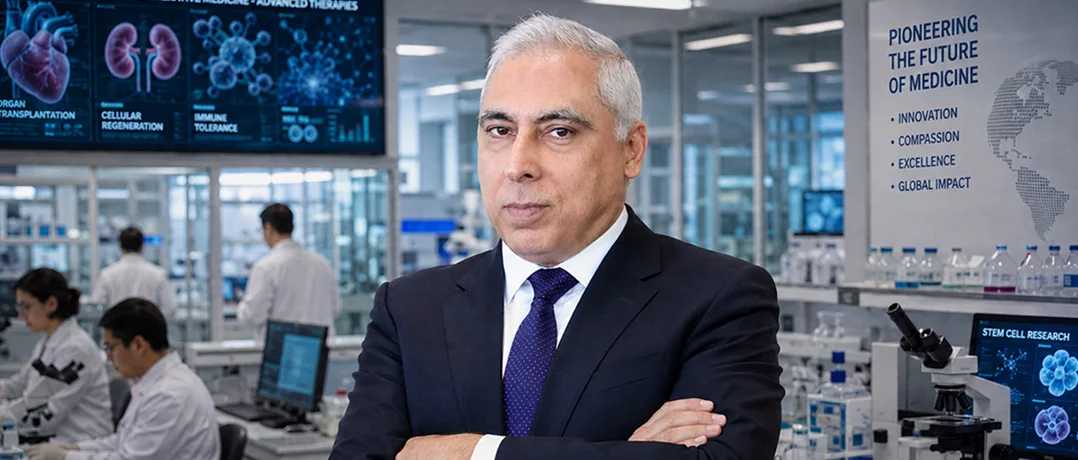
Fresh off receiving the 2026 Lifetime Achievement Award from the American Society of Transplantation (AST), Dr. Mohamed H. Sayegh stands at the pinnacle of a career that has reshaped the fields of transplantation, renal medicine, and immunobiology.
The award marks another historic milestone for the Lebanese American physician-scientist, who became the first individual in AST history to achieve what has been described as the “Triple Crown” receiving the Society’s Basic Science Award, Mentorship Award, and Lifetime Achievement Award.
Speaking exclusively to The Beiruter, Dr. Sayegh described the recognition as both a personal honor and a reflection of decades of collaborative scientific work. “Of course, this is a great recognition of our efforts over many years,” he said. “My recent work with the National Institutes of Health leading collaborative research projects in the Middle East is exactly aimed at promoting collaborative research in the region.”
A career built on research, mentorship, and regional impact
Over a career spanning more than 3 decades, Dr. Sayegh has held leadership roles at Harvard Medical School, Brigham and Women’s Hospital, Boston Children’s Hospital, and later the American University of Beirut Medical Center (AUBMC), where he returned in 2009 as Dean of Medicine and Executive Vice President.
Reflecting on the defining factors behind his exceptional journey, Dr. Sayegh pointed to three pillars: passion, mentorship, and impact. “The first important step is having passion and conducting high-quality research,” he said. “Then mentoring future scientists, which has been a major part of my career. Finally, the impact of the research work defines the ultimate achievements. I have been lucky and blessed.”
One of Dr. Sayegh’s most notable achievements was leading what became known as a “reverse brain drain” initiative during his years at AUB. Between 2009 and 2020, approximately 250 physicians and scientists were recruited back to the American University of Beirut Medical School.
If the regional political situation is stable, I do believe it is possible to bring talent back to our region.
Lebanon and the challenge of sustaining scientific progress
Despite spending years at some of the world’s most prestigious academic institutions, including Harvard, Dr. Sayegh said his return to Lebanon was driven by a belief that regional institutions remain capable of competing internationally. “That is exactly why I am now working with the National Institutes of Health in the United States on promoting collaborative regional research in our region,” he explained.
However, he stressed that sustaining such progress depends on stronger funding and institutional support for research across the region. “We have great talent, but the biggest problem we face is funding for research,” he said. “We are working on developing mechanisms to promote collaborative research and capacity building. Governments and foundations need to increase their support for research if we are to compete globally.”
Dr. Sayegh also highlighted that Lebanese physicians and researchers continue to leave a major scientific impact internationally, despite the country’s ongoing crises. “The Lebanese have proven for decades that they are very talented and can contribute to science, literature, and art throughout the world,” he said. At a time when Lebanon continues to grapple with economic collapse, institutional instability, and an ongoing brain drain, Dr. Sayegh believes global Lebanese success stories have become more important than ever.
Such achievements highlight that even when our country is devastated by war, the Lebanese people remain creative and capable of contributing to advancements in the region and the world.
The future of medicine and global collaboration
Looking ahead, Dr. Sayegh believes the future of organ transplantation will be shaped by artificial intelligence (AI), precision medicine, immunology, and emerging regenerative technologies.
However, he stressed that the field still faces critical challenges, particularly the growing shortage of available organs. “The major challenge now in organ transplantation is the availability of enough organs for the growing transplant lists,” he said. “Xenotransplantation and developing ways to promote long-term survival of transplanted organs are key areas for overcoming these challenges.”
He also pointed to stem cell transplantation and tissue regeneration as major future research priorities, while warning that ethical questions surrounding unrelated live organ donation remain an urgent issue in the Middle East. “Working out the ethical issues of unrelated live donation of some organs is critical in our region,” he noted.
Today, much of Dr. Sayegh’s focus is centered on strengthening long-term medical and scientific cooperation between Lebanon, the broader Middle East, and the United States through the NIAID-Middle East, North Africa, and Türkiye (MENAT) Initiative, which he has led since 2020. “This is exactly the purpose of the NIAID-MENAT initiative,” he said. “We have made significant advancements, but there is still a lot of work to do.”
Hence, for Dr. Sayegh, the future of medicine will depend not only on scientific innovation, but also on the ability of institutions to build sustainable international partnerships that foster talent, advance research, and reinforce Lebanon and the region’s role in global scientific progress.
-
-

-
The Beiruter
-
