



From evil eye charms to everyday rituals, Lebanese superstitions quietly shape daily life. Rooted in history, faith, and collective trauma, these inherited beliefs offer comfort, protection, and a sense of control amid uncertainty.
The Lebanese superstitions we still live by

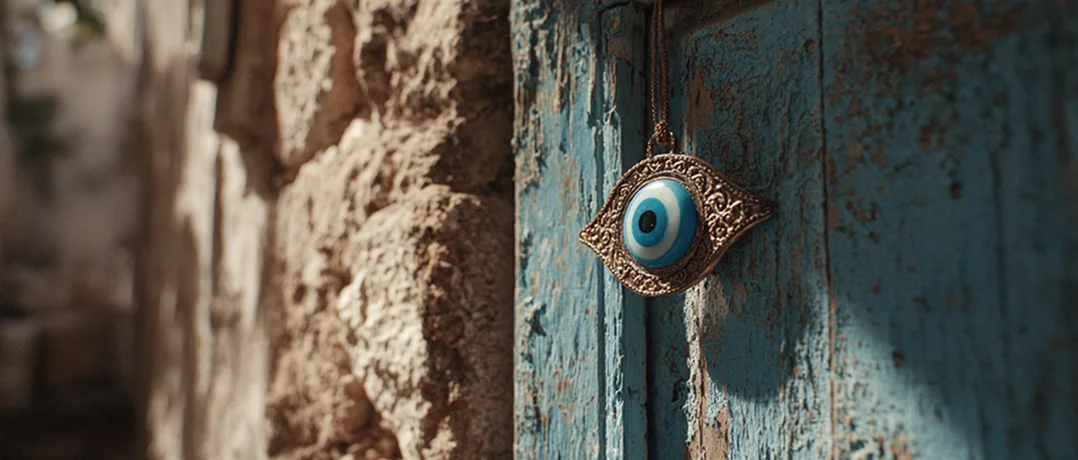
In Lebanon, belief does not always announce itself as religion. Sometimes, it hangs quietly above a doorway. Sometimes, it is tucked into a baby’s onesie. Sometimes, it’s the instinctive act of throwing salt over your shoulder after a spill, without really knowing why.
These small, inherited gestures form a parallel belief system: Lebanese folk superstition. Passed down through generations, shaped by history, religion, and collective trauma, these practices exist in the space between faith and fear, logic and instinct.
The evil eye
Few symbols are as widespread in Lebanese homes as the blue “ayn”, the evil eye charm. It hangs over front doors, rearview mirrors, and hospital bassinets. It appears in jewelry, embroidery, and keychains. The belief behind it is simple but powerful: envy can harm. Not through intention, but through gaze. A compliment without protection can invite misfortune. Success, beauty, happiness, these things must be shielded.
In a country where certainty is rare, the evil eye offers something practical: a sense of control. It transforms abstract fear into something visible, and therefore manageable.
Signs, omens, and sudden fortune
Some superstitions promise. If a lizard falls on you, many Lebanese will tell you one thing: money is coming. The logic is unclear, but the excitement is immediate. What might terrify someone elsewhere becomes, in Lebanon, a strange sign of luck.
Other signs are less generous. Spilling salt is never just a mess. It’s an omen. The solution is automatic: throw a pinch over your left shoulder to ward off bad luck. Even those who claim not to believe will still do it, just in case.
In Lebanese homes, money is surrounded by unspoken rules. Putting a purse on the floor is believed to invite financial loss, money out the door. Breaking a mirror does not just mean bad luck, but seven years of it, a belief that echoes across cultures but remains firmly alive in Lebanese households. These rules echo a deep cultural anxiety around financial security, shaped by decades of economic instability.
Names, gossip, and the invisible thread
Even language carries superstition. Saying someone’s name by mistake is believed to mean they’re talking about you. It’s a small belief, almost playful, yet deeply ingrained, proof of how superstition often softens fear with humor. These ideas create invisible connections between people, reinforcing the sense that nothing happens in isolation.
Why we still believe
Lebanese superstitions endure because they are practiced. They offer participation in a world that often feels uncontrollable. In a country where nothing is guaranteed, superstition becomes emotional insurance. A way to act. A way to protect. A way to feel less exposed.
Some beliefs make us laugh. Others make us pause before picking up a fallen shoe or placing a purse on the floor. All of them reveal something essential about Lebanese culture:
our relationship with uncertainty, memory, and survival. Lebanese superstitions are as rich and colorful as the culture itself, reminders that even in chaos, we still look for signs, protection, and meaning.
-
-

-
The Beiruter
-
