



Nearly 2 decades after the Battle of Nahr al-Bared, Lebanon remains trapped between fragile sovereignty, non-state armed factions, and unresolved refugee camp tensions.
The legacy of Nahr al-Bared: The border within
The legacy of Nahr al-Bared: The border within
By Anthony Chamoun | May 20, 2026

Reading time: 7 min
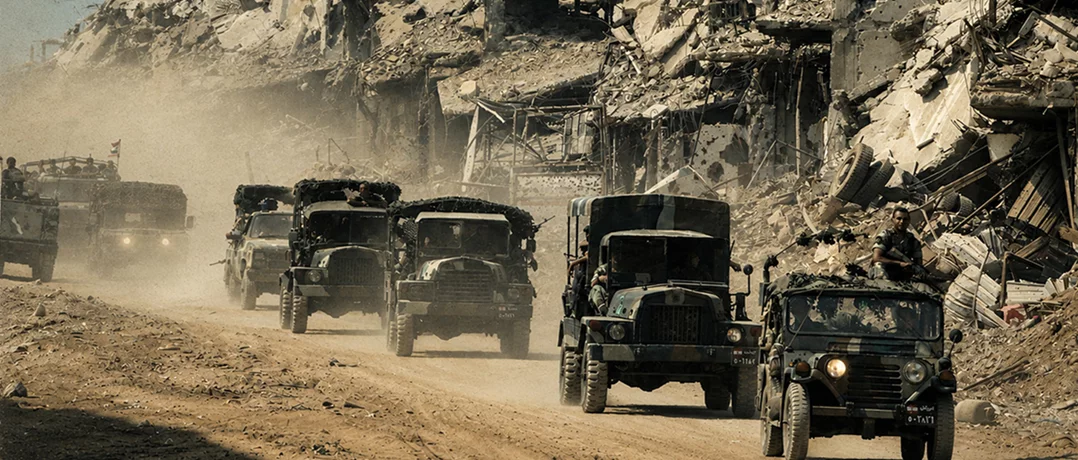
The issue of Palestinian armed factions in Lebanon remains one of the most complex and sensitive questions in the country’s modern political history. More than 3 decades after the end of the Lebanese War (1975-1990) and nearly 20 years after the Battle of Nahr al-Bared in 2007, the Lebanese state continues to struggle with the challenge of asserting full sovereignty over its territory while managing the political, social, and security realities of Palestinian Refugee Camps (P.R.C.s).
The experience of the Battle of Nahr al-Bared demonstrated both the dangers posed by armed non-state actors operating beyond state control and the devastating humanitarian and political consequences of military confrontation inside refugee camps. Today, as Lebanon once again revisits the issue of Palestinian arms, the lessons of Nahr al-Bared remain highly relevant.
The 2007 Battle of Nahr al-Bared and the rise of Islamist militancy
The Battle of Nahr al-Bared erupted on 20 May 2007 in the P.R.C. located near Tripoli in northern Lebanon. The conflict began after clashes between Lebanese security forces and members of Fatah al-Islam, a militant extremist organization that had established a stronghold inside the camp. The group, composed of militants from various Arab countries, adopted a radical jihadist ideology and was accused of carrying out terrorist attacks, bank robberies, and assassinations inside Lebanon.
Tensions escalated after Lebanese authorities attempted to arrest members of the group linked to criminal activities. In response, Fatah al-Islam launched coordinated attacks against Lebanese Armed Forces (L.A.F.) positions, killing numerous soldiers in surprise assaults. The L.A.F. rapidly mobilized and surrounded the camp, initiating what would become a prolonged and destructive military confrontation lasting more than 3 months.
The battle represented an unprecedented challenge for the L.A.F. in the post-war era. Fighting occurred in densely populated urban areas where militants utilized narrow alleyways, underground tunnels, improvised explosive devices, and fortified positions. The army faced severe operational difficulties due to the camp’s geography and the militants’ ability to blend into the surrounding civilian environment.
As the confrontation intensified, the Lebanese military launched a large-scale offensive involving artillery bombardment, infantry assaults, and siege tactics. The battle inflicted heavy casualties on both sides. Around 168 Lebanese soldiers were killed, alongside hundreds of militants and civilians. Entire sections of the camp were destroyed, forcing approximately 30,000 Palestinian refugees to flee their homes.
In September 2007, the L.A.F. officially declared victory after defeating the remaining Fatah al-Islam fighters. Across Lebanon, the military operation was widely portrayed as a decisive victory against terrorism and a demonstration of the L.A.F.’s ability to defend national security despite limited resources and political fragmentation.
At the same time, the battle exposed the fragility of the relationship between the Lebanese state and the P.R.C.s. Although Fatah al-Islam was not representative of the Palestinian population, the camp itself became the battlefield due to the absence of effective state authority and the persistence of armed enclaves operating beyond governmental control.
The battle’s lasting consequences
The consequences of the Battle of Nahr al-Bared were profound and multidimensional, affecting Lebanon’s security landscape, civil-military relations, Palestinian refugees, and broader political discourse.
First, the battle significantly strengthened the symbolic legitimacy of the L.A.F. At a time when Lebanon remained deeply polarized following the withdrawal of Syrian forces in April 2005 and amid escalating regional tensions, the army emerged as one of the few national institutions capable of uniting large segments of the population. Public support for the military increased substantially as the confrontation was framed as a defense of Lebanese sovereignty against extremist violence. That battle was not merely a military confrontation, but a true test of the state's ability to defend itself against terrorism. Indeed, it proved that the L.A.F., when given the opportunity to fulfill its duty, is capable of protecting Lebanon, regardless of the sacrifices required.
Second, the battle had important regional and political implications. Various Lebanese political actors accused external powers and intelligence networks of exploiting P.R.C.s for geopolitical purposes, specifically tackling Syria under the Assad regime. The latter facilitated Fatah al-Islam and its leader Shaker al-Absi’s infiltration into Lebanon with the intention of using the terrorist group in Beirut’s internal conflict (especially with the presence of an anti-Syrian government at the time) and wreaking havoc throughout the country as a whole. Thus, the conflict reinforced fears that Lebanon’s internal vulnerabilities could continue to be manipulated through non-state armed groups operating within the camps.
Third, the humanitarian consequences were severe. The destruction of Nahr al-Bared displaced thousands of refugees and devastated civilian infrastructure. Reconstruction efforts lasted for years and were accompanied by strict military oversight and security procedures. Many Palestinians came to perceive the post-battle governance model as highly securitized, characterized by surveillance, checkpoints, and movement restrictions. Consequently, the battle deepened feelings of mistrust between segments of the Palestinian refugee population and the Lebanese state.
Finally, the conflict exposed the dangers associated with ungoverned spaces inside refugee camps. Since the Cairo Agreement of 1969, P.R.C.s had largely remained outside the direct authority of the Lebanese state. Although the agreement was formally annulled in 1987, the practical reality of limited state intervention persisted. This environment enabled various armed factions, criminal networks, and extremist organizations to operate with relative autonomy. Nahr al-Bared demonstrated how such spaces could become incubators for militant groups, notably extremist ones, capable of threatening national stability. Hence, the battle influenced subsequent Lebanese debates regarding sovereignty and weapons outside state control. It reinforced arguments that the existence of autonomous armed organizations undermines the authority of the state and creates long-term security threats that may eventually erupt into violence (which will be tackled below).
The lessons for Lebanon and the question of Palestinian disarmament
The contemporary debate over disarming Palestinian factions cannot be separated from the lessons of Nahr al-Bared. The battle illustrated that allowing armed groups to function independently of state institutions creates structural instability that ultimately threatens both Lebanon and the Palestinian refugees themselves.
One of the primary lessons is that fragmented sovereignty produces ever-growing insecurity. When the state lacks full authority over portions of its territory, alternative systems of governance emerge, often dominated by militias, factional rivalries, illicit economies, and external influences. Over time, these environments become susceptible to infiltration by extremist organizations, as occurred with Fatah al-Islam in 2007.
At the same time, the Lebanese experience demonstrates that military solutions alone are insufficient. While the L.A.F. succeeded in eliminating Fatah al-Islam, the destruction of the camp and the suffering endured by civilians generated long-lasting resentment and humanitarian hardship, while various other militant factions persistent and even proliferated. Any future disarmament process must therefore avoid reproducing the conditions of violent confrontation witnessed at Nahr al-Bared.
The current efforts to disarm Palestinian factions, which was officially proclaimed in May 2025, through negotiation rather than force reflect an awareness of these risks. Lebanese authorities seek to establish a gradual and consensual process capable of integrating the camps into the framework of state sovereignty without provoking internal conflict. However, the initiative faces major obstacles, including divisions among Palestinian factions regarding disarmament (especially between Fatah, Hamas, and Islamic Jihad), ongoing Israeli military actions, regional power struggles, and the absence of comprehensive reforms addressing refugee rights. The Lebanese state must therefore pursue a balanced approach that simultaneously reinforces sovereignty and builds trust with Palestinian communities.
Furthermore, the issue of Palestinian arms intersects with Lebanon’s wider challenge of non-state weapons. The attempt to disarm smaller Palestinian factions is widely viewed as part of a broader effort to normalize the principle that all weapons should ultimately fall under state authority; including disarming Hezbollah. The matter has also a sectarian dimension to it, viewing any attempt to disarm “Sunni” factions with the need to mutually approach the disarmament of “Shiite” factions. Whether Lebanon can successfully apply this principle more broadly remains uncertain, particularly given the country’s sectarian divisions and complex geopolitical environment.
Ultimately, the future of the P.R.C.s is inseparable from the future of Lebanese sovereignty itself. Lebanon cannot fully restore state authority while maintaining zones governed by competing armed actors. The challenge therefore lies not only in deciding to collect weapons, but to effectively deliver official pledges while also building a new framework of trust, rights, and shared responsibility capable of preventing another Nahr al-Bared from emerging in the future.
-
-

-
Anthony ChamounResearcher/WriterFocusing on Political Science and International Affairs.
-
