



A system built to power Lebanon and support agriculture now operates below capacity, constrained by pollution, fragmented governance, and economic pressures.
The Litani River project, then and now

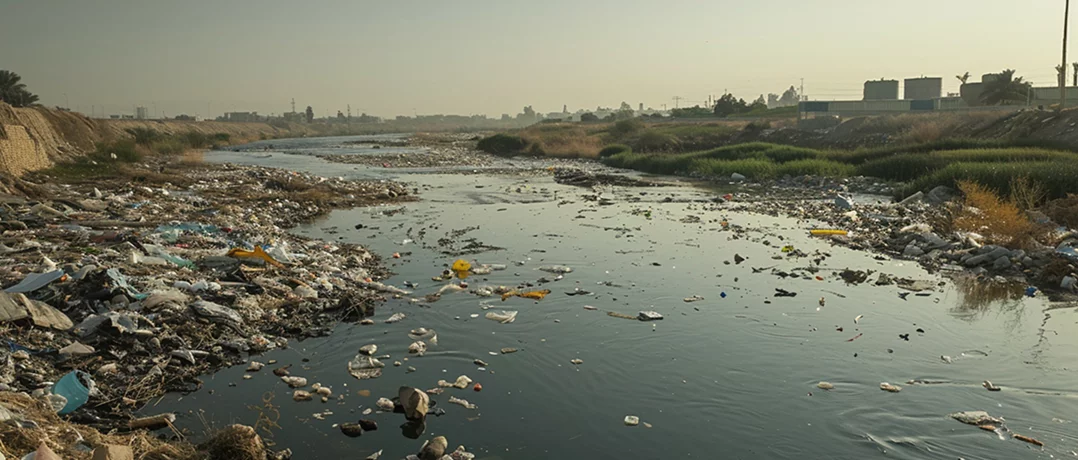
At a time when Lebanon faces chronic electricity shortages and rising energy costs, one of its largest domestic energy systems continues to operate far below its intended capacity. The Litani River, the country’s largest river entirely within its borders, is not only a natural resource but the foundation of a national infrastructure system designed to reduce reliance on imported fuel while supporting agricultural development.
That system took shape through the Litani River Project, one of Lebanon’s largest state-led development efforts. Established with the creation of the Litani River Authority in 1954, it aimed to convert the river into a combined network for hydroelectric generation and irrigation. At its center is the Qaraoun Dam, completed in 1959, which forms Lake Qaraoun with an estimated storage capacity of 220 million cubic meters. Water is then diverted through tunnels to the Markaba, Joun, and Awali plants, bringing total capacity to approximately 190 megawatts.
At the time of its inception, the project was expected to supply a significant share of national electricity demand while irrigating tens of thousands of hectares across the Bekaa Valley and South Lebanon. In scale and ambition, it was designed to anchor a self-sustaining system for energy and agriculture.
Declining output and constraints
Today, the system operates well below its original potential.
Hydropower accounts for a limited share of Lebanon’s electricity mix. According to data from the International Energy Agency (IEA), hydroelectric generation typically contributes a low, single-digit share of Lebanon’s total electricity production, depending on rainfall. In drier years, output declines further.
This comes as Lebanon’s electricity system remains constrained. Before the 2019 crisis, peak electricity demand exceeded 3,500 megawatts, while available generation capacity remained significantly lower, according to World Bank and sector analyses. Since 2019, fuel shortages and financial constraints have reduced state electricity provision to only a few hours per day in many areas.
Pollution and system-level degradation
Beyond water availability, the more persistent constraint has been water quality.
Monitoring data from the Litani River Authority, along with assessments by the United Nations Development Programme and academic research on the basin, point to sustained pollution across large sections of the river system. In parts of the upper Litani, biological and chemical oxygen demand levels have exceeded national standards, with testing also identifying elevated levels of heavy metals and nitrates linked to industrial discharge and agricultural activity.
The scale of the issue is widely documented. Analyses of the basin highlight industrial waste and untreated wastewater as major sources of pollution, with limited wastewater treatment coverage allowing significant volumes of discharge to enter waterways.
These conditions increase sedimentation and maintenance requirements for hydropower infrastructure while reducing the reliability of water for irrigation.
Fragmented governance and uneven enforcement
The gap between design and output is closely tied to how the system is managed.
Responsibility for the Litani basin is distributed across multiple institutions. The Litani River Authority oversees water flow and parts of the infrastructure. The Ministry of Energy and Water is responsible for national water policy, while wastewater infrastructure is managed through the Council for Development and Reconstruction and local municipalities. Industrial regulation falls under the Ministries of Industry and Environment.
This distribution has complicated implementation. In 2016, parliament approved a national plan to address pollution in the Litani basin, allocating substantial funding for wastewater treatment plants, sewage networks, and enforcement measures. Several projects were launched, but progress has been uneven.
By the early 2020s, multiple wastewater treatment plants in the basin had been completed but were not fully operational or were running below capacity due to electricity shortages, funding constraints, and incomplete connections to sewer networks. In some areas, facilities operate intermittently, limiting their effectiveness.
Enforcement has also been inconsistent. Efforts to identify industrial violations have taken place, but monitoring has been difficult to sustain over time, and untreated discharge continues to be reported in parts of the basin.
Energy dependence and agricultural pressure
The Litani’s reduced output is particularly relevant in the context of Lebanon’s broader economic structure.
Lebanon imports the vast majority of its fuel. According to World Bank trade data, total imports were $18–19.5 billion in 2022 and 2023, with fuel representing a major component of the import bill. Hydropower remains one of the few local generation sources not directly tied to imported fuel, even if its scale is limited.
The irrigation component of the Litani project also remains central to agricultural activity. The system was designed to support tens of thousands of hectares, and agriculture continues to play a key role in the Bekaa Valley and parts of South Lebanon, where it provides income and employment in areas with limited alternatives.
Water contamination now has direct economic effects. Crops irrigated with polluted water face higher rejection risks in export markets, while farmers incur additional costs for treatment, soil remediation, or switching crops. At the same time, input costs have risen sharply. Fuel, fertilizers, and transport are largely priced in dollars, increasing costs as the currency depreciates, as documented in World Bank and Food and Agriculture Organization reporting.
These pressures are already reflected in both the country’s energy supply and its agricultural output. More than 70 years after its completion, the Litani River Project continues to function, but at a fraction of its original ambition. Its trajectory reflects a broader pattern in Lebanon’s infrastructure. Large systems can be built through concentrated investment, but sustaining them requires continuous coordination, enforcement, and funding. Without these, even major national projects remain constrained in their impact.
-
-

-
The Beiruter
-
