



Lebanon’s ancient basket-weaving tradition, where local materials, handcraft, and regional identity come together as a living heritage.
The living tradition of basket weaving

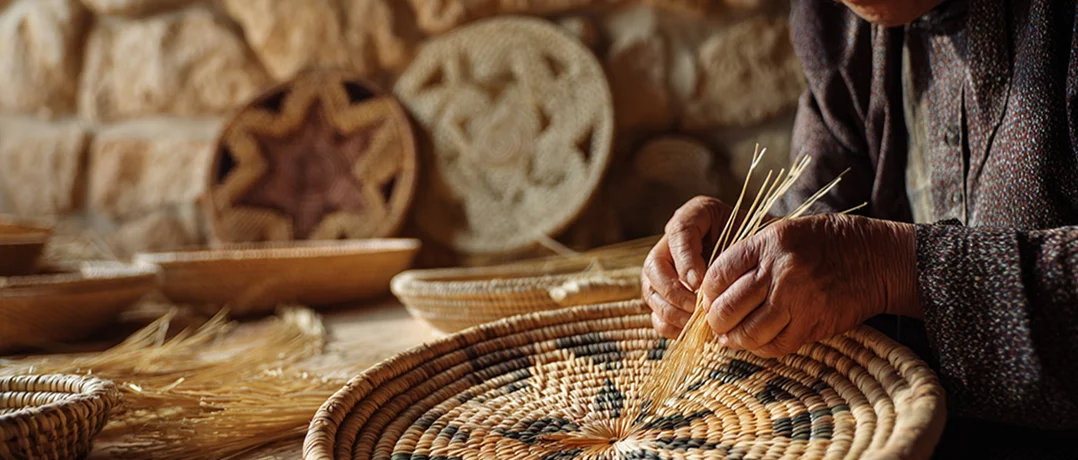
Long before plastic, packaging, and mass production, Lebanon wove its needs by hand. Basket weaving, one of the country’s oldest crafts, has been practiced in rural villages for centuries, shaped by landscape, climate, and daily life. More than utilitarian objects, these baskets tell the story of a people who learned to work with what the land offered them.
Across Lebanon, baskets are born from local raw materials: reeds, wheat stalks, palm leaves, corn straw, bulrush, and alfa (esparto grass). Each region developed its own weaving language, dictated by what grew naturally nearby. As a result, basketry centers are scattered throughout the country, each carrying its own visual identity and function.
A craft shaped by place
In Al-Kouachra, near the northern border with Syria, halfah (esparto grass) is transformed into multicolored mats and trays, their patterns echoing both nature and tradition. In Hermel, artisans weave prayer rugs from dyed corn straw, blending function with spiritual symbolism.
Northern villages such as Zgharta and Bcharre, as well as Helweh in Jbeil, Kefraya in the Bekaa, and Saida in the South, are known for producing large, sturdy baskets from rough cane or wicker. These were designed to transport fruits, vegetables, and fish, essential tools in agricultural and coastal life. In Amchit, palm leaves became the signature material, giving rise to a distinct local style. Men and women both practiced the craft, depending on the material and technique involved, making it a shared economic and cultural activity.
The intelligence of the hand
The weaving process is meticulous and deeply attuned to nature’s rhythms. Mature reeds, for example, are harvested at the end of winter, before sap rises through the stalk, a crucial timing that prevents rot. The reeds are cleaned, bundled, dried upside down in the sun, then flattened under the rolling weight of a stone millstone, cracking them lengthwise without breaking them.
Only then are the strips ready to be worked. Without nails, screws, or glue, artisans assemble and braid plant fibers entirely by hand, relying on techniques passed down from generation to generation. The strands are chosen carefully, depending on the form and purpose of each basket.
In Kwashra, Akkar, women cut the alfa plant and transform it into threads, which are dyed, dried, and arranged into vibrant strands used primarily for trays and decorative items, a quiet testimony to patience and precision.
From sea to city
Along Lebanon’s coastal fishing ports, baskets remain inseparable from the sea. They line harbors filled with fishing nets or carry the morning’s catch. In rural regions, baskets are essential during harvest season, carrying figs, olives, and fruit, while flat woven mats once covered rooftops to dry keshek in mountain and Bekaa villages.
Basketry also crossed into urban life. In old city neighborhoods, woven baskets were lowered from high balconies of aging heritage buildings, bridging domestic life and street commerce, a familiar image of a slower, more tactile era.
Preserving a living heritage
For centuries, rural communities sustained basket weaving as part of their living heritage. Today, as industrial alternatives threaten traditional crafts, basket weavers are adapting rather than disappearing. With the support of national and local NGOs, often in collaboration with international organizations, the craft is being revived through modern designs that respect traditional methods while appealing to contemporary tastes.
Many of these initiatives focus on empowering women, creating economic opportunities while promoting sustainable development, cultural tourism, and environmentally conscious production.
Basket weaving in Lebanon is a living practice, one that bends, adapts, and endures. Each woven strand carries memory, labor, and landscape, reminding us that some of the most enduring designs are those shaped by hand and in harmony with the land.
-
-

-
The Beiruter
-
