



The long fight for mothers’ financial rights in Lebanon
The long fight for mothers’ financial rights in Lebanon
By The Beiruter | May 26, 2026

Reading time 3 min
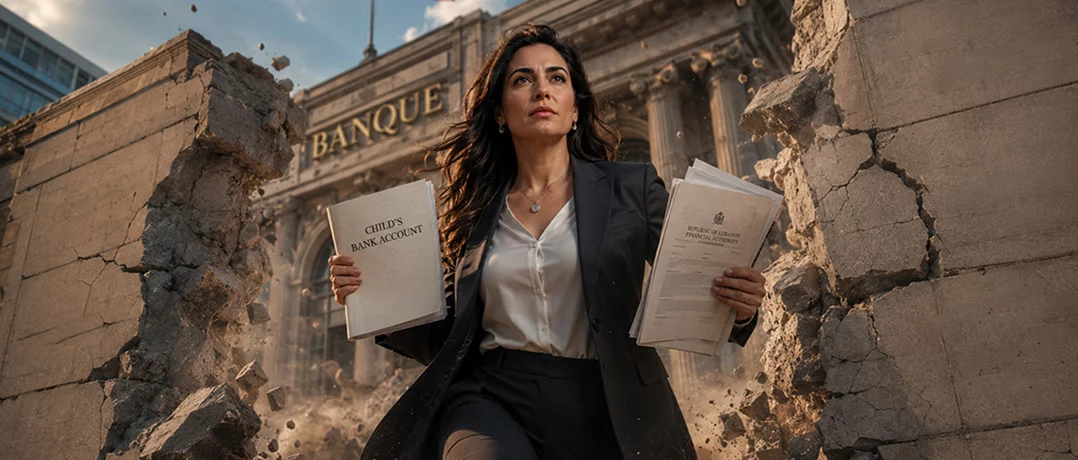
In a move welcomed by women’s rights advocates across Lebanon, Banque du Liban Governor Karim Souaid has instructed banks across the country to fully implement Circular No. 305/2009, a long-overlooked regulation issued by the Association of Banks in Lebanon granting married women the right to open bank accounts for their minor children. Though the measure is rooted in a directive that has existed for more than 15 years, its renewed enforcement marks a notable institutional shift and reflects a broader effort to strengthen women’s financial agency within Lebanon’s traditionally patriarchal legal framework.
The decision also arrives at a pivotal moment for Lebanon’s banking sector, which continues to struggle to rebuild public trust following the country’s financial collapse in 2019, a crisis the World Bank described as among the worst globally since the mid-19th century.
A long-overdue enforcement
The circular was first introduced in 2009 and was viewed at the time as a modest yet symbolically significant step toward expanding women’s financial rights in Lebanon. That same year, a Lebanese woman successfully opened a bank account in the name of her underage children, a move widely described as precedent-setting in a country where women continue to face structural legal discrimination in family and financial matters.
Yet despite the regulation’s existence, implementation remained inconsistent for years. Many Lebanese banks continued to require the father’s approval or physical presence before allowing mothers to open or manage accounts on behalf of their children, effectively limiting women’s ability to make routine financial decisions concerning their families.
The renewed push to enforce the circular under Souaid, who assumed office in March 2025 after Lebanon’s prolonged central bank leadership vacuum, gives the regulation new institutional weight and signals that compliance is no longer optional.
Financial inclusion gap
The reform also highlights the broader gender disparities that continue to shape Lebanon’s financial landscape. According to the World Bank’s Gender Data Portal, only 15.3% of women in Lebanon had an account at a financial institution or mobile money service provider in 2024, compared with 31% of men, one of the widest gender gaps in financial inclusion in the Middle East and North Africa region.
The figures reflect wider economic inequalities. World Bank data shows that female labor force participation in Lebanon stood at 22.2% in 2023, compared with 66.7% for men. For many Lebanese women, limited access to formal financial systems has been compounded by the country’s sectarian family law structure, which often grants fathers primary legal authority over children’s affairs, including financial decisions. Mothers seeking to save money for their children, receive transfers on their behalf, or manage school and medical expenses have frequently faced bureaucratic barriers requiring paternal authorization.
In that context, the enforcement of a seemingly administrative banking circular carries significance far beyond the financial sector. It strengthens the mother’s position as an equal financial stakeholder within the family and signals a rare institutional acknowledgment of women’s economic autonomy in Lebanon’s legal system.
Banking sector under pressure
The move comes as Lebanon’s financial institutions continue attempting to restore credibility after years of economic turmoil. Since the onset of the 2019 collapse, depositors have faced severe restrictions on accessing their savings, while the Lebanese pound lost much of its value.
The country’s banking sector has also contracted dramatically. Discussions over banking reform, deposit recovery, and financial restructuring remain central to negotiations with international institutions and potential donor countries.
Against that backdrop, women’s financial inclusion is increasingly being treated not only as a social issue but also as an economic necessity. The World Bank has repeatedly linked access to banking services and financial assets to broader economic resilience and poverty reduction for women and vulnerable households.
A limited but symbolic reform
Despite the significance of the directive, Lebanon’s broader personal status framework remains deeply fragmented. The country officially recognizes 18 religious sects, each governing its own laws related to marriage, divorce, custody, inheritance, and family affairs rather than a unified civil code. Women’s rights organizations have long argued that the system institutionalizes discrimination against women and limits their autonomy in matters involving children and guardianship.
Still, advocates say the practical implications of the circular should not be understated. International organizations increasingly view women’s access to financial resources as a foundational pillar of gender equality and economic participation. By actively backing the implementation of the directive, Lebanon’s central bank has effectively aligned itself with that principle.
For many Lebanese mothers who have long managed household finances and their children’s day-to-day needs without formal institutional recognition, the move represents more than a procedural banking adjustment. It is, in many ways, an acknowledgment of their equal role in shaping the financial future of their families.
-
-

-
The Beiruter
-
