

From ancient warrior rituals and battlefield stimulants to AI-era biotechnology, this article explores humanity’s centuries-long pursuit of creating soldiers who can overcome fear, fatigue and the limits of the human body.
The long quest to engineer the soldier

Long before armies spoke of human enhancement, societies imagined warriors who had already escaped the limits of ordinary men. Their stories told of heroes who fought without fear, berserkers who entered states of uncontrollable fury, and warrior traditions across continents that promised courage, endurance, or communion with forces beyond the self.
War has always had reason to dream of such a man. Soldiers become exhausted. They need sleep. They feel hunger and pain. They freeze, overheat, panic and bleed. The history of military technology is filled with attempts to compensate for those weaknesses through better weapons, armor, or tactics. But there has always been another solution: change the soldier himself.
Entering the warrior state
Before anyone could engineer the soldier’s body, societies first tried to transform his mind. The most immediate obstacle was fear. Battle demanded that ordinary restraints be overcome, and across cultures, ritual and intoxicants offered ways of turning the individual into something temporarily different from the man who had approached the battlefield.
Few figures embody that idea better than the Norse berserker. Medieval accounts described warriors entering a violent frenzy marked by extraordinary aggression and apparent indifference to pain. Their behavior later produced one of military history’s most persistent drug theories: that berserkers consumed the hallucinogenic Amanita muscaria mushroom before fighting.
The evidence, however, is thin. A more recent hypothesis has proposed henbane, whose effects better resemble descriptions of berserker behavior, though researchers acknowledge that neither explanation can be proved from the surviving archaeological and historical record.
Across the Atlantic, the link between psychoactive substances and fearlessness is better documented. The Aztecs possessed extensive knowledge of mind-altering plants and preparations. Among them was teotlaqualli, an ointment containing psychoactive morning-glory seeds as well as strong tobacco. Historical accounts from conquistadors describe Aztec priests applying it to overcome fear and enter the mental condition required for ritual duties, while several cases also record its use on soldiers.
These practices were far removed from modern performance science, but the underlying objective is recognizable: weakening the psychological barriers that told warriors to hesitate, retreat or turn away from what came next.
Making the body endure
Yet, courage alone was not enough. Once men entered battle, they still had to march for days, endure hunger and cold, fight through pain and remain functional long after exhaustion began to set in. Across different societies, substances increasingly served a more practical purpose: helping the body tolerate what war demanded of it.
In the Andes, coca became one of the clearest examples. The Inca state maintained large supplies of the leaves, which acted as a stimulant and helped reduce sensations of hunger, thirst, and fatigue. Coca was distributed within the Inca imperial system and used by military personnel operating across the vast and often high-altitude terrain of the empire.
A similar logic appeared in South Asia. Among the Nihangs, the Sikh warrior order, preparations containing cannabis became associated with martial life. Later accounts describe bhang, an edible preparation made from the leaves of the cannabis plant, being consumed to dull pain, steady nerves and endure the hardships of campaigning, although the practice remains disputed within Sikh tradition and should not be confused with a universal Sikh custom.
Alcohol and tobacco would become even more familiar companions of armies. Their effects differed, but the principle was becoming clearer: the soldier’s limitations could be addressed one by one. Fear could be softened, pain dulled, hunger suppressed, and fatigue postponed.
For centuries, however, such methods remained rooted largely in tradition and experience. Industrial chemistry would turn that scattered knowledge into something armies could manufacture, measure, and distribute on a vastly different scale.
When the state became the pharmacist
The Second World War transformed that relationship. Industrial warfare demanded that men keep pace with machines capable of moving and fighting through the night, and chemistry offered armies a way to postpone one of the body’s most stubborn demands: sleep.
Germany turned heavily to Pervitin, a commercial form of methamphetamine introduced before the war. It could increase alertness and confidence while suppressing fatigue, and German commanders distributed it to exhausted troops despite growing medical concerns over its effects. Yet stimulant warfare was hardly unique to the Wehrmacht. The United States issued Benzedrine, an amphetamine, while Britain purchased an estimated 72 million stimulant tablets for its armed forces during the war.
Few stories illustrate both the promise and danger of battlefield drugs better than that of Finnish soldier Aimo Koivunen. During a long-range patrol in March 1944, while being pursued by Soviet forces, Koivunen tried to take the Pervitin his unit had received from Germany. The tablets had stuck together, and he swallowed the entire supply of roughly 30 pills.
At first, the methamphetamine did what it was supposed to do, giving Koivunen the strength to ski rapidly away before confusion, blackouts and hallucinations set in. He became separated from his patrol and spent days moving through the Arctic wilderness, eventually stepping on a mine. By his own later account, he covered roughly 400 kilometers before rescue. When he reached a field hospital on April 1, he weighed only 43 kilograms, and his heart rate was still around 200 beats per minute.
Koivunen’s ordeal exposed the contradiction at the heart of stimulant enhancement. Methamphetamine could silence exhaustion, but it could not abolish the exhaustion itself.
From intoxication to optimization
By Vietnam, battlefield pharmacology had become far more systematic. Between 1966 and 1969, the U.S. armed forces consumed some 225 million stimulant tablets, while amphetamines such as Dexedrine were prescribed to sustain endurance during long missions. Sedatives were also issued to reduce anxiety and help soldiers sleep.
At the same time, many soldiers turned to drugs to self-medicate against the strains of war. A 1971 Defense Department report found that 51 percent of U.S. servicemen had used marijuana, 31 percent had taken psychedelics, and 28 percent had used harder drugs such as cocaine or heroin. By 1973, a Pentagon study estimated that as many as 20 percent of soldiers were habitual heroin users.
Drug use had become so pervasive that in 1970, Egil Krogh, a liaison to the Bureau of Narcotics and Dangerous Drugs, told President Richard Nixon: “You don’t have a drug problem in Vietnam, you have a condition.”
In the decades that followed, militaries sought something more controlled: wakefulness without euphoria, endurance without impaired judgment, and performance without the brutal crash associated with earlier stimulants.
One answer emerged from France. Research begun in the 1970s eventually produced modafinil, a wakefulness-promoting drug first used clinically in the early 1980s. Unlike the amphetamines associated with earlier wars, it offered the possibility of sustaining alertness with less euphoria and a less severe post-stimulant crash. French forces used modafinil during the 1991 Gulf War, its first documented use on a military theater of operations, as part of efforts to maintain performance during prolonged sleep deprivation.
The ideal was shifting toward a soldier who appeared entirely normal while performing beyond normal limits. Yet pharmacology could still only manipulate systems the body already possessed. The next frontier would ask whether those systems themselves could be altered.
From pharmacology to engineering
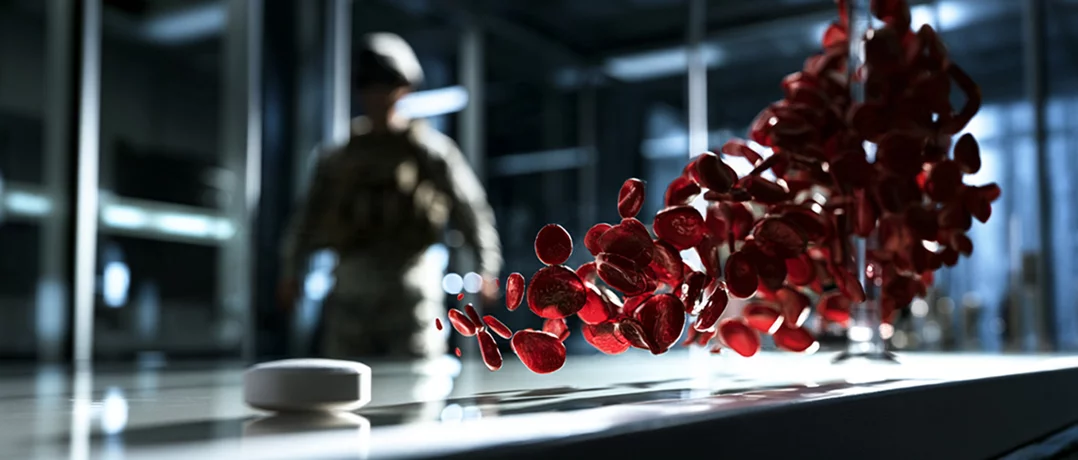
Today, DARPA’s Smart Red Blood Cells (Smart-RBC) program is exploring whether red blood cells can be engineered to sense physiological conditions, process that information and trigger a useful biological response. The program’s two demonstration goals are increased exercise tolerance and faster control of bleeding, with DARPA testing whether modified cells can improve performance and survivability in extreme environments.
The concept is built around a biological “sense-decide-act” circuit. An engineered cell would detect a signal in its surroundings, determine whether a programmed condition had been met and then release or activate an effector molecule designed to alter the body’s response. DARPA requires this decision process to involve biological logic rather than a simple automatic reaction.
The cells would be engineered through their precursors so that the necessary molecular machinery remains once they mature. Because mature red blood cells have no nucleus, they cannot replicate or pass on genetic material, allowing the modification to disappear as the engineered cells naturally leave circulation. The program remains experimental and does not involve human trials.
This marks an important shift from what came before. Coca, amphetamines and modafinil act on an existing human system, while Smart-RBC asks whether parts of that system can instead be temporarily engineered to perform differently. DARPA is pursuing a related idea through its RBC-Factory program, which seeks to insert biologically active components into red blood cells to protect warfighters against environmental and physiological threats.
For centuries, armies sought ways to suppress fear, postpone exhaustion and push soldiers beyond ordinary limits. The frontier is now moving inward: enhancement may become something temporarily incorporated into a soldier’s own biology, rather than something he takes before battle. The super-soldier remains a dream, but the means of pursuing it have moved from ritual to chemistry and, increasingly, toward engineering.
-
-

-
Nami El KhazenJournalistFocusing on geopolitics and international affairs.
-
