



A proposed expansion of U.S.-Morocco defense cooperation highlights how the kingdom's religious institutions, diplomacy and military partnerships have become a strategic advantage as jihadist violence spreads across the Sahel.
The making of Morocco's counterterrorism state
The making of Morocco's counterterrorism state
By Katharine Sorensen | July 23, 2026

Reading time: 9 min
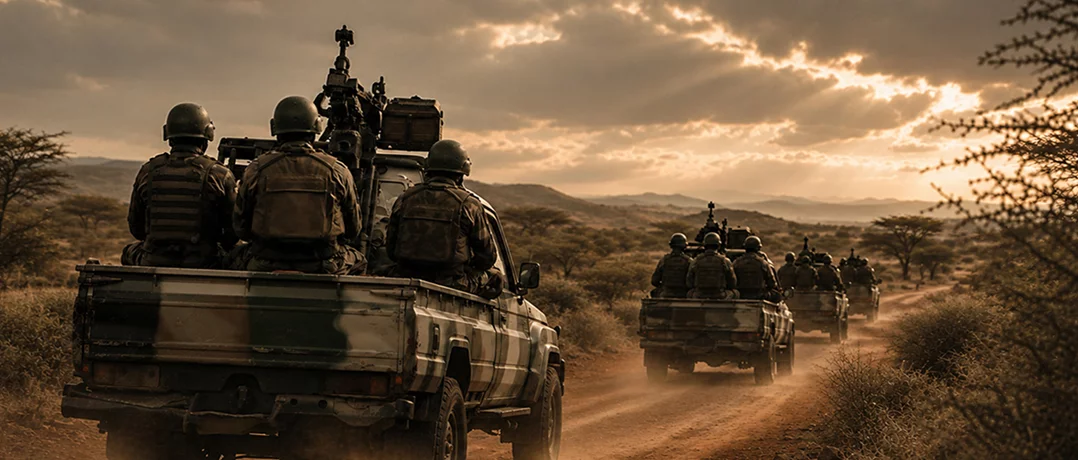
Buried inside the more than 1,000-page draft of the United States’ fiscal year 2027 National Defense Authorization Act is an unusual directive. Within 180 days of the legislation taking effect, the Pentagon would be required to produce a plan to expand defense cooperation with Morocco under a new 10-year bilateral roadmap.
The proposal extends well beyond traditional counterterrorism. It calls on the Defense Department to assess the feasibility of "refurbish[ing] strategic air command runways formerly operated by the United States," "establish[ing] cooperative security locations," creating a "drone center of excellence," and increasing Moroccan procurement of U.S. defense equipment.
The provision arrives as jihadist insurgencies continue to expand across the Sahel, the semi-arid region stretching south of the Sahara from the Atlantic Ocean to the Red Sea, where al-Qaida- and Islamic State-linked groups have steadily expanded their reach. According to the Global Terrorism Index 2026, the region accounted for more than half of global terrorism-related deaths in 2025, up from less than 1% in 2007, with attacks and fatalities increasing roughly tenfold since 2009.
Morocco is not immune to the political, economic and religious pressures that militant organizations exploit. Yet while governments across the Sahel struggle to contain insurgencies, the kingdom has spent decades building institutions that combine religious authority, intelligence capacity, military cooperation and regional diplomacy.
“Morocco has positioned itself as a safe, reliable and desirable partner,” Michael Shurkin, a former CIA political analyst and director of global programs at 14 North Strategies, told The Beiruter.
The kingdom is exceptionally good at balancing relationships. They're very skilled diplomats.
These combined capabilities have made Morocco one of Washington's most valuable security partners in North and West Africa.
A threat wider than theology
The expansion of jihadist organizations across the Sahel is often framed as a story of religious radicalization. In practice, recruitment is driven as much by weak governance, local conflict and limited economic opportunity.
Jama'at Nusrat al-Islam wal-Muslimin (JNIM), al-Qaida's affiliate in the Sahel, has become the region's most powerful militant organization since its creation in 2017. It exploits weak governance, local grievances and limited economic opportunity where state authority is absent. The Global Terrorism Index ranked it among the world's four deadliest terrorist organizations in 2025.
Shurkin argues that the religious language used by such organizations can obscure the political conditions that make recruitment possible.
“Most people who join JNIM are not primarily motivated by radical Islam,” he told The Beiruter.
Many recruits are motivated by politics. They’re motivated by resentment. They feel marginalized, neglected or mistreated by the system. The Islamist groups exploit those grievances.
That distinction is central to understanding Morocco's approach to countering extremism. Since the infamous 2003 Casablanca bombings, which killed 45 people, including the 12 attackers, the kingdom has strengthened its security services and expanded international intelligence cooperation. But it has also pursued a broader strategy aimed at competing with extremist movements for religious and political legitimacy rather than relying on force alone.
Centuries of religious statecraft
Morocco's management of religious life long predates the emergence of al-Qaida or the Islamic State. The monarchy has historically viewed rival religious and ideological movements as potential competitors to the political order.
The relationship has required constant negotiation. From the French protectorate (1912-56) through independence, the monarchy strengthened its religious authority while confronting Arab nationalists, leftist movements and later political Islam to prevent rivals from challenging the crown.
Shurkin places the current jihadist threat within this much longer history of Moroccan statecraft.
“Morocco has been thinking about radical Islam as a strategic threat for centuries,” he said.
“The Moroccan government has long understood the relationship between religion, insurgency and state security. The West African states are still learning how to think about those issues.”
That history continues to shape Morocco's approach to countering extremism. Rather than separating religion from the state, Morocco embeds religious authority within it. The king serves as Commander of the Faithful, while state institutions such as the Ministry of Endowments and Islamic Affairs oversee mosques, supervise clerical appointments and regulate religious discourse.
Morocco has also exported that model through the Mohammed VI Institute for the Training of Imams in Rabat, which trains religious leaders from Morocco and across Africa, including Mali, Senegal, Nigeria and Chad, as part of efforts to promote religious moderation and counter extremist interpretations.
“Morocco has the institutional capacity to operate within the Islamic public sphere and influence it in a particular direction,” Shurkin said.
The monarchy has always had to negotiate with religious movements while also keeping extremism at bay.
Morocco's approach does not eliminate extremism, nor does it suggest that its model can simply be exported elsewhere. Much of its effectiveness depends on institutions many Sahel governments lack: a monarchy claiming religious authority, a centralized bureaucracy regulating religious life and capable security services.
This institutional difference helps explain the contrast with much of the Sahel. Organizations such as JNIM do not seek only to carry out attacks; they also attempt to replace the state as a source of justice, protection and religious authority where governments are weak or absent. Morocco confronts that challenge with religious institutions embedded in the state and backed by centuries of continuity.
What Section 1268 would build
The Morocco provision in the House draft of the fiscal year 2027 NDAA translates the kingdom’s perceived reliability into a series of unusually specific military proposals. It does not authorize the reopening of American bases or guarantee that every proposed initiative will be implemented. Instead, it directs the Defense Department to assess how cooperation could develop under the 2026-2036 U.S.-Morocco Roadmap for Defense Cooperation.
One of the most consequential phrases concerns the possible establishment of cooperative security locations in Morocco.
These would not generally resemble large permanent American bases. Cooperative security locations remain under host-country ownership with little or no permanent U.S. troop presence, allowing aircraft, personnel and equipment to deploy rapidly during exercises or regional crises.
The bill also directs the Pentagon to examine a cost-sharing arrangement to refurbish former Strategic Air Command runways previously operated by the United States. During the 1950s, the United States operated major air bases at Nouasseur near Casablanca, Sidi Slimane and Ben Guerir, whose long runways were built for heavy strategic aircraft, including the B-47 bomber. Morocco retained the facilities after the U.S. withdrawal in the early 1960s.
Refurbished runways could support transport aircraft, aerial refueling, joint exercises and rapid reinforcement rather than their original Cold War mission. Their location would give Morocco the capacity to connect Atlantic and Mediterranean routes with operations toward West Africa without requiring a permanent American presence.
The proposal has acquired greater relevance as Western military access in the central Sahel has contracted. Coups in Mali (2020-21), Burkina Faso (2022) and Niger (2023) disrupted longstanding security partnerships, and the United States completed its withdrawal from Niger in 2024, including from Air Base 201 near Agadez. Morocco does not replace direct access to the Sahel, but its stability, infrastructure and access to both the Atlantic and the Mediterranean make it a potential staging and logistics partner farther north.
Other provisions make clear that the requested plan is not limited to jihadist organizations. Section 1268 calls for an “all-domain range complex” where forces could train across land, air, maritime, space and cyber operations. It also proposes a drone center of excellence focused on joint all-domain operations.
The proposal would expand African Lion, the largest annual U.S.-led military exercise in Africa, to include artificial intelligence, cybersecurity, drones, counter-drone capabilities, hybrid warfare, logistics, undersea technologies and the protection of critical infrastructure. Hosted primarily by Morocco, the exercise brings together forces from the United States, Africa, Europe and other partner countries.
Read together, the proposals extend cooperation beyond counterterrorism to the infrastructure, training and technologies expected to define future conflicts.
“The United States and other governments recognize its utility,” Shurkin said.
Morocco has done an excellent job of making itself valuable to a wide range of countries.
The limits of strategic value
Morocco has long balanced relationships across competing blocs. It is a major non-NATO ally of the United States, maintains extensive ties with Europe, restored relations with Israel under the Abraham Accords and has expanded its engagement across sub-Saharan Africa.
It has also avoided defining itself exclusively through any one relationship. Rabat maintains security partnerships with Western states and close political connections with Gulf monarchies while deepening economic ties with China, which has invested in Morocco's emerging electric vehicle battery industry, attracted by its manufacturing base and phosphate reserves.
Yet this balancing strategy can create political exposure at home. Government policy does not always reflect the views of the Moroccan public, particularly concerning Israel. Large demonstrations against the war in Gaza and normalization have highlighted the gap between government policy and public opinion. In that respect, Morocco may resemble Egypt, where decades of formal relations and security cooperation with Israel have not produced broad public acceptance of normalization..
Shurkin identifies that gap as a potential constraint on deeper security cooperation.
There’s always a risk that governments move further than their populations are willing to go,” he said.
Morocco could face a similar backlash if it moves too far in embracing the United States, Israel or the broader Western security architecture.
The risk is not necessarily an immediate rupture. Morocco’s monarchy retains considerable authority, and foreign partners have a strong interest in the country’s continued stability. Nevertheless, strategic value does not remove the domestic political costs of visible alignment with external powers, particularly when those partnerships involve military infrastructure or relations with Israel.
Domestic legitimacy is also central to Morocco's counterextremism strategy. The state’s religious institutions provide an alternative to radical movements, but their credibility depends partly on the monarchy’s ability to present itself as the guardian of Moroccan and Islamic interests. A perception that foreign policy has moved too far from public opinion could give political or religious opponents additional grievances to exploit.
“Nobody wants to see Morocco destabilized,” Shurkin said. That broad international interest strengthens the kingdom’s position, but it cannot substitute for domestic legitimacy.
Whether or not every proposal in Section 1268 is ultimately implemented, the legislation illustrates how Washington increasingly views Morocco as a long-term strategic partner. More importantly, it underscores a broader reality. Morocco's strategic importance rests not on one advantage but on an accumulation of strengths: geographic access, military infrastructure, religious institutions, diplomatic reach and a state that has spent centuries managing the intersection of political authority and Islam.
-
-

-
Katharine SorensenReporterSpecializing in global affairs, technology and economics, with a focus on on-the-ground investigative reporting.
-
