



From rooftops to festivals, Lebanese dabke endures as a shared rhythm of land, history, and community.
The many faces of Lebanese dabke

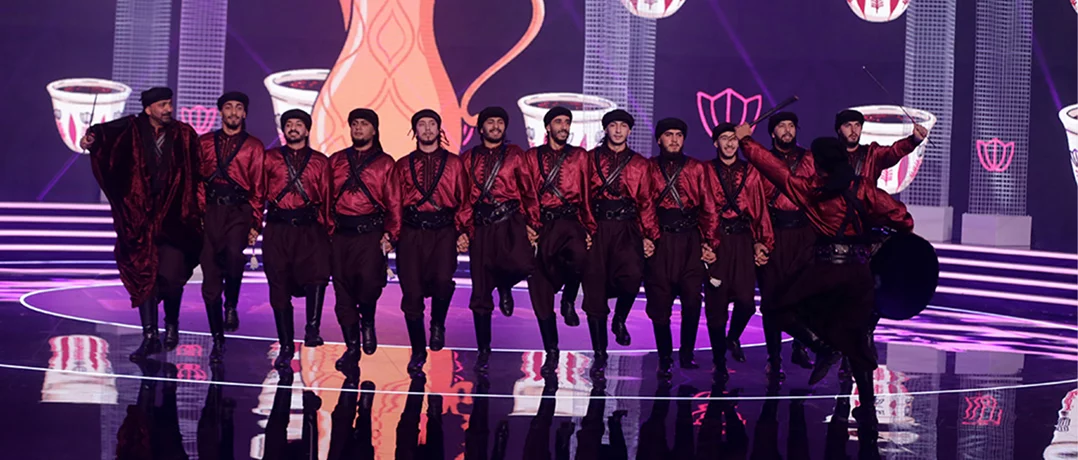
In Lebanon, dabke is a memory pressed into the ground, a rhythm inherited rather than learned, a collective instinct that emerges wherever there is joy, grief, or gathering. From village rooftops to festival stages, dabke has survived because it remained needed to mark life’s most human moments.
To understand Lebanese dabke is to understand that it does not belong to one place, one people, or one tempo. It splinters into styles, each shaped by geography, labor, music, and social life. Together, these types form a living archive of how Lebanese communities once lived and, in many ways, still do.
Al-Dal‘ouna (Al-Shamaliyya): The language of the line
The most recognizable dabke form, Al-Dal‘ouna, often referred to as Al-Shamaliyya, is the backbone of Lebanese celebrations. Performed in a semicircle or line, dancers link hands or shoulders, moving as a single unit under the guidance of the lawwih, the leader whose footwork, improvisation, and stamina steer the rhythm.
Its popularity in Mount Lebanon, the Bekaa Valley, and parts of the South reflects its communal nature. This is the dabke of weddings, homecomings, and national moments. As the rhythm slows, guests are invited to join. The line expands. The dance becomes collective memory in motion. Though often danced to “Dal‘ouna” songs, the dabke itself is the response to the music. A reminder that Lebanese culture moves through participation, not spectatorship.
Al-Sha‘rāwiyya: Strength grounded in earth
Where Dal‘ouna flows, “Al-Sha‘rawiyya” strikes. Traditionally performed by men, this dabke is heavy, grounded, and forceful, defined by powerful stomps that seem to challenge the earth beneath them.
Common in rural Mount Lebanon and the Bekaa, “Sha‘rawiyya” reflects agricultural life. The movements echo plowing, threshing, and harvesting, labor translated into rhythm. The lawwih here is not merely a guide but a symbol of endurance and command. This is dabke as assertion: of strength, of presence, of belonging to the land.
Al-Karadiyya: When music leads
Distinct among dabke forms, “Al-Karadiyya” abandons the lead dancer altogether. Instead, an “azif”, often playing the mijwiz or flute, stands at the center of a slow, circular formation. The dancers move not by command, but by sound.
Most commonly found in Southern Lebanon, Karadiyya prioritizes harmony over dominance. The absence of hierarchy mirrors its rhythm: restrained, flowing, collective. It is dabke stripped of spectacle, returning to its earliest function, unity through shared tempo.
Al-Hawwara and Al-Ghazil: Joy, stamina, and challenge
Al-Hawwara and Al-Ghazil are among the most physically demanding dabke forms. Hawwara bursts with energy, fast, lively, and exuberant, while Ghazil is defined by three repeated stomps of the right foot, testing precision and endurance.
These styles are especially beloved in the Bekaa Valley and northern villages, where dabke often borders on friendly competition. Tempo accelerates. Breath shortens. The dance becomes a challenge, not to outshine the group, but to keep up with it.
Al-Badawiyya: Traces of migration
Unlike other forms rooted in settled village life, Al-Badawiyya carries the memory of movement. Its origins are traced to Bedouin groups who arrived from Najd around four centuries ago. While dabke itself did not exist in Najd, these communities adapted local rhythms, creating a distinct style marked by unique transitions and steps. Al-Badawiyya stands as evidence that Lebanese dabke absorbs migration, influence, and adaptation, without losing its communal soul.
Lebanese dabke survives because it still answers a need, to belong, to gather, to move as one. It is heritage that breathes, adapts, and refuses to be reduced to nostalgia. Dabke is Lebanon, insisting, step by step, on continuity.
-
-

-
The Beiruter
-
