



The collapse and revival of the March 10 agreement highlight the uncertainty surrounding the SDF’s future, as military pressure and regional rivalries push Syria’s northeast from autonomy toward forced reintegration.
The March 10 agreement: Still an option?

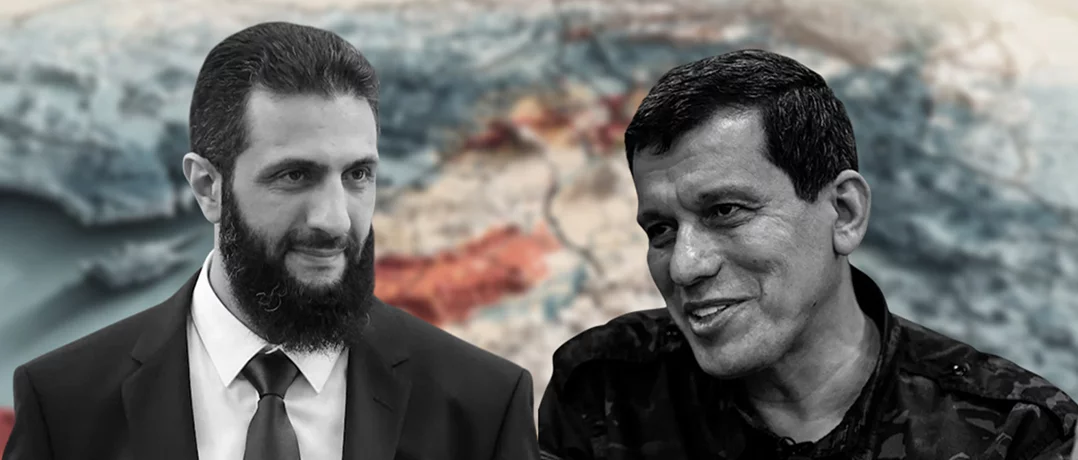
The agreement reached on March 10 between the government and the Syrian Democratic Forces (SDF) marked a decisive turning point towards a new post-Assad era in the country, particularly in Arab–Kurdish relations. However, in the final days of 2025, uncertainty once again descended over Syria.
The agreement failed to materialize, and the recent clashes in Aleppo exposed the fragility of the country’s internal balances. The Syrian Democratic Forces now face pressure, particularly from Damascus and Ankara. So how did the SDF, that currently administers approximately 25% of Syria’s territory, get to this current state? More importantly, what future awaits it?
On December 8, 2024, one of the most significant events in Syria’s history occurred. Opposition factions led by Hay’at Tahrir al-Sham entered the capital, Damascus prompting Bashar al-Assad to flee to Russia, marking the end of the Baathist regime’s 60-year rule.
Abu Mohammad al-Jolani, the leader of Hay’at Tahrir al-Sham, now known as Ahmed al-Sharaa, became Syria’s interim president. On March 10, 2025, President Ahmed al-Sharaa and the Commander-in-Chief of the Syrian Democratic Forces, Mazloum Abdi, signed an 8-point agreement.
The agreement provided for the integration of the SDF into the Syrian army and the reintegration of the territories under its control. It affirmed Syria’s territorial unity and guaranteed the rights of all ethnic and religious groups. Separate committees were to be formed to implement each provision, with all terms to be completed by the end of 2025.
However, the agreement remained suspended for several months. In September 2025, Saleh Muslim, former head of the Democratic Union Party and a member of the Presidential Council, stated that dissolving the Syrian Democratic Forces was unacceptable. He emphasized that they would not accept a full return to a centralized system in Syria.
The Syrian government presented the SDF with a 13-point roadmap, which Damascus considered a final offer. According to the proposal, the SDF could be reorganized into three divisions within the Syrian army:
1- A border division responsible for securing Syria’s northeastern borders
2- A women’s division maintaining existing female units
3- A counterterrorism division coordinating directly with the Syrian government
Damascus also expressed openness to allocating three deputy minister positions to the SDF: Deputy Minister of Defense, Deputy Minister of Interior, and Deputy Chief of the General Staff.
Nevertheless, the Syrian Democratic Forces insisted on limiting the presence of the Syrian army in the northeast, restricting it to its three divisions east of the Euphrates River.
Following the Suwayda events, fear grew amidst the Kurdish group that tensions could rise again, and therefore there remains a need to have an independent military body capable of protecting their population. According to Mazloum Abdi, there remains no security guarantees for the Kurds post integration.
Israel, the SDF, and the stalling of the March 10 agreement
From Ankara’s perspective, Israeli policy in post-Assad Syria has emerged as a critical obstacle to the implementation of the March 10 agreement between Damascus and the SDF. Turkey increasingly believes that Israeli military and political actions are reinforcing separatist tendencies within Syria, particularly among actors whose leverage depends on continued fragmentation.
According to Ömer Özkizilcik with Stimson, Israeli airstrikes against central state institutions in Damascus, including the Presidential Palace and the Ministry of Defense, are seen in Ankara as having altered the SDF’s cost–benefit calculations. Rather than accelerating integration into the new Syrian army, the SDF has slowed or suspended implementation. Turkish officials interpret this hesitation as evidence that Israeli pressure has weakened Damascus’ authority and emboldened the SDF to retain autonomous military and political leverage. In this regard, Israel functions less as a direct partner of the SDF than as an external enabler of its reluctance to subordinate itself to the Syrian state.
These dynamic carries consequences well beyond Syria. Ankara views the March 10 agreement as structurally linked to its own domestic Kurdish track, particularly renewed discussions surrounding PKK disarmament following statements by Abdullah Öcalan. Progress on SDF integration would reinforce Ankara’s argument that armed Kurdish movements can transition into state structures; failure, by contrast, risks entrenching hardliners and collapsing the domestic process altogether.
Turkey therefore frames Israeli actions in Syria not merely as regional interference, but as indirect intervention in its internal security and political settlement efforts. As long as the SDF’s status remains unresolved, Ankara argues, neither Syrian stabilization nor a sustainable Kurdish settlement in Turkey is possible.
Should the March 10 process collapse entirely, Turkey has signaled that direct military action against the SDF would become unavoidable. In that scenario, Israeli obstruction of Syrian reintegration efforts would cross a clear Turkish red line, alongside expanded Israeli territorial control in southern Syria or any move threatening the survival of the al-Sharaa government.
Recent developments
At the time of this writing, an immediate ceasefire sponsored by Washington has been between Damascus and the Syrian Democratic Forces (SDF). For his part, Barak described the agreement as a “pivotal turning point,” noting that both sides chose partnership over confrontation. This development followed a rapid advance by Syrian government forces, which captured the strategic town of Tabqa during a push toward Raqqa and consolidated control over Deir Hafer and the Jarrah airbase, while heavy clashes continued east of Deir ez-Zor.
Under the terms of the agreement, all SDF military and security personnel are to be integrated individually into the Syrian Ministries of Defense and Interior following security vetting. The SDF leadership is to exclude remnants of the former Assad-era regime from its ranks, submit lists of former-regime officers currently present in northeastern Syria, and transfers responsibility for the files of ISIS detainees and their camps to the Syrian government. In return, the Syrian government has pledged not to target SDF employees, fighters, or civilian administrators and to ensure security through regular state forces. Control over border crossings and oil and gas fields will also revert to Damascus, consolidating the state’s authority over strategic infrastructure and resources.
The agreement is not limited to military arrangements; it carries deep political dimensions. It stipulates the integration of the institutions of the Autonomous Administration into state structures, the granting of administrative representation to Kurds, and the recognition of cultural and linguistic rights, alongside a commitment to the return of displaced persons, the resolution of property disputes, and the removal of non-Syrian members of the Kurdistan Workers’ Party (PKK) from the country.
The timing and substance of the agreement underscore how shifts in military balance have narrowed the SDF’s room for maneuver. The SDF’s willingness to implement the March 10 framework is closely tied to perceptions of Syrian state strength. After prolonged hesitation, the SDF moved toward reintegration amid mounting pressure and diminishing leverage.
A new scene in the North
In parallel with the political understanding, government forces have reasserted their control over a broad strip stretching from eastern Aleppo countryside through Raqqa and all the way to Deir ez-Zor. This redraws the map of influence in northeastern Syria and effectively marks the end of the phase of separate administration that has prevailed since 2017.
While some implementation details remain subject to testing, the Damascus–SDF agreement appears to constitute a major turning point in the Syrian landscape, one defined by a shift from confrontation to settlement, at a highly sensitive regional moment that may shape the contours of the next phase in Syria and the region.
-
-

-
Peter ChouayfatiPolitical Analyst and Researcher
-
