



The US strike on Venezuela highlights a shift away from multilateral norms, reinforcing the Monroe Doctrine and reshaping global power calculations.
The meaning behind Maduro’s capture

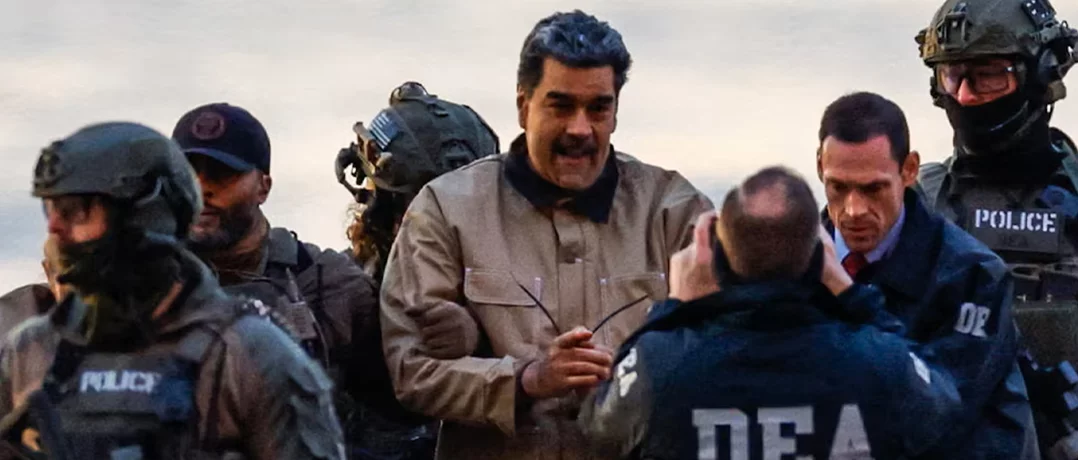
In a sudden escalation of tensions, the United States (US) has carried out a large-scale military strike on Venezuela, reportedly capturing President Nicolás Maduro and his wife, Cilia Flores.
Explosions rocked Caracas early Saturday, with aircraft flying low over the capital and military bases hit in surrounding states. Maduro was seized by elite special forces (the Delta Force) with CIA assistance and flown to New York, where he and his wife now face multiple criminal charges, including narco-terrorism conspiracy and possession of destructive devices.
US President Donald Trump described the operation as precise, with no US casualties, and promised a transitional US-led oversight of the country. Meanwhile, Venezuela’s government declared a national emergency, condemning the strike as an imperialist attack on the nation’s sovereignty and accusing the US of attempting to seize strategic resources. Vice-President Delcy Rodríguez has been sworn in as interim president, though she maintains Maduro is the legitimate leader.
The operation has nevertheless raised urgent questions that transcends Venezuelan borders, impacting international order and axes.
The return of Realism (Realpolitik)
Long believed to be “dead,” US actions against Venezuela have enhanced the return of a long-forgotten school of thought in International Relations (IR): Realism (Realpolitik). The latter was severely sidelined following the disintegration of the Soviet Union and the end of the Cold War in 1991, as Liberalism gained pre-eminence. However, the rise of Donald Trump (especially in his second term) has revived this theory once again; the latter dominated IR for centuries, culminating in the eruption of World War I (1914-1918) and World War II (1939-1945).
Indeed, the US operation reflects a decisive return to Realpolitik, where power and national interest dictate actions over ideals or international law (key characteristics that Thucydides, Cardinal Richelieu, Niccolò Machiavelli, Thomas Hobbes, Hans Morgenthau, Kenneth Waltz and John Mearsheimer promoted). The US bypassed multilateral negotiations and directly intervened on foreign soil, prioritizing strategic goals (removing a perceived hostile leader and securing influence over Venezuelan resources) over diplomatic consensus.
Rather than resorting to multilateralism, through the United Nations (UN) which Washington contributed to its establishment, Trump decided to act unilaterally and topple a president of a sovereign nation.
Therefore, Realpolitik has returned as a central driver in US foreign policy, demonstrating that military might and strategic leverage remain fundamental tools in shaping regional outcomes. This raises significant concerns about the erosion of international norms. Unilateral military intervention, conducted without UN approval, challenges longstanding principles of sovereignty and non-intervention. The targeting a sitting head of state and forcibly removing him from his country blurs the lines between law enforcement, counter-narcotics operations and foreign aggression. Critics argue that such actions undermine the credibility of international law and may embolden other powers to adopt similar extraterritorial tactics. This includes creating a justification for Russia’s war on Ukraine as well as a precedent for China to invade Taiwan and achieve the intended unification by force.
The Monroe Doctrine solidified
The strikes also signal a revival of the Monroe Doctrine, long considered a principle asserting US dominance in the Western Hemisphere.
The Monroe Doctrine is a US foreign policy established by President James Monroe in 1823, which opposes European colonialism in the Western Hemisphere. It asserts that any intervention by foreign powers in the political affairs of the Americas (the “backyard” of the Washington) would be viewed as a hostile act against the United States. This doctrine clearly aligns with Realpolitik as it defines a specific geographic “sphere of influence” to safeguard US safety and interests, similar to what Russia and China promote in their own “backyards” (being Eastern Europe and Southeast Asia, respectively).
By directly intervening in Venezuela, the United States reinforced its historical stance against foreign interference in its “sphere of influence” and emphasized its willingness to use force to maintain hemispheric control. This marks a more assertive US posture in Latin America than seen in decades, sending a stark warning to other regional actors, including left-leaning governments (such as Columbia and Cuba) and external powers with interests in the Americas.
In conclusion, the US strikes on Venezuela demonstrate a convergence of classical power politics, hemispheric dominance and targeted counter-Iran operations. Realism has returned, international norms are increasingly flexible and the Monroe Doctrine has been reinforced in practice. As the world watches the fallout, the question remains: how far will states go in prioritizing strategic advantage over multilateral rules, and what new precedents are being set for global order in the 21st century?
-
-

-
The Beiruter
-
