Lebanon's oldest barbershops are more than places for haircuts, they are living archives where generations of Beirutis have preserved the city's memories, traditions and stories through everyday conversation.


Lebanon's oldest barbershops are more than places for haircuts, they are living archives where generations of Beirutis have preserved the city's memories, traditions and stories through everyday conversation.

For my family, Mike's Barbershop on Bliss Street was never simply a place to get a haircut. My grandfather was a customer there, followed by my father and eventually my younger brother, making it one of those rare places that quietly becomes part of a family's history. Like countless neighborhood barbershops across Lebanon, it was a place where generations of families returned, neighbors gathered and everyday conversations became woven into the identity of the community.
I initially set out to write about Lebanon's oldest barbershops expecting to learn about changing hairstyles and the challenges of keeping traditional businesses alive. Instead, I found that the three barbers I interviewed spoke remarkably little about hair and almost endlessly about people. Every conversation drifted toward memories of war, neighborhoods that had changed beyond recognition, lifelong customers and the quiet routines that have shaped Beirut for decades. By the end of each interview, it had become clear that these barbers were doing far more than cutting hair, they had become custodians of their neighborhoods' collective memory, preserving the city's history one conversation at a time.
That sense of continuity is perhaps most visible at Bliss Barbershop, which today stands directly across the street from the original Mike's. Its owner, Habib, entered the profession at just thirteen years old before joining Mike in 1995, where he spent nearly three decades learning both the craft of barbering and the importance of building relationships with customers. "He taught us how to do business," Habib told me, explaining that Mike continues to inspire him years after his passing. Today, many of those same customers walk into Habib's shop. Some remember Mike from childhood, while others simply associate him with an earlier version of Bliss Street. Although hairstyles have changed dramatically over the years, Habib says the essence of the profession has remained the same. Older customers continue returning, new generations have taken their place and families still pass the tradition of visiting the neighbourhood barber from one generation to the next.
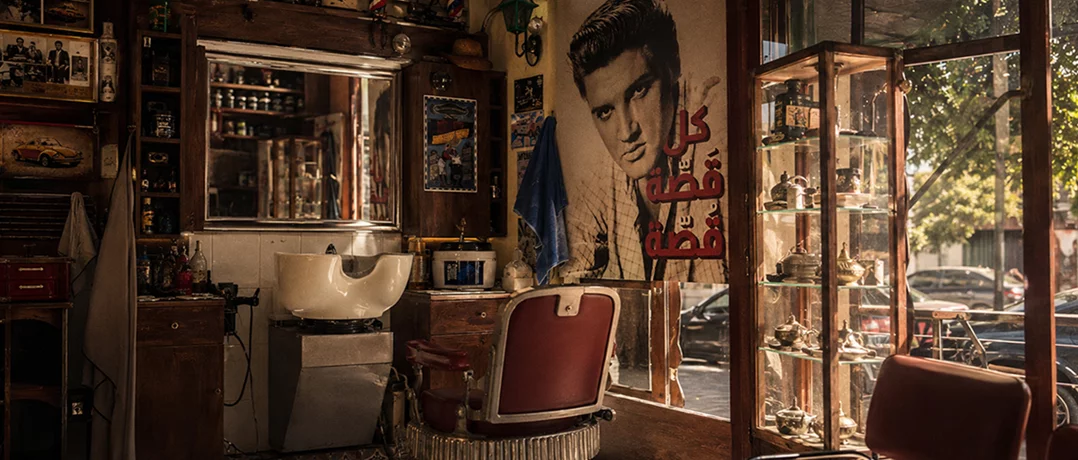
If Habib's shop represents continuity, Hallak El Shabeb represents conversation. Painted across one of its walls is the phrase "Kel assa ossa," or every haircut comes with a story, a motto that perfectly captures the atmosphere inside. Customers come for a haircut but often stay much longer, with conversations flowing naturally between politics, childhood memories, football and everyday life. I spent much of the afternoon listening as Tony reflected on decades behind the barber's chair. Before I could finish asking one question, another customer would walk in to greet him or someone passing outside would stop to say hello. The rhythm of the shop was shaped less by appointments than by conversation, making it clear that many people returned not only for the haircut but because they felt at home there. Tony has watched Mar Mikhael transform around him while welcoming an increasingly diverse clientele. Families who once brought their children now return with grandchildren, while foreigners passing through Beirut often become regular visitors.
Our conversation eventually turned to war. When I asked Tony how Lebanon's conflicts had affected him, he surprised me by pointing toward the entrance of the shop. "Look at the door," he said. He asked whether I could see the small black marks scattered across it."That's my blood from the day of the explosion." He never cleaned it away, the stains remain as a reminder of the Beirut port explosion and the lives it changed. Although he was later offered help to renovate the shop, Tony refused to modernize it, insisting that everything be restored exactly as it had been before. The conversation quickly drifted elsewhere. Tony spoke about an Argentinian customer who visits regularly to improve his Lebanese Arabic, learning a few new words every time he comes for a haircut. He also explained how he learned new hairstyles before the internet, relying on friends returning from abroad to bring him magazines that introduced him to international trends. One loyal customer even became his unofficial practice model, allowing Tony to experiment with a different haircut almost every day. Before I left, Tony asked if I had watched the music video for Mitsubishi by Saint Levant and Haifa Wehbe, I hadn't ; Smiling, he told me much of it had been filmed inside his shop, a reminder that these traditional spaces continue to shape Lebanon's contemporary culture.
Michel has spent nearly fifty years working at Salon Al Bhamdouni, a family business that stretches back more than a century. His father opened the salon in the 1940s after Michel's grandfather, who had worked on Lebanon's railway beginning in 1907, settled in Beirut. Today, the history of the family is inseparable from the history of the shop itself. Unlike many interviewees, Michel rarely answered questions directly. Every question became another story. At one point he described an AUB student researching her final-year project who had come to interview him about Mar Mikhael. Rather than simply answering her questions, Michel pulled out old maps of the neighborhood, pointed to where the historic railway station once stood and explained the location of Beirut's former brewery. It quickly became clear that decades spent listening to customers and watching the neighborhood evolve had turned him into an unofficial historian, someone whose knowledge came not from books but from lived experience.
When our conversation turned to the Lebanese Civil War, Michel replied saying "I'd go fight with the Lebanese Forces,Then I'd come open the shop." When I asked whether that reflected how accustomed Lebanese people had become to living through conflict, he simply shrugged, "Aade. What's wrong with it?" His response was striking because of how ordinary it sounded. Going to work after fighting had become just another part of daily life, illustrating how deeply conflict had been woven into the routines of an entire generation. Like Tony, Michel chose to restore rather than reinvent his salon after the Beirut port explosion. Today, Salon Al Bhamdouni is known as much for its distinctive decor as for its haircuts, attracting photographers, filmmakers and international television crews who come to document one of Beirut's most recognizable traditional barbershops.
Spending time with Habib, Tony and Michel made it clear that these shops have always been about much more than haircuts. They are places where strangers become regulars, generations of families continue returning and the history of Beirut is preserved through everyday conversations rather than official archives. These men have quietly witnessed wars, neighborhoods changing and families growing older from behind the barber's chair. Looking back, I realized that Mike's wasn't unique. Every one of these barbershops had become a place where the history of Beirut was quietly preserved through conversation rather than documents. As long as people continue sitting down for a haircut and staying a little longer to talk, Lebanon's old barbershops will continue preserving the stories that make up the city.
