

From Byblos to Tripoli’s souks, Lebanon’s copper craft evolved from ancient metallurgy to cultural artistry.
The metal that shaped Lebanon’s identity

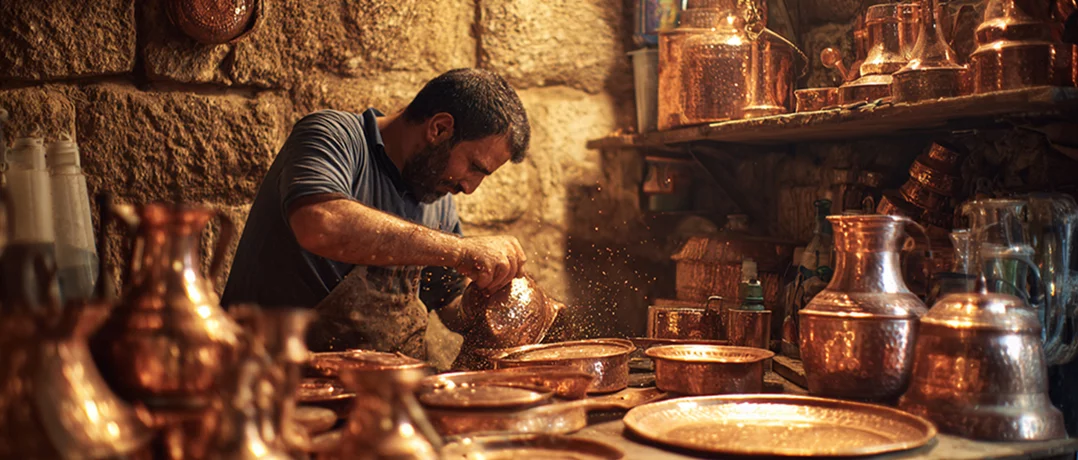
Long before Lebanon became synonymous with cedar, it was known for something far more elemental: copper. In the ancient Near East, copper was the first material that allowed humans to manipulate fire, shape tools, and turn imagination into form. And for millennia, Lebanon stood at the crossroads of this transformation, a land where artisans forged metal into meaning, and where craftsmanship became a language of civilization.
The birth of a metal age
Copper is born in volcanic terrain, formed when hot, sulfur-rich solutions seep through rock and deposit concentrated ores. Around 9,000 years ago, early communities learned to extract the glowing red metal from stone. That discovery ignited the first sparks of metallurgy and Lebanon was one of its earliest centers.
The first traces of pottery and metalworking on Lebanese soil appear in Byblos in the 4th millennium B.C., placing it firmly within the dawn of the region’s metal era. Forty-four copper weapons unearthed in Byblos reveal a vast network of exchange: isotopic studies trace their metal back to Iran and Oman, proof of the ancient world’s interconnected trade routes long before the Phoenicians set sail.
Copper’s versatility quickly expanded. When people learned to alloy it with tin, they created bronze: harder, more durable, and so revolutionary that an entire age of human history carries its name.
Copper and the Lebanese hand
Copper was first melded into weapons: spears, arrows, blades. But its legacy lies not only in warfare, but in the rise of daily craftsmanship. Resistant to corrosion and able to withstand high heat, copper became indispensable in kitchens and workshops.
Then came artistry. Phoenician metalworkers, famed throughout the Mediterranean, mastered chiseling and engraving with remarkable precision. They adorned their copper plates and vessels with hunting scenes, geometric motifs, and symbolic patterns. As centuries passed, the language of decoration evolved with faith and empire.
Across Lebanon, entire districts thrived as centers of metal craftsmanship, Al-Nahassin Street in Tripoli, the workshops of Bourj Hammoud, Qalamoun, Zahle, Sidon, Baalbeck. These were not just commercial hubs; they were cultural ecosystems. The rhythmic clang of hammers was once the soundtrack of Tripoli’s old souks, echoing down narrow alleys where molten metal met human skill.
A craft under threat
Today, the soundscape has changed. Copper and brass, once essential, now compete with aluminium and stainless steel: cheaper, lighter, and mass-produced. Economics has become the craft’s newest adversary. Equally urgent is another crisis: continuity. Young artisans are rare. Many have emigrated; others simply do not see a future in the labor-intensive, low margin trade their grandparents once mastered. Without new hands to inherit the craft, entire lineages of knowledge risk disappearing.
The Lebanese home
Despite these challenges, copper remains woven into Lebanese domestic life. From hammered trays to brass vases, coffee cups to incense burners, nearly every home keeps at least one piece, an heirloom, a wedding gift, a relic of the past that continues to glow in the present.
Copper is both material and witness to Lebanon’s story. From the arsenals of Bronze Age Byblos to the souks of Tripoli, it has carried the imprint of civilizations, beliefs, and craftsmanship that shaped the region for thousands of years. Whether its future will be as enduring as its past depends on the choices made today by artisans, collectors, institutions, and a new generation rediscovering the value of handmade beauty in a world of disposable alternatives.
-
-

-
The Beiruter
-
