



Military escalation between Iran, Israel and the United States has turned Middle Eastern airspace into a global aviation chokepoint, triggering flight cancellations, supply chain disruptions and mounting economic losses worldwide.
The Middle East airspace crisis

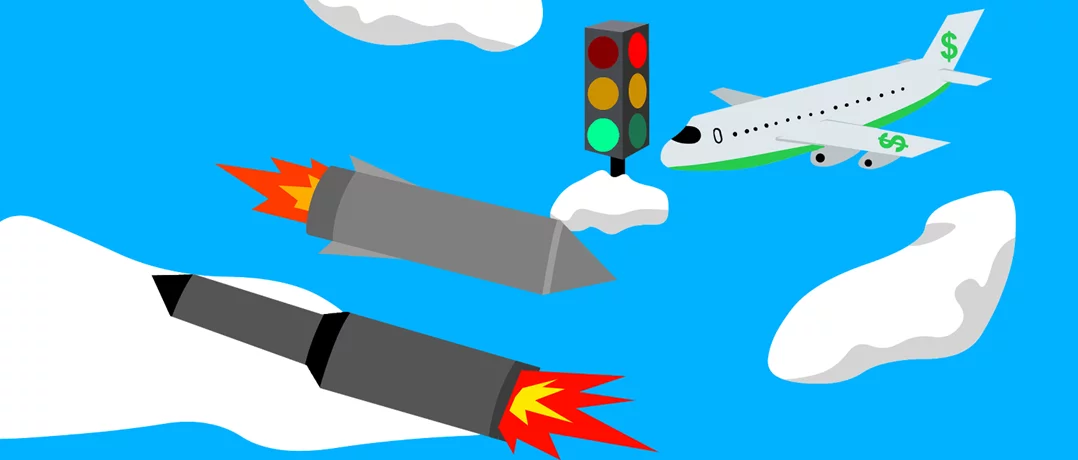
In a matter of hours, military escalation between Iran, Israel and the United States transformed the Middle East into an aviation red zone. Airspace closures, grounded hubs and thousands of cancelled flights have created a shock that extends far beyond stranded passengers. What appears at first to be a transport disruption is rapidly becoming an economic stress test for an already fragile global system.
More than 5,800 flights were cancelled worldwide over the weekend, with a significant share directly linked to instability in Middle Eastern airspace. On a regional level alone, at least 1,555 flights to and from the Middle East were cancelled in a single day. Around key Gulf hubs such as Dubai, Riyadh, Doha, Abu Dhabi, Kuwait and Bahrain, over 3,400 flights were grounded within 24 hours, triggering cascading operational failures. Aircraft rotations were disrupted, crews were displaced, and long-haul connections across continents were severed.
The Middle East is not merely another aviation market; it is a global crossroads linking Asia, Europe and Africa. When its corridors close, the ripple effects are immediate and global. Several countries, including Iran, Iraq, Kuwait, Bahrain and Qatar, fully shut their airspace, while others imposed heavy restrictions. Under normal conditions, airlines operating through Dubai, Doha and Abu Dhabi process roughly 90,000 transit passengers per day. Even a short disruption therefore affects close to 180,000 connecting travelers over a 48-hour period, not counting origin and destination traffic.
The financial implications escalate quickly. Commercial airlines generate, on average, between $80,000 and $120,000 in revenue per flight when combining passenger and cargo income. If approximately 3,000 regional flights per day are directly impacted, this translates into between $240 million and $360 million in disrupted airline revenue daily. Once compensation costs, hotel accommodation, aircraft repositioning, insurance surcharges and cargo delays are factored in, total economic exposure could plausibly exceed half a billion dollars per day at the peak of disruption.
Cargo, freight and the invisible crisis
The invisible damage may prove even more consequential. The Middle East serves as a critical air freight corridor for high-value goods, pharmaceuticals, industrial components and time-sensitive shipments linking Asia and Europe.
When flights are cancelled or rerouted, cargo capacity shrinks and freight rates climb. Even a short-term 10 to 20 percent spike in air cargo rates can generate millions in additional costs for global supply chains already strained by geopolitical tension and manufacturing fragility.
With aircraft deliveries delayed worldwide and fleet expansion constrained, rerouting capacity is limited, making rapid recovery structurally difficult.
Oil, inflation and the broader economic fallout
Beyond aviation and logistics, the macroeconomic consequences begin to surface. Tourism-dependent economies face cancellations, refund pressures and weakened service-sector revenues. Trade flows slow as longer routes increase fuel burn and insurance premiums. At the same time, geopolitical risk immediately feeds into commodity markets. Oil prices reportedly surged by as much as 13 percent at the height of the escalation, a move that directly raises jet fuel costs and reinforces inflationary pressures across transport and goods pricing. Even a sustained $5 to $10 per barrel increase in crude can add billions of dollars annually to global airline operating expenses.
Crucially, aviation networks do not return to equilibrium overnight. Aircraft and crews are scattered across alternative airports, airport slots are lost, and congestion builds along newly adopted routes. Notices to Airmen continue to evolve as security conditions shift. Even when partial reopening is announced, such as the limited resumption of operations at Israel’s Ben Gurion Airport, capacity returns gradually and cautiously.
The number of cancelled flights measures the visible disruption. The broader cost lies in delayed trade, higher logistics expenses, suppressed tourism revenue and renewed inflationary pressure. If instability in Middle Eastern airspace persists, the financial impact will extend far beyond the region, testing the resilience of global supply chains and an aviation industry that has only recently regained post-pandemic stability.
The question is no longer whether the disruption is significant. It is how long the global economy can absorb another systemic shock in one of its most critical transit corridors.
