The life of Blessed Brother Estephan Nehme reveals how humility, faith, and ordinary work became a lasting path to holiness.




The life of Blessed Brother Estephan Nehme reveals how humility, faith, and ordinary work became a lasting path to holiness.

In a world increasingly obsessed with visibility, achievement, and recognition, the life of Blessed Brother Estephan Nehme offers a radically different path.
He left behind no political speeches, founded no major institutions, and held no position of authority. He spent most of his life cultivating fields, building stone walls, carrying tools, and performing the humble tasks assigned to him by his monastery.
Yet decades after his death, thousands continue to visit his tomb, pray through his intercession, and draw inspiration from a simple phrase that defined his life:
"God sees me."
For many Lebanese, Blessed Estephan Nehme remains one of the clearest examples of holiness hidden in ordinary life.
Born Youssef Nehme on March 8, 1889, in the village of Lehfed, he was the youngest of seven children in a modest Maronite farming family. Life in Mount Lebanon was difficult, shaped by agriculture, economic hardship, and a strong religious tradition. From an early age, Youssef displayed an unusual love for prayer and solitude, often withdrawing to the hillsides and fields around his village.
The death of his father when he was fourteen brought new responsibilities, but it did not diminish his desire for a religious vocation. At sixteen, he entered the Lebanese Maronite Order at the Monastery of Saints Cyprian and Justina in Kfifan and took the name Estephan.
Unlike many well-known religious figures, he never became a priest. Instead, he embraced the vocation of a lay brother, dedicating himself to manual labor and community service. Over the following decades, he worked as a farmer, carpenter, builder, and gardener in monasteries across Lebanon. No task was too small, and no responsibility beneath him.
What distinguished Estephan was not the work itself, but the spirit with which he carried it out. Those who knew him described a man of remarkable serenity who rarely complained and approached every task as an act of prayer.
Whether cultivating vineyards, repairing buildings, or working under the summer sun, he sought to remain constantly aware of God's presence. This spirituality earned him a reputation for kindness, humility, and joy, eventually leading many to call him the "Smiling Saint."
His monastic life unfolded during some of the most difficult years in Lebanon's history. During the First World War and the famine that devastated Mount Lebanon, he quietly assisted those in need and helped support struggling families.
One of the final significant missions entrusted to him involved resolving a long-standing dispute over monastery lands. His good judgment and perseverance helped bring the conflict to an end, but the demanding effort left him physically exhausted. His health deteriorated soon afterward, and on August 30, 1938, he died at the Monastery of Kfifan at the age of forty-nine.
His death, however, marked the beginning of a growing devotion.
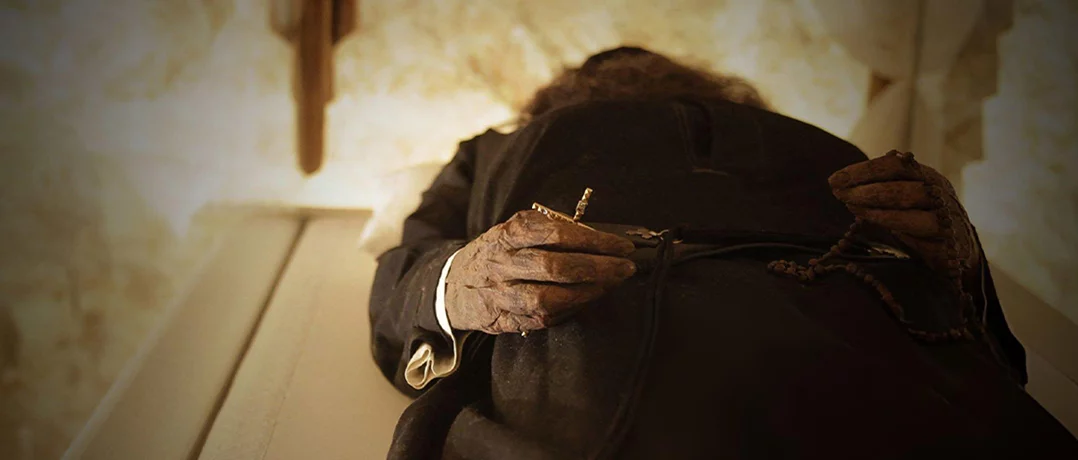
In 1951, when monks reopened his tomb while preparing another burial, they discovered that his body had remained remarkably preserved. Reports that his remains showed little sign of decay spread quickly, drawing pilgrims and strengthening devotion to the humble monk from Lehfed.
Stories of favors and healings attributed to his intercession soon followed. The most significant involved his niece, Sister Marina Nehme, a nun at Saint Joseph Monastery in Jrabta, who was diagnosed with osteosarcoma, a form of bone cancer. After praying through her uncle's intercession and drinking water from a spring known as the Fountain of Ghreir, which Brother Estephan had discovered years earlier, she reported an immediate improvement. Subsequent medical examinations found no trace of the disease. The Catholic Church later recognized her healing as the miracle required for his beatification.
Other healings attributed to Blessed Estephan have also been reported over the years. Among them were Sister Clara Abi Habib, who claimed to have recovered from a severe kidney infection after praying at his tomb, six-year-old Nassab Salim Tarraf, whose family attributed her recovery from a painful eye condition to his intercession, and Elias Abi Jawdeh, who reported being healed from a serious hand infection after applying oil blessed at Brother Estephan's tomb.
While the Church officially recognized only the healing of Sister Marina in the beatification process, these testimonies contributed to the growing reputation for holiness that continues to draw pilgrims to Kfifan today.
On June 27, 2010, before tens of thousands of faithful gathered in Kfifan, Estephan Nehme was officially declared Blessed.
More than a century after he first entered monastic life, his story continues to resonate far beyond monastery walls. In a society that often measures success through influence, wealth, or public recognition, Blessed Estephan offers a different vision.
His legacy suggests that holiness is not found only in extraordinary achievements, but also in the quiet faithfulness with which ordinary duties are carried out.
His message remains as simple today as it was during his lifetime: "God sees me."
A simple belief that turned labor into service, and ordinary life into a path to holiness.