

Revived Lebanese tiles blend tradition and craftsmanship, telling stories of culture, history, and timeless decorative artistry.
The mosaic that carried our stories

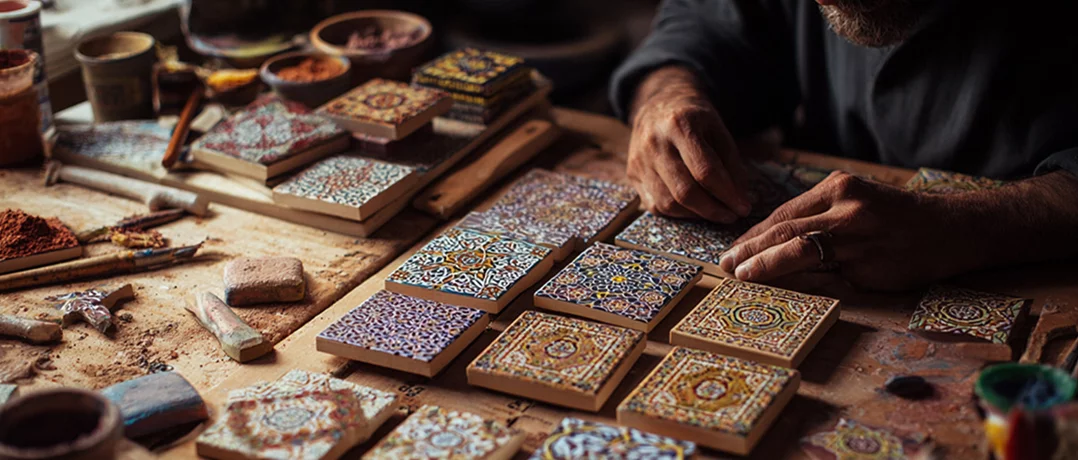
Long before Beirut grew into a city of glass towers and concrete blocks, it was a city of color. Walk into any home built in the late 1800s or early 1900s, and you will find floors that look like stories: geometric borders, floral motifs, stars, vines, and patterns named after towns and families. These are the Lebanese mosaic tiles, locally known as “blat libnéné”, a craft that shaped the country’s architectural identity and is now being revived after almost vanishing.
A craft rooted in the levant
Lebanon’s mosaic cement tiles emerged in the late 19th century, influenced by the Ottoman Empire’s decorative traditions and by Mediterranean Arts & Crafts movements. What made Lebanese tiles distinct was not just their patterns, but their symbolism: squares inspired by village gardens, colors borrowed from coastal sunsets, stars taken from church ceilings, and motifs echoing Beirut’s old facades.
Homes in Achrafieh, Tripoli, Zahle, and Saida used these tiles to tell stories of lineage and taste. Families often requested custom patterns that became part of their household identity, passed down like heirlooms. By the early 20th century, Beirut was filled with these floors. You could walk through entire neighborhoods connected by a patchwork of motifs, each tile poured by hand, each design crafted through metal stencils and natural pigments.
The fall and near disappearance of a Lebanese icon
Everything changed in the 1950s. As industrialization spread, factory-produced ceramic flooring became cheaper and quicker to install. Then came the civil war, which ravaged old buildings, wiping out entire streets that had been tiled by artisans whose methods were already fading. By the 1990s, only a handful of moulds still existed in families’ attics and abandoned workshops. The craft was on the brink of extinction, a silent casualty of modernization and war.
A revival led by artisans who refused to let the past die
The revival of handmade Lebanese tiles was not driven by profit, but by guardians of heritage who saw the craft as part of the country’s soul. These artisans revived old moulds, restored discarded patterns, and returned to the slow, meticulous process that defined Lebanese tile-making:
Metal moulds shaped into geometric or floral designs
Pigments mixed by hand
A delicate pour where colours meet and bleed naturally
A manual hydraulic press
Polishing, drying, sanding
And the final result: a tile that is never identical to another
Lebanese mosaic tiles are crafted. Each piece contains imperfections that make it alive, human, and unrepeatable.
The technique that travelled the world
Lebanon’s mosaic tile tradition did not remain confined to Lebanese homes. As the craft re-emerged in the 2000s, designers and architects abroad began to seek out Lebanese tiles specifically for their warmth, their history, and their artisanal look. Today, Lebanese handcrafted tiles are used in:
• France: especially in cafés, boutique hotels, and renovated Haussmann apartments looking for Mediterranean character.
• Italy: where interior designers incorporate Lebanese patterns into kitchens and courtyards for a Levantine touch.
• The United States: particularly in New York, California, and Florida, where Lebanese-style tiles appear in art galleries, restored homes, and restaurant interiors.
• The Gulf: Qatar, UAE, and Kuwait frequently request Lebanese handmade tiles for villas and luxury retail spaces.
Lebanese techniques stand out internationally for one reason: the tiles are not printed, stamped, or glazed, they are poured and pigmented, giving them depth that ceramic tiles cannot replicate.
Tiles as a Lebanese Metaphor
There is something poetic about Lebanese mosaic tiles. They are created piece by piece, by hand, from fragments of colour and pressure and patience, much like Lebanon itself. They survive cracks, wars, neglect, and time, yet somehow, they return. The craft persists because the story persists. And as long as there are artisans who refuse to let machines replace human hands, Lebanese mosaic tiles will continue to travel the world, carrying with them a piece of this country: its memory, its resilience, its artistry, one fragment at a time.
-
-

-
The Beiruter
-
