



From the teachings of Saint Maron to the creation of modern Lebanon, this article examines how the Maronite Church shaped a community’s institutions, identity and political vision.
The mountain that became a church

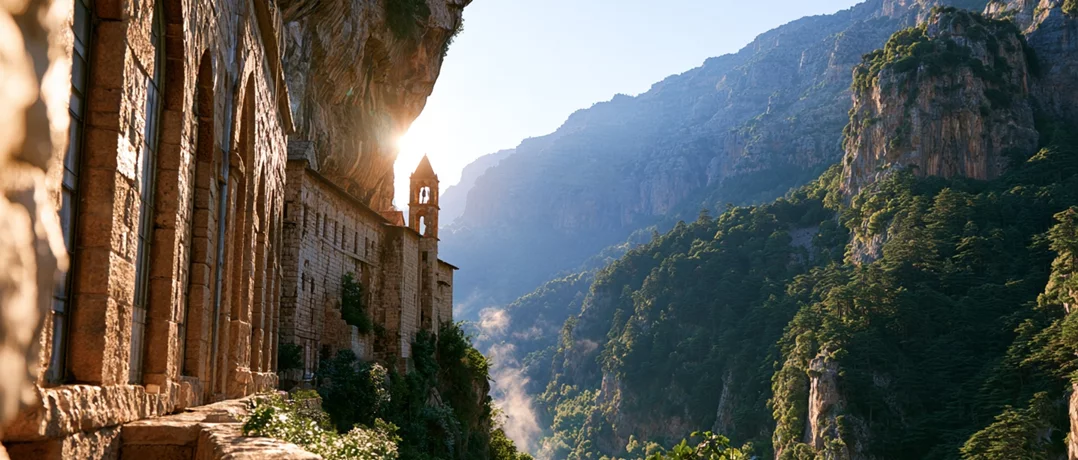
Nothing at the beginning suggested a nation. In the last decades of the fourth century, a hermit named Maron lived in the open air on a hillside in the district of Cyrrhus, north-east of Antioch. He had no see, no wealth and no army, and when he died around 410, he left behind nothing but disciples. Sixteen centuries later, a church bearing his name stands at the centre of a republic it helped bring into being. The distance between those two facts is the whole story: how a mountain became a church, and how a church became the institutional form of a people.
The first defining choice of Maron's followers was doctrinal, not ethnic. Gathered in a monastery raised in his memory on the banks of the Orontes, in what is now northern Syria, they defended the christological formula adopted at the Council of Chalcedon in 451: one Christ, in two natures. In a Syria where much of the countryside rejected the council, that was an allegiance rather than an abstraction, and it carried a price. In 517, more than 350 Maronite monks were killed and several of their monasteries sacked and burned by Christian opponents of Chalcedon. The survivors did what the community would do again and again: they wrote to Rome, appealing to Pope Hormisdas. The instinct to look westward for recognition was present long before the Franks (later the Crusades), the colleges or the diplomacy.
The second choice was institutional. By the late seventh century, the Arab conquest had dissolved Byzantine authority across Syria, and the patriarchal see of Antioch had become a prize contested from afar. Maron's followers did not wait for an empire that was not coming back; they gave themselves a head of their own. Patriarch John Maron, remembered as the first Maronite patriarch, built a monastery at Kfar Hay in the mountains of Batroun, and from then on, the patriarch was both the spiritual father and the political authority of the community.
The principle would endure: when the imperial centre withdraws, a people that wishes to survive must constitute its own authority rather than borrow one.
The third choice was geographical.
In the eighth century, renewed conflict among Christians and the consolidation of Islamic rule pushed many of Maron's followers out of the Orontes valley and into the Qadisha, the deepest and most remote of the gorges of northern Lebanon. Its inaccessibility became the community's first line of sovereignty, a frontier that no distant ruler could easily cross and no local governor could easily administer. The Maronites cut terraces into slopes that had never been farmed. Their monasteries grew into landholders, and a partnership known as shriiq allowed impoverished refugees to work church land for a share of the harvest, with housing and schooling provided. A church that distributes land, organises labour, houses families and educates children is no longer only a church. It is the skeleton of a state without the name.
This is why the Maronites spoke of themselves, for centuries, as a nation. A “Maronite” functioned historically as a territorial and civilisational designation rather than a confessional label, and that the adoption of Arabic was a linguistic adjustment, not an ethnic transformation. One need not accept every conclusion The conclusion on Mount Lebanon, confession did the work that nationality did elsewhere, and the patriarch, not a prince, was the custodian of collective memory.
Isolation from the Latin West ended in 1099, when the armies of the First Crusade reached the Lebanese coast. The Maronites received them as co-religionists and supplied guides for the march on Jerusalem. In the late twelfth century the community as a whole formally reaffirmed its attachment to the Holy See, and in 1215 Patriarch Jeremias al-Amshiti travelled to Rome for the Fourth Lateran Council, the first Maronite patriarch to do so. He returned in 1216 bearing the pallium, the sign of communion with the See of Peter. From then on, every Maronite patriarch has carried the name Boutros, Peter.
Here lies what sets the Maronites apart among the Eastern churches. The other Eastern churches in communion with Rome were born of partial unions: a party within an Orthodox church entered communion with the pope while the larger body stayed apart. The Melkites separated from the Antiochian Orthodox, the Syriac Catholics from the Syriac Orthodox, the Chaldeans from the Church of the East. Each has a twin. The Maronites have none.
There is no "Maronite Orthodox Church", because there was never a moment when one part of the community went to Rome and another stayed behind. The bond was confirmed by a whole people, not created by a secession.
That bond was an alliance of faith, not a patronage of arms. When the Ottomans took the Levant in 1516, Rome did not abandon its Eastern partner. In 1584, Pope Gregory XIII founded the Maronite College in Rome to form the community's clergy, and its graduates returned as scholars and reformers. In the early seventeenth century, Maronite monks set up a printing press at the monastery of Qozhaya, above the Qadisha, one of the earliest in the region.
The relationship also carried a cost but the Maronites accepted the price because Rome offered what no Ottoman governor or neighbouring empire could: an anchor outside the region that no local power could revoke.
That anchor proved decisive in the twentieth century. In 1919, Patriarch Elias Howayek, backed by the Administrative Council of the Mutasarrifate and by diaspora lobbying, carried the case for an independent Lebanon within its natural borders to the Peace Conference in Paris. The church that had governed a mountain now asked for a state, and, crucially, for a state larger than itself, shared with communities that were not Maronite. It was a Greek Orthodox statesman, Charles Malik, who later named the Maronites the guardians of Lebanese freedom. Patriarch Nasrallah Boutros Sfeir gave that conviction its sharpest form in 1993: asked to choose between coexistence and freedom, he answered that the choice had been made the day the Maronites settled in these mountains, because "like fish in the sea, they cannot live without freedom."
In 1997, Pope John Paul II's apostolic exhortation A New Hope for Lebanon described the country as a message of freedom and pluralism to East and West. In 2006, the Maronite Patriarchal Synod, addressing a church now spread across five continents, committed it to a transnational vocation while holding fast to its Antiochian tradition and its communion with Rome.
In the village of Kfar Hay, whose Aramaic name means "village of life", a school stands on the ground where John Maron raised his monastery at the end of the seventh century. In the 1990s, its pupils were still the children of families farming church land, and their grandparents still remembered the silkworm seasons, when weddings were held once the cocoons were sold. A hermit without a roof, monks killed for a creed, a patriarch elected when the empire withdrew, terraces cut into a gorge, a pallium carried home from Rome, a patriarch at the peace table in 1919: and beneath it all, the same mountain, still holding the same school above the valley.
-
-
-
Dr. Elie EliasUniversity Lecturer & Political Historian
-
