

Everyone recognizes the cedar on Lebanon's flag, but few know the story behind it. From ancient civilizations to the legend of the "Old Lady Cedar," discover the history, science and folklore surrounding Lebanon's most enduring national symbol.
The mystery behind Lebanon's most famous tree

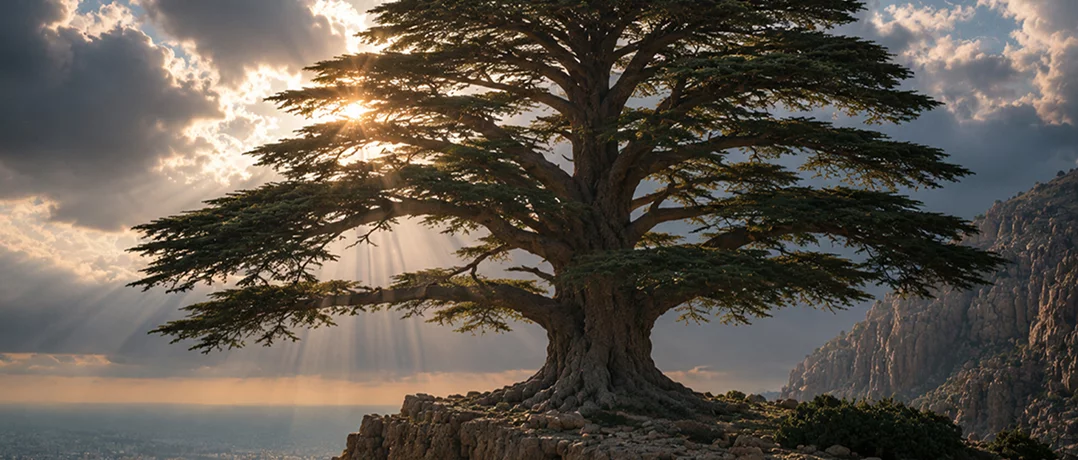
Every Lebanese can instantly recognize the green cedar standing proudly at the center of the national flag. It appears on passports, official documents, military insignia and the national currency, making it one of the country's most enduring symbols. Yet despite its constant presence in everyday life, few people know the story behind the tree that came to represent an entire nation or whether the cedar of the Lebanese flag was ever inspired by a real tree at all.
Long before the creation of modern Lebanon, the Cedar of Lebanon (Cedrus libani) was renowned across the ancient world. Its strong, fragrant and durable wood was prized by civilizations including the Phoenicians, who built their ships from it, as well as the Egyptians and other civilizations who used it to construct temples, palaces and royal tombs. Over time, the cedar became more than a valuable natural resource it evolved into a lasting symbol of strength, resilience and endurance.
The tree behind the symbol
Today, the cedar continues to thrive in several protected reserves across Lebanon, including Bsharri, Tannourine and Shouf. While each forest preserves a part of the country's natural heritage, one tree in particular has captured the imagination of generations. To uncover the story behind the cedar at the center of the Lebanese flag,
The Beiruter spoke with Samer Zebian, Administrative Unit Officer at the Shouf Biosphere Reserve. According to Zebian, one cedar in the Barouk forest , Al Shouf reserve known as "Al-Arza Al-Khatyara" ("The Old Lady Cedar") has long been associated with the national emblem. But is this belief rooted in history, or has it simply become part of Lebanon's folklore? The answer, he says, is far less certain than many would expect.
The legend of the "old lady cedar"
Among Lebanon's many cedar forests, one tree in particular has captured the imagination of generations. Standing in the Barouk forest within the Shouf Biosphere Reserve is "Al-Arza Al-Khatyara", or the "Old Lady Cedar," a majestic tree that many Lebanese have come to associate with the cedar at the center of the national flag. According to Samer Zebian, Administrative Unit Officer at the Shouf Biosphere Reserve, the tree earned its nickname because it is one of the first large cedars visitors encounter upon entering the reserve. Although even larger cedars exist elsewhere in the forest, this one gradually became the most recognizable.
Despite its popularity, Zebian stresses that there is no documented evidence proving that the "Old Lady Cedar" is the tree depicted on the Lebanese flag. "There is nothing officially documented or written that says this is the cedar of the Lebanese flag," he said. Instead, the story has been passed down through generations, with people associating the tree with the national emblem because its silhouette closely resembles the cedar illustrated on the flag.
"The cedar on the flag is a drawing, not a photograph," Zebian explained. "It may have been inspired by the characteristic shape of the Lebanese cedar, but not necessarily by one particular tree." While the true origin of the flag's cedar remains unknown, the "Old Lady Cedar" has become a landmark in its own right, embodying a story that continues to fascinate visitors and reminding Lebanese that some of their most cherished national symbols are rooted as much in tradition as in documented history.
Why every cedar looks different
Part of the mystery lies in the nature of the Lebanese cedar itself. Although every Lebanese cedar belongs to the same species, Cedrus libani, no two trees develop in exactly the same way."The shape of the tree changes depending on its environment," Zebian explained.
A cedar growing alone has enough space to spread its branches widely, creating the broad silhouette many associate with the Lebanese flag. By contrast, trees growing within dense forests compete for sunlight and tend to grow taller and narrower.
Age also plays an important role. Young cedars naturally grow upward, but as the years pass, strong winds and harsh mountain storms can damage the tree's crown the uppermost part of the cedar. Once the crown dies, the tree gradually stops growing vertically and instead expands outward, giving centuries-old cedars their distinctive umbrella-like appearance.
Reading the life of a cedar
Beyond its symbolism, every cedar tells a story through its trunk. Scientists estimate a cedar's age by extracting a small core sample using an increment borer and counting its annual growth rings. In most cases, each ring represents one year of the tree's life, offering a glimpse into its history.
"The rings can also tell us about the conditions the tree experienced," Zebian explained. "In dry years, the rings are closer together because the tree grows more slowly. During years with abundant rainfall, they are wider apart, showing stronger growth."
Without such analysis, a cedar's age can only be estimated based on its size. Some of Lebanon's oldest cedars are believed to be several centuries old, while others may have stood on the country's mountains for well over a thousand years.
More than a symbol
Whether or not the "Old Lady Cedar" truly inspired the emblem on Lebanon's flag may never be known with certainty. Yet perhaps that is precisely what gives the story its lasting appeal.
The cedar at the heart of the Lebanese flag does not belong to a single forest or a single tree. Instead, it represents an entire landscape, a shared history and a symbol that has endured for thousands of years. While the mystery of its exact inspiration remains unsolved, its place in Lebanon's identity has never been in doubt.
-
-

-
Yara SalibaJunior Writer/Translator
-
