Once an Ottoman-era government building and prison, the National Library of Baakline has become one of Lebanon’s leading cultural institutions, expanding access to knowledge, education, and the arts beyond Beirut.


Once an Ottoman-era government building and prison, the National Library of Baakline has become one of Lebanon’s leading cultural institutions, expanding access to knowledge, education, and the arts beyond Beirut.

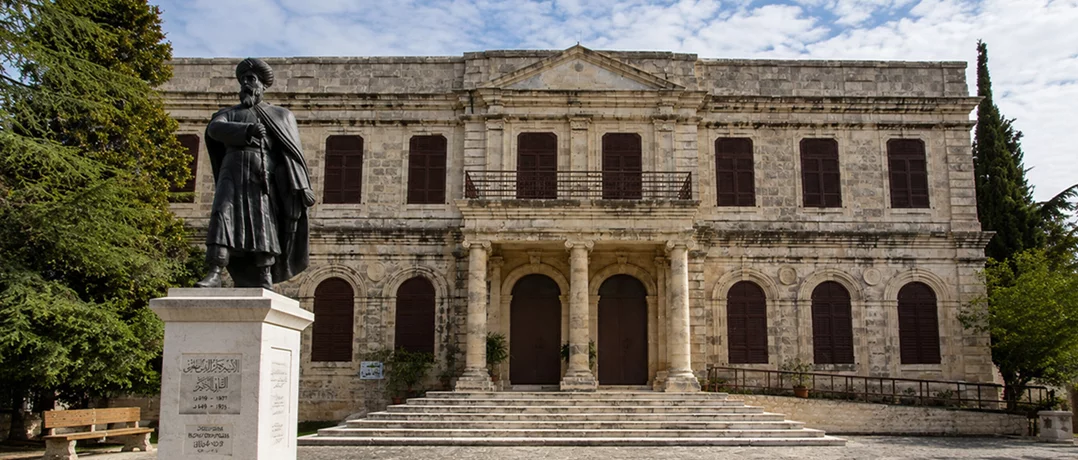
In the heart of Baakline, a historic Ottoman-era building has been transformed from a center of authority and imprisonment into one of Lebanon’s most active public cultural institutions. The National Library of Baakline occupies the former Baakline Serail, a building constructed during the reign of Ottoman Sultan Abdul Hamid II and inaugurated in 1897. Over the decades, the building served several functions, reflecting the political changes that passed through Lebanon. Under Ottoman rule, it was used as an administrative center housing government, military and intelligence offices.
Following the First World War, the French authorities continued to use as an administrative and security center. It was later partially converted into a prison, while other sections housed public institutions, including municipal offices, a school and judicial services. During the Lebanese Civil War, the building was abandoned and temporarily used as a center for collecting and distributing supplies such as rice and diesel to surrounding villages.
According to Ghazi Saab, director of the National Library of Baakline, the government attempted to reopen the building as a prison in the mid-1980s. The plan was rejected after opposition from residents of Baakline and surrounding communities . Instead, the building was restored and transformed into a public library. "The building was in a terrible condition," Saab said, explaining that it required extensive renovation inside and outside before the library could begin operating. The National Library of Baakline officially opened on March 13, 1987. Around ten years later, a Council of Ministers decision placed it under the authority of Lebanon's Ministry of Culture.
Although it is called a library, the institution functions as a wider cultural center. Its work includes cataloguing and documenting books, organizing workshops, holding artistic and musical training sessions, welcoming researchers and hosting theatrical performances. The library complex includes three buildings and a theatre with a capacity of around 350 people. According to Saab, the theatre regularly hosts plays, rehearsals, ceremonies and cultural events. The library also contains a dedicated section for children and young adults with approximately 45,000 books. The section welcomes schools, organizes educational activities and provides free external borrowing services. Rather than serving only as a place to read quietly, the library has evolved into a community space where students, artists, researchers and families gather throughout the year.
Perhaps the library's greatest contribution is not only its collection, but also its location. For decades, Lebanon's cultural and educational institutions have been concentrated in Beirut. Major archives, museums, universities and libraries remain largely centered in the capital, often making access difficult for people living elsewhere. The National Library of Baakline presents an alternative model.
By establishing a national cultural institution in the Chouf, it brings research resources, books and public programming closer to communities outside Beirut. Its external borrowing program is free for all Lebanese citizens regardless of where they live. Graduate students conducting advanced research can also receive permission to borrow larger numbers of books, reducing the need for repeated travel. "We do not want people to suffer," Saab explained, noting that doctoral and master's students may borrow up to fifteen books at a time with the library director's approval. The library's philosophy extends beyond lending books.
Saab emphasized that visitors are welcomed equally regardless of their region, political background or community. "This is in the service of all Lebanese," he said. By hosting school visits, theatre productions, cultural events and educational workshops throughout the year, the library demonstrates that cultural life does not have to revolve around Beirut. Instead, it has become a model of how public institutions can decentralize access to knowledge while strengthening local communities.
Despite its success, the library continues to face serious financial challenges. According to Saab, funding remains the institution's greatest obstacle. He said the library has not received financial support from the Ministry of Culture for the past five years. Instead, the library relies on income generated through theatre performances and events to cover operational costs. Revenue is often used to purchase diesel for generators, an essential expense given Lebanon's ongoing electricity shortages. Maintenance, staffing and daily operations all depend on careful management of limited resources, illustrating the wider financial pressures facing many public cultural institutions across Lebanon.
The library's influence extends beyond its physical walls. Its online catalogue allows researchers to search its collections remotely, making resources more accessible both within Lebanon and abroad. While not every publication has been digitized, the website enables visitors to locate materials before making the journey to Baakline. Saab said the website receives visitors from across Europe, the Arab world and many other countries. According to figures provided by the library, the website recorded approximately 3.6 million visits in December 2025, with even quieter months attracting more than two million visits. Whether in person or online, the library continues expanding access to knowledge well beyond its immediate surroundings.
The building's transformation is perhaps its strongest symbol. Once associated with surveillance, imprisonment and political authority, it has become a place dedicated to education, culture and public access. Today, the National Library of Baakline welcomes children discovering books for the first time, researchers pursuing advanced studies, artists rehearsing performances and families attending cultural events. Its story is not simply about preserving books. It is about reclaiming a historic building and redefining its purpose. In a country where many public institutions struggle with limited resources and centralized services, the National Library of Baakline demonstrates that knowledge does not have to remain confined to the capital. Instead, it shows how culture can thrive when access is brought closer to the communities it is meant to serve.
