

The other Saif: The reformist who stayed

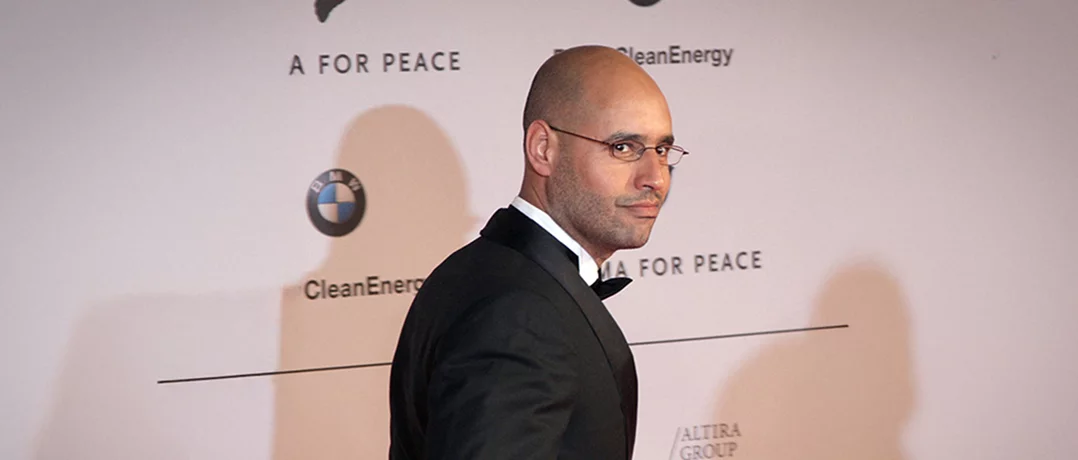
On 3 February, four masked gunmen entered Saif al-Islam Gaddafi’s compound in Zintan, a mountain town in western Libya, disabled the security cameras, and shot him nineteen times. He was fifty-three. He had lived there since his capture in 2011 first as a prisoner, then, after his release in 2017, in a kind of internal exile. No one has claimed responsibility. In the coverage that followed, the world was reminded of the man it had decided he was nearly 15 years ago: the dictator’s son who chose blood over reform. That is not the man I knew.
I met Saif on the first day of registration at the London School of Economics. We were standing in the same slow queue, two strangers bound for the same classroom. He was behind me. I introduced myself, asked where he was from.
“Libya,” he said.
I told him I wished I could visit, but my Arabic wasn’t good enough. “And I don’t think I’d get a visa,” I added.
With quiet certainty, he replied, “No problem. I’ll get you a visa.”
I laughed. “Who are you? Do you keep visas in your basement?”
In that moment, a friendship was born between two Bedouins starting a new journey he from Sirte, of the al-Gaddafi tribe, and I from a small Saudi town called AlBaha, of a southern tribe. For most of that year, I didn’t fully grasp who he was. He had no bodyguards with him in the classroom, he would appear quietly, and vanish the same way. To me, he was simply the only other Arab in my programme a quiet classmate I’d see in the library, at our adviser’s office, or in another seminar we shared, on Legitimacy, taught by Professor Rodney Barker. He was, I thought, reserved, yet always gracious and kind.
I remember trading thoughts in campus cafés about Singapore’s Lee Kuan Yew I had spent some of my youth in neighboring Malaysia and the applicability of the Singapore and Malaysia models to Libya, along with ideas about just war. He spoke with pride about Libya’s potential. On the day UN sanctions were lifted, he said, “We have made history today.” I thought the “we” was simply an expression of patriotism. I showed him how to navigate JSTOR. We took our exams side by side.
In retrospect, I think he opened up to me because I was one of the few people who treated him as just another student. By the time I figured out who he was, we had an unpracticed routine. One of the things Saif remembered about me was that my father was Saudi, that he had died when I was young, and that I felt walled off from my Arab roots and wanted a way back in.
Before the end of the programme, he made me an unusual offer.
You want to spend time in an Arab country. Come spend a year as a consultant to our National Economic Strategy the map for what Libya will become, inshallah.
I had just gotten a job at a New York investment bank. When Saif called, I took a leap of faith. I managed a deferment and found myself, a few days after graduation, on a BA flight to Tripoli.
Walking into the arrivals terminal whose painted lime green and covered in images of Muammar Gaddafi, my heart sank. Had I made a horrible mistake? Then I saw a smiling classmate, seemingly immune to his father’s ubiquitous image. I was driven through the baking sun into the capital, past Green Square a monument to his father’s 1969 revolution, and now the location of an upscale outdoor café. I watched from the car as men walked into a mosque at the call to prayer. My apprehension dissolved quickly.
 Green square, Tripolitania, Tripoli, Libya. Source: AFP
Libya then was a place of daily, visible change. One day, the roundabouts in the city centre were lifeless and grey; the next, they were decorated with grass and flowers. One day, no ATMs anywhere; the next, there were. One day, no Western brands; the next, Marks & Spencer. There was a powerful sense that better things were coming, a feeling so strong it drew the diaspora home in droves.
Saif himself transformed with the surroundings, shedding a nervous student persona for that of an incrementally more polished, eloquent figure. What I witnessed were not performative acts, but accomplishments: he recruited global figures like Michael Porter and Francis Fukuyama to inform his national strategy. He spoke genuinely and passionately about the need for improved human rights, and put himself forward as a mediator in hostage crises including a successful effort to release Western hostages held by Abu Sayyaf militants in the Philippines. He played a key role in the release of the Bulgarian nurses imprisoned and sentenced to death by his father’s regime.
Working for Saif was far more interesting than working for other parts of the government for this was the bubble in which it was permissible to think big, as opposed to being part of a slow-moving Middle East bureaucracy.
When I left Libya in 2006, I felt changed. While Libya was not Saudi Arabia, I felt closer to my roots, and felt as though I had given something back an added bit of optimism that this country, so long hidden under sanctions and fear, was breathing again.
Of course, that wasn’t to be.
Less than five years later, the Arab Spring revolutions broke out, and Saif became caught between his position, his family, the anger of the street, and Western eagerness to make an example of Libya. In short order, he was cast as the reformist son who, when forced to choose between the people and his father, chose violence and tyranny.
That story deformed the person I knew. One crucial television appearance, which would be known as the “rivers of blood” speech, was interpreted as a betrayal by those who had believed in him. Many experienced his words as a direct threat, and people died in the crackdown that followed. I think it was the act of someone who saw the future as it would be, and was trying to manage both his position and a rebellion that threatened to undo everything he hoped the country would become. I don’t know what happened exactly in those first chaotic days. What I do know is that the West cut off communication with the one person it had trained to be its interlocutor at the critical moment. And what Saif warned would come to pass if Libyans didn’t solve their own problems has come to pass. In a tragic historic irony, the reason he was killed now seems to be that, had there been an election, he would probably have won.
He was strafed by NATO jets in the desert after his father was killed in Sirte. He was captured by men who cut off three of his fingers and then protected him from a death sentence in the capital. He spent years in captivity, caught between warring parties and outside powers who sought to exploit the chaos for their own ends. He experienced betrayal from almost everyone in his life and yet argued for a better, freer country to the end.
As he once said, “I will live and die in Libya.” On 3 February, he did.
Before he was a symbol, Saif was my friend someone who, after my father’s death, helped me reconnect with a sense of Arab identity and purpose. I was blessed to see Libya in a better time. I walked the ruins of the Roman ruins Leptis Magna and Sabratha, the pristine Mediterranean coastline, and was welcomed into a vibrant community. One of my Libyan friends said of me, “Munirah worked with us, she lived with us, and she became one of us.” I learned there the profound meaning of Arab hospitality and honour that I will never forget.
That journey, which began with a conversation in a queue, changed my life. I will remember Saif not for who he was in the news, but for the friend he was and for the genuine, hopeful chapter we lived through, before it was taken from Libya, and now, finally, from him.
