



As artificial intelligence moves deeper into diagnosis and clinical decision-making, medicine is confronting how to expand access to expertise without surrendering human judgment or weakening the training that produces future specialists.
The paradox of medical AI in the exam room
The paradox of medical AI in the exam room
By The Beiruter | September 01, 2026

Reading time: 5 mins
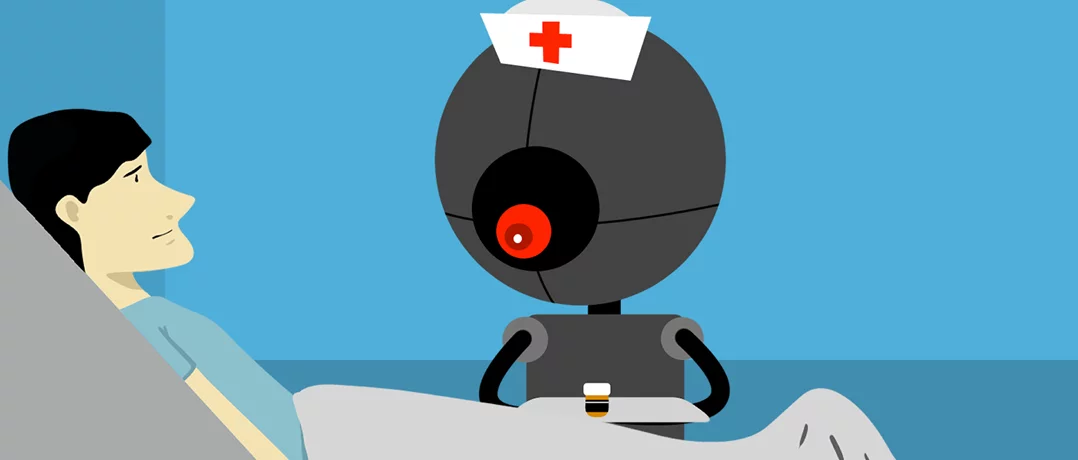
Illustration by Karim Dagher
Artificial intelligence systems can now identify patterns in medical images, calculate disease probabilities and help clinicians assess risks, adding a new source of information to decisions that can determine a patient’s diagnosis and treatment. Adoption is accelerating. By the end of 2025, the U.S. Food and Drug Administration had authorized 1,357 AI-enabled medical devices from 693 companies across 17 clinical specialties, according to Stanford University’s 2026 AI Index Report, with medical imaging among the technology’s most established applications. AI offers medicine something more consequential than efficiency: a way to make specialist knowledge less dependent on the specialist being physically present. Yet as algorithms assume a greater role in interpreting clinical information, they are also testing where technological assistance should end and human judgment must remain decisive. “AI should provide the best available information, but decision-making should remain entirely, with the physician,” said Prof. Waël Hanna, a Lebanese-Canadian thoracic surgeon at McMaster University and co-founder of medical technology company Node AI. Medical expertise remains unevenly distributed, not only between countries but between hospitals within the same health system. A patient at a major academic center may have access to physicians with extensive specialist training and clinical experience, while another with the same disease may depend on far less specialized expertise. “The discrepancy is that the level and quality of care in cancer is very much related to the center you’re at and the experience of the person seeing you,” Hanna said. Hanna calls the difference between the care a patient currently receives and the highest level of care available the “augmentation potential.” In Node AI’s work on lung cancer, for example, an algorithm analyzes ultrasound images to estimate the probability that a lymph node contains cancer. Specialists presented with the same image can reach different assessments. A validated algorithm applies the same learned criteria each time. The value of that consistency rises as specialist capacity falls. The World Health Organization projects a global shortage of 11 million health workers by 2030, primarily in low- and lower-middle-income countries. AI cannot fill those vacancies, but it can give physicians far from major medical centers access to diagnostic capabilities developed from far larger bodies of medical evidence and experience. Medicine has repeatedly transferred parts of diagnosis from unaided human observation to technology. X-rays, CT scans and echocardiography progressively expanded what physicians could know beyond unaided observation. AI goes further by interpreting information itself, producing predictions or recommendations whose value depends partly on a physician knowing how much to trust them. A 2025 WHO survey covering 50 countries in its European region found that 64% were already using AI-assisted diagnostics, particularly in imaging and detection. Yet only 8% had a dedicated national AI strategy for health, while 86% identified legal uncertainty as a major barrier to adoption. Adoption is moving faster than the rules governing it, leaving physicians to use AI while questions of validation, accountability and oversight remain unresolved. “Good physicians will use AI that way, as better information that leads to a better decision,” Hanna said. The performance of medical AI depends as much on the clinical data used to train it as on the sophistication of the algorithm itself. “AI models themselves are widely available,” Hanna said. Quality alone, however, is not enough, as the data must also represent the patients on whom the system will eventually be used. Much medical AI research originates at large academic centers, whose patients may differ by ethnicity, age, income or disease prevalence from populations elsewhere, potentially limiting how well a model performs in other clinical settings. The OECD’s March 2026 report “Scaling Artificial Intelligence in Health” identified fragmented data foundations, regulatory uncertainty and gaps in governance and workforce capacity among the main obstacles to scaling medical AI responsibly. WHO has similarly warned that fragmented and biased datasets, unclear accountability and deficits in AI literacy remain barriers to safe deployment. AI presents medicine with a paradox. It can narrow the gap between novice and expert physicians while potentially eroding the path that turns one into the other. Clinical judgment develops through repeated interpretation, error and correction. If algorithms assume more of that work, younger physicians may gain immediate capability while losing some of the experience through which expertise is built. A July 2026 Brookings Institution analysis calls this “borrowed expertise.” Senior professionals can use AI effectively partly because they developed their judgment before the technology could perform much of the cognitive work for them. Younger workers may instead gain immediate performance without the same process of developing expertise. “Training experts is a huge problem that hasn’t been given enough thought or that people have tried to solve,” Hanna said. AI may make sophisticated medical analysis available without putting the most experienced specialist in every room. But medicine cannot afford to consume expertise faster than it creates it. It will still need physicians capable of recognizing when an algorithm is wrong and producing the knowledge on which its successors depend.We’ve had many technological revolutions in medicine. AI is one of them.
Narrowing the expertise gap
AI can bridge that gap by taking away differences of opinion that are based on expertise and standardizing it.
The doctor still decides
AI is not infallible. It gives you a probability, and the onus is on the human to process that information and make decisions accordingly.
What the machine learns
It’s the data that makes the difference in whether a model is good or not. In medicine, it is quite important to train models with the best possible ground truth.
Who trains the next expert?
How do we ensure that we can continue to train expert-level people in the age of AI?
-
-

-
The Beiruter
-
