



The paso doble traces its journey from a Spanish military march to a theatrical ballroom dance, carrying influences from bullfighting, Andalusian culture and the shared musical heritage of the Arab world.
The Paso Doble, dance of the matador

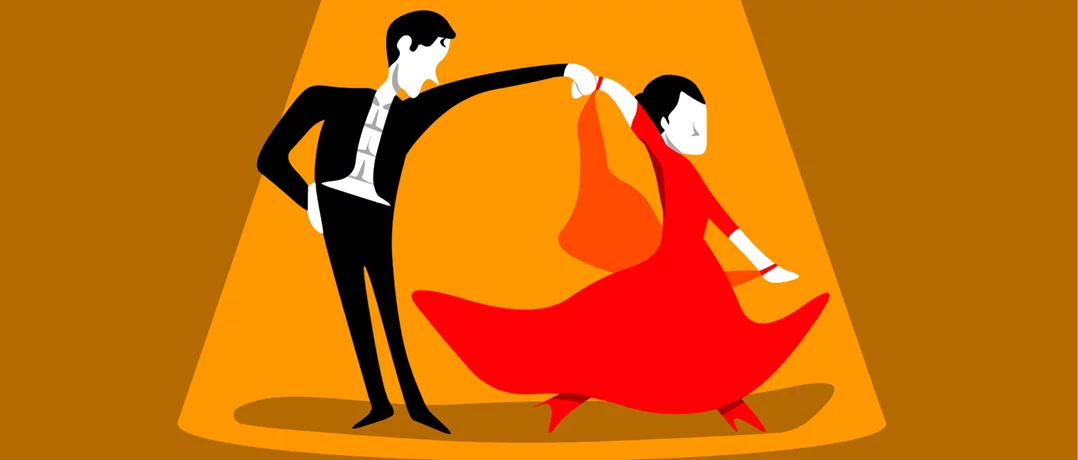
The Paso Doble presents itself in the most powerful way. The chest lifts, the shoulders square, and a sense of drama unfolds. Its name means “double step” in Spanish, and it has become ballroom’s most theatrical form.
The paso doble began as a march. Spanish infantry regiments used a quick, two-beat step to keep soldiers in unison, and the music that accompanied them became its own genre, the pasodoble, a 2/4 composition with brass melodies. These pieces were popular in town squares and festivals across Spain before they were choreographed for couples.
Its most enduring association came through the bullring. Bands played pasodobles as matadors entered the arena and between the stages of the corrida, and a whole repertoire known as pasodoble taurino took shape. Famous compositions from the 1990s such as “España Cañí” and “El Gato Montés” became inseparable from the spectacle, matching the ritual tension of the bullfight.
Although the music is Spanish, the dance as we know it was shaped substantially in France. During the early twentieth century, Parisian dance culture, fascinated with Iberian exoticism, adopted the rhythm and built a partner dance around its imagery. By the 1930s it had been codified as a ballroom form and spread through Europe, eventually becoming one of the five Latin dances of international competition alongside the cha-cha, samba, rumba and jive.
The choreography is a staged retelling of the corrida. The man plays the matador. The woman is most often his cape, the capa, though she may also be read as a flamenco dancer or, in some interpretations, the bull’s counterpart. The man’s posture includes a raised chest, lowered shoulders, a proud, almost arrogant carriage. Signature figures such as the appel (a sharp stamp of the foot), the sur place and the Spanish line define its movement. It is among the very few ballroom dances with a narrative, and one in which the leader dominates visually while the follower provides the fabric of the story.
The Andalusian connection
The Spanish character of the dance is inseparable from Andalusia, and Andalusia is inseparable from the Arab world. Muslim rule in the Iberian Peninsula, from 711 until the fall of Granada in 1492, left a deep imprint on Spanish music, language and dance. The lute descends from the Arabic oud. Flamenco, the great expressive tradition of the south, absorbed Moorish vocal enhancement and phrasing. Some scholars even trace the origins of bull-fighting, the ancestor of the rejoneo, partly to the equestrian traditions of the Moorish nobility, although the origins of bullfighting remain contested, with roots also claimed in ancient Iberian and Roman practice.
The scale at the heart of flamenco, known in Western theory as the Phrygian dominant, is essentially the Arabic maqam Hijaz, a mode familiar from Lebanese, Syrian and Egyptian music. The same dramatic tension and augmented second that give a pasodoble its edge are the signature of countless Arabic songs. The two traditions speak, in effect, a shared melodic language.
This kinship is why choreographers have so readily paired the dance with Arabic music. On television programs such as Dancing with the Stars and its international counterparts, the paso doble is often set to unexpected music, from rock anthems to film scores, and Middle Eastern pieces fit it naturally. Dramatic Arabic songs, offer the same ingredients as a bullring march: tension, pride and release.
The paso doble asks for character. Its history, from military march to bullring to ballroom, is a story of ritual being transformed into art. A dance of the Spanish arena carries the memory of many civilizations in the defiant stamp of the heel.
-
-
-
The Beiruter
-
