



Rooted in history and resistance, Maronite political thought continues to guide Lebanon’s pursuit of sovereignty, democracy, and pluralism.
The political culture of Lebanon’s Maronite Christians: Between freedom, coexistence, and statehood
The political culture of Lebanon’s Maronite Christians: Between freedom, coexistence, and statehood
By Dr. Elie Elias | November 28, 2025

Reading time: 5 min
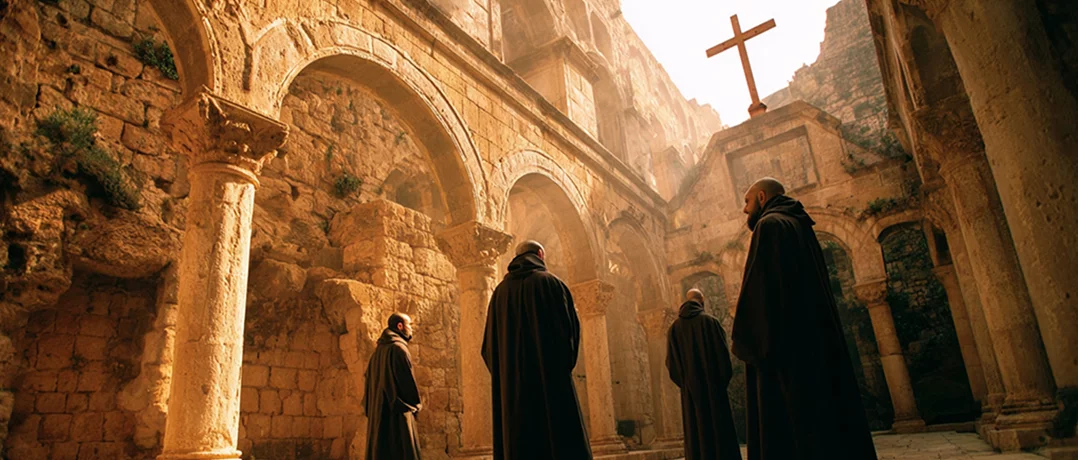
Few communities in the Middle East possess a political culture as old, layered, and self-aware as Lebanon’s Maronite Christians. Their political identity was not born with the modern Lebanese state, but out of centuries of survival, negotiation, resistance, and state-building. What emerges from this long history is a political culture defined by three constants: a deep attachment to freedom, a commitment to coexistence, and an insistence on Lebanon as a sovereign and plural homeland.
These principles: developed in monasteries, articulated in synods, and tested in wars; continue to shape Christian political behaviour today.
A church hat became a political actor
The Maronite Church developed in a unique environment. Unlike the strong Byzantine state or the Latin West where the Church often replaced collapsed institutions, the Maronite community lived for centuries under shifting imperial powers; Byzantine, Arab, Mamluk, and Ottoman; without any stable local government. As the Apostolic Exhortation A New Hope for Lebanon notes, the Church “lives in time and place with all the historical, social, and cultural consequences of this reality” (Sec. 20).
After the turmoil that followed the Council of Chalcedon (451), Maronites regrouped around monastic communities in the Orontes region. When Antioch fell to the Arabs in 636 and the patriarchal seat was thrown into chaos between 641–742, they elected their own patriarch to preserve unity; an early act of political self-determination (Salibi).
In Mount Lebanon, where no functioning political authority existed, the Church naturally assumed communal leadership: resolving disputes, representing villages, negotiating taxes, and protecting autonomy. Over centuries, a defining instinct developed: freedom, civil, religious, and political, is essential to survival. As one medieval chronicler recorded, Maronite leaders were persecuted not for wealth or rebellion, but because they “refused any authority that threatened their freedom,” especially political liberty (Salibi).
This mountain life, built on terraced slopes and inherited fields, produced a deeply rooted, land-centered community whose survival depended on self-sufficiency and cohesion. In such an environment, the Church naturally became the guardian of the land, Mount Lebanon identity, and communal autonomy, further solidifying its role as both a spiritual and political leader.
Openness to the west, fidelity to the east
From the 16th century onward, Maronites became a conduit of cultural and intellectual modernity. The Maronite College in Rome (1584) and the first ever printed book in the Middle East, in Qozhaya (1610) placed them at the heart of the eastern and later arabic cultural renaissance. They adopted Western educational tools while revitalizing Arabic scholarship and making key contributions to the Nahda.
Their project was not to escape the East but to reform it. This synthesis produced a community marked by both Eastern identity and Western intellectual exposure, enabling them to introduce concepts such as rights, constitutionalism, free inquiry, and civic participation into regional debates (Rabta al-Akhawiyat).
This dual belonging: rooted in eastern culture yet open to Western influence, remains one of the core traits of Maronite political consciousness.
The Mountain, the Emirate, and the Birth of Lebanon
Politically, the Maronites grew not by isolation but by partnership. During the Ma‘ani and Shihabi emirates, they cooperated with Druze and Sunni rulers on the basis of mutual interests. This partnership expanded Maronite demographic presence, strengthened local autonomy, and produced embryonic forms of shared governance.
The civil war of 1860, though devastating, led to the establishment of the Mutasarrifiyya (1861–1914): a political entity with international guarantees and a quasi-constitutional order. This period formed “the political, legal, and geographic nucleus of Greater Lebanon” (Hourani).
The creation of Greater Lebanon in 1920, led by Patriarch Elias Howayek and supported by diaspora activism, was not a sectarian project but an attempt to restore historic Lebanese frontiers and institutionalize coexistence. As Patriarch Nasrallah Sfeir later affirmed, the Maronites helped shape a Lebanon “distinguished by freedom, dignity, and shared civic life” (Sec. 5).
The 1943 National Pact expressed this vision. Christians renounced Western protection; Muslims renounced unionist ambitions. Lebanon became an Arab country with a distinct plural character; neither Western nor pan-Arab, but uniquely Lebanese.
War, Fragmentation, and the Challenge of Sovereignty
From the 1950s onward, Lebanon’s delicate balance came under pressure. Arab nationalism, the creation of Israel, the Palestinian armed presence after 1967, and the 1969 Cairo Agreement eroded state sovereignty and fed Christian worries.
The violence that erupted between 1975 and 1990 inflicted immense trauma on Lebanon. The war caused mass displacement, demographic shifts, militia fragmentation, and the near collapse of Christian institutional life.
More than 500,000 Lebanese were forced to emigrate, and ethnic-religious cleansing was carried out by foreign forces as well as internal actors. Two newly elected presidents were assassinated, and many of the community’s political leaders were either jailed or exiled. Once again, the Maronite community found itself in a very difficult position as it struggled to protect its values, principles, and freedom. Fifteen thousand martyrs were offered on the altar of the homeland.
The Taif Agreement (1989) attempted to redress imbalances by reducing presidential powers and reaffirming that no authority is legitimate if it contradicts the Pact of mutual coexistence; a principle long central to Maronite political thought (Taif Preamble). The Maronite Patriarchate accepted Taif as a necessary basis for peace and institutional revival.
Yet the post-war Syrian occupation (1990–2005) created a new crisis. Electoral engineering, security repression, demographic manipulation (the 1994 naturalization decree), and attempts to silence independent Christian voices weakened the community’s political role. The Maronite Patriarchate’s 1998 memorandum to PM Rafic Hariri warned that Lebanon’s core problem was “a political crisis undermining democracy, sovereignty, and balanced participation” (Sfeir).
The Patriarchate’s historic 20 September 2000 appeal laid the moral foundations for the 2005 Independence Intifada, when Christians and Muslims jointly demanded the end of Syrian control and the restoration of sovereign political life.
Political culture today: Freedom, coexistence, and public service
From this long trajectory, three enduring elements of Maronite political culture remain clear. First the Freedom and sovereignty as non-negotiable. The Maronites historically equate political freedom with survival. Any force; foreign or domestic; that overrides state sovereignty threatens coexistence itself. Second, Coexistence as a way of life. Living together is not a slogan but a social ethic. A New Hope for Lebanon describes coexistence as “a mode of life that respects the other in difference and equality” (Sec. 92). Lebanon, in this view, is not a Christian homeland but a shared civic project that holds regional significance as an example of pluralism.
And finally, Politics as service, not spoils. The Church repeatedly calls for “reconciliation with politics”: public life is a form of service to the common good, not an arena for personal gain (French Episcopal Conference, 1972). This implies renewing leadership, rejecting clientelism, and choosing representatives based on competence and integrity rather than sectarian mobilization.
A global community with a Lebanese mission
The Maronite diaspora; larger today than the population in Lebanon; lives under democratic systems that shape new political habits. Yet they remain tied to the Lebanese identity articulated in A New Hope for Lebanon: a commitment to sovereignty, pluralism, and civic freedom (Sec. 112).
The Church sees the diaspora as a strategic asset: ambassadors of Lebanese coexistence abroad and bridges between cultures. Their political engagement, both in host countries and toward Lebanon, reinforces the idea that Maronite identity is global while remaining anchored in a particular vision of the Lebanese state.
Conclusion
The political culture of the Maronite Christians is not a historical relic but a living framework that continues to influence Lebanon’s political trajectory. It insists that democracy is not optional, that sovereignty is essential, and that coexistence is the country’s only plausible future.
At a moment when Lebanon is collapsing under corruption, paralysis, and geopolitical pressure, the Maronite political tradition; born in resistance, shaped by coexistence, and refined in national struggle; remains one of the few coherent visions capable of imagining a sovereign, plural, democratic Lebanon.
-
-
-
Dr. Elie EliasUniversity Lecturer & Political Historian
-
