



As Iran prepares for Ayatollah Ali Khamenei's funeral, centuries-old Shiite mourning traditions once again underscore the role of public grief in expressing political legitimacy, collective memory and national identity.
The political traditions of Iran's funeral processions
The political traditions of Iran's funeral processions
By The Beiruter | June 21, 2026

Reading time: 5 min
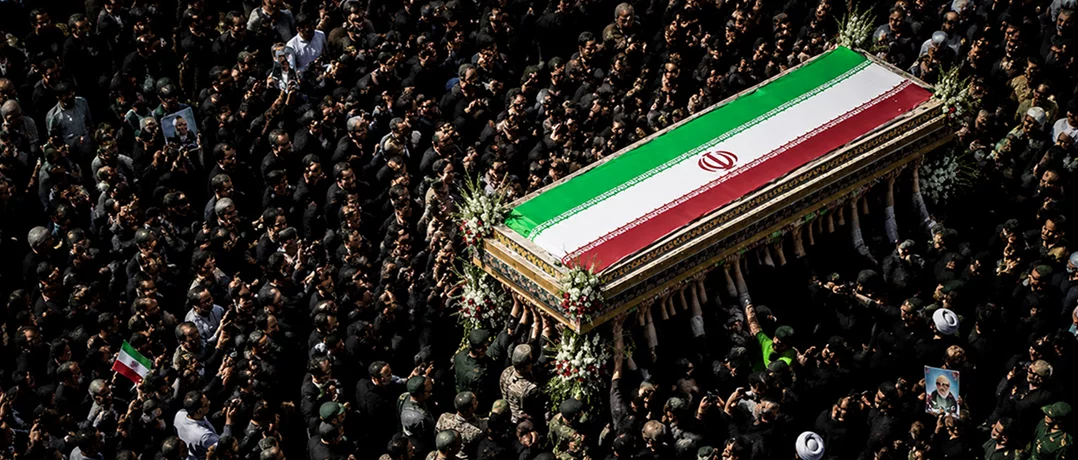
As Iran prepares for a series of funeral ceremonies for former Supreme Leader Ayatollah Ali Khamenei, millions are expected to participate in processions stretching from Tehran to the holy cities of Qom and Mashhad. The ceremonies will begin in Tehran on July 4 and conclude with Khamenei's burial in Mashhad on July 9 near the Imam Reza shrine. Yet for all its scale, the sequence recalls another moment when public mourning became inseparable from politics and national identity.
In 1989, Iranian officials estimated that nearly 10 million people participated in the funeral of Ayatollah Ruhollah Khomeini, transforming the farewell to the founder of the Islamic Republic into one of the largest public gatherings in modern history. The memory of that event continues to loom over major moments of succession and remembrance in Iran. Such ceremonies are more than expressions of grief. For centuries, Shiite traditions have used public mourning to bind faith, identity and collective memory.
Since the 1979 revolution, those traditions have become deeply intertwined with the political life of the Islamic Republic. State institutions have incorporated rituals rooted in Shiite history into the revolutionary narrative, turning public mourning into an important expression of collective memory and national identity. From Ashura commemorations to funerals for prominent clerics and military figures, mass gatherings have served to project continuity, reinforce legitimacy and reaffirm the values upon which the republic was founded. Khomeini's funeral in 1989 and the ceremonies planned for Khamenei illustrate how moments of mourning have also become moments of political transition.
Rituals of remembrance
Public mourning occupies a central place in Iranian religious life. Traditional funeral practices extend far beyond burial itself and commonly include communal prayers, public processions, the recitation of elegies and gatherings held on the third, seventh and fortieth days after death. Families and neighbors often distribute food and charitable donations in memory of the deceased, turning mourning into a communal rather than private experience.
The fortieth day, known as chehelom, carries particular significance in Iran and reflects traditions associated with Imam Hussein, the grandson of the Prophet Muhammad whose death at the Battle of Karbala in 680 lies at the heart of Shiite Islam. His martyrdom is commemorated each year during Ashura through processions, chest beating, lament recitations and other acts of remembrance that emphasize sacrifice, justice and communal solidarity. Many of the rituals associated with ordinary funerals draw upon these same traditions, linking personal grief with a broader religious culture of remembrance.
According to research by Iranian-born psychologist Afsaneh Karimitar, such practices provide emotional support while reinforcing religious identity and social cohesion. Modern customs have evolved alongside urbanization and changing social norms, yet collective mourning remains deeply embedded in Iranian society.
The politics of public mourning
Over time, these traditions have also become intertwined with politics and national identity. In her 2019 study of collective mourning in Iran, political scientist Esha Momeni argued that public grief is never purely ceremonial. Rather, mourning rituals create spaces where power and legitimacy are negotiated.
That relationship predates the Islamic Republic. During the revolutionary movement of 1978 and 1979, forty-day mourning cycles for protesters killed by the Shah's security forces helped sustain demonstrations and mobilize opposition. Public mourning therefore occupies a place where religious traditions and political symbolism meet. It honors the dead, but it also communicates continuity and unity during periods of uncertainty.
The funeral that defined the Islamic Republic
No funeral demonstrated the connection between religion and politics more dramatically than the death of Ayatollah Ruhollah Khomeini in June 1989. Millions poured into Tehran to pay tribute to the man who had led the Islamic Revolution and governed Iran for a decade. Contemporary reporting described scenes of extraordinary emotion as crowds surged toward the coffin, tearing at the burial shroud and forcing authorities to postpone the burial after Khomeini's body briefly fell from the casket.
British historian and novelist James Buchan later argued that the extraordinary scenes surrounding the funeral reflected a devotion that extended beyond politics. For many Iranians, Khomeini embodied both the revolutionary state and a spiritual authority whose image had become intertwined with Shiite symbolism. The emotional intensity of the crowds illustrated the extent to which reverence for Khomeini transcended his role as a political leader and entered the realm of collective faith and memory.
The event also marked a critical political transition. Fereydoun Jahanpour, an Iranian-born scholar and former professor at the University of Oxford, observed that Khomeini's death raised immediate questions about succession and the future direction of the Islamic Republic. Yet the massive turnout conveyed a sense of continuity at a potentially fragile moment. Images of millions gathered in Tehran became part of the state's political narrative and reinforced the revolutionary legitimacy associated with Khomeini's legacy.
From Tehran to Mashhad
The route planned for Khamenei's funeral carries symbolism of its own. After ceremonies in Tehran and Qom, the processions will conclude in Mashhad, one of Shiite Islam's holiest cities and Khamenei's birthplace. Home to the shrine of Imam Reza, the eighth imam in Shiite Islam, Mashhad attracts millions of pilgrims every year and occupies a central place in Iran's religious life. The journey from the political center of Tehran to the clerical center of Qom and finally to the country's most important pilgrimage city reflects the close relationship between state authority and religious tradition that has defined the Islamic Republic since its founding.
Beyond comparisons with 1989, the ceremonies underscore a broader truth about public mourning in Iran. Funerals have long represented more than acts of farewell. They are rituals through which religious tradition, political authority and national memory intersect. In moments of transition, they provide societies with a language for honoring the past while affirming continuity in the present. Whether commemorating revolutionary leaders or ordinary citizens, collective mourning remains a powerful vehicle for preserving memory and transmitting values.
-
-

-
The Beiruter
-
