



Camille Chamoun’s presidency helped shape Lebanon’s modern cultural identity, from Baalbeck’s global stage to lasting artistic and institutional landmarks.
The power couple who shaped Lebanon’s cultural identity
The power couple who shaped Lebanon’s cultural identity
By Patricia Khoder | December 28, 2025

Reading time: 3 min
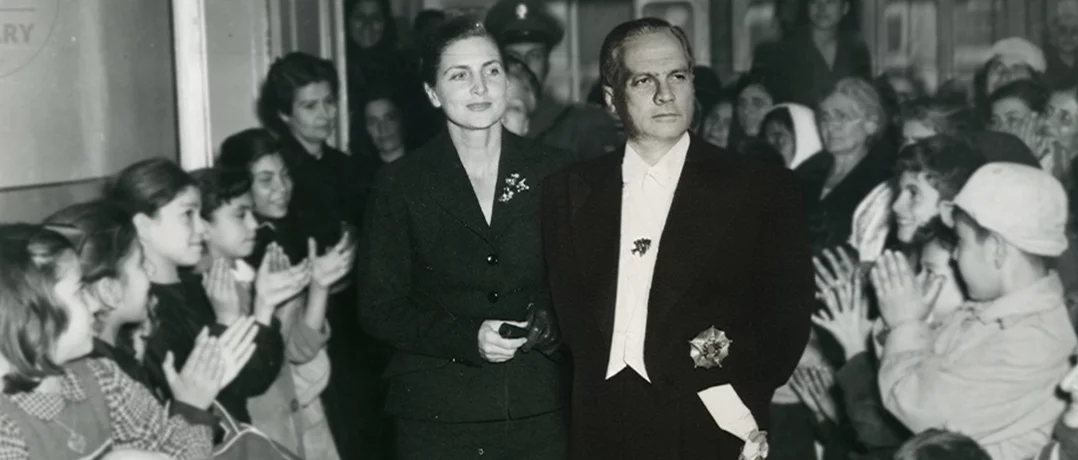
Camille Chmoun, who served as second president of the young Lebanese Republic from 1952 to 1958 as the second president of the young independent republic, undeniably shaped Lebanon’s identity, not only politically but also culturally. Despite the many crises that have marked Lebanon’s history the most recent being the 2019 collapse — the country’s enduring cultural vitality still draws in part from what Chamoun helped build. His wife, Zalfa Tabet Chamoun, played a decisive role in this cultural legacy.
When discussing the cultural contribution of Camille and Zalfa Chamoun, the Baalbeck International Festival inevitably comes to mind. Launched in 1957, it began as a series of Lebanese folkloric nights before evolving into an international festival under the supervision of Zalfa Chamoun. “In 1956, the festival brought together the most prominent Lebanese musicians of the time, including the Rahbani Brothers, Zaki Nassif and Toufic el-Bacha,” recalls veteran journalist Georges Ghanem in an interview with The Beiruter.
Preparing for the festival was itself a cultural undertaking. “My grandmother, surrounded by her friends and acquaintances, turned the presidential palace in Kantari into a beehive,” says MP Camille Chamoun. “The Baalbeck costumes, for example, were made inside the presidential palace.”
In 1956, Chamoun officially founded the Baalbeck International Festival, administered by a 12-member volunteer committee. The first committee, chaired by Aimée Kettaneh, included Salwa Said, Nina Jidijian, May Arida, Jean Fattal, Jean Skaff, Elia Abou Jaoudé, Samir Souki, Camille Aboussouan, Khalil Hibri, Salim Haidar and Fouad Sarrouf. “I want everything — the very best,” Chamoun reportedly said. And that is what he achieved.
Zalfa Chamoun also played a key role in democratizing visual arts in Lebanon. “Painting had long been reserved for the elite, who alone owned artworks,” notes Carole Dory Chamoun. “Sitt Zalfa organized exhibitions by contemporary Lebanese masters and encouraged everyone to buy paintings, ” she adds. Through these initiatives, art was no longer confined to salons but became accessible to the broader public.
Zalfa Chamoun also played an important role in the construction of the Baabda Presidential Palace. When Camille Chamoun was elected president, he settled in Qantari, in a residence that Bechara el Khoury had rented from his brother.
However, it was considered inappropriate for a president to live in a rented home. He began searching for a plot of land on the most beautiful hill in Baabda, purchased it and commissioned the construction of a presidential palace there. He personally chose the style and architecture, drawing on the advice of Zalfa.
The presidential palace was unique in its design. Every room enjoyed a magnificent panoramic view. Camille and Zalfa Chamoun did not live in the presidential palace, which was built in 1956.
Camille Chamoun’s presidency was marked by prosperity, construction and development. He was not a man of many words, but one of action — cultivated, an art lover and a music enthusiast. Beyond Baalbeck, he was behind the creation of Casino du Liban, not merely as a gambling venue but as a cultural landmark governed by strict artistic standards. Only top-tier performers were allowed on its stage. He also laid the foundations for the Lebanese television and the Tripoli International Fair, later known as the Rachid Karame International Fair. Although these three major projects were initiated during his presidency, they were inaugurated after his term ended.
It is important to reflect on the Tripoli International Fair, a little-known architectural jewel that has been listed three years ago on UNESCO’s List of World Heritage in Danger.
The idea for the fair was conceived shortly before the end of President Camille Chamoun’s term and took shape during the presidency of Fouad Chehab, when the Lebanese state turned to one of the most influential architects of his time, Brazilian architect Oscar Niemeyer one of the most modernist architects of the 20th century. Niemeyer had designed the most important structures of his country’s new administrative capital, Brasília, a modern city that rose from the desert.
Chamoun also founded Radio Lebanon in Amchit, which later broadcasted worldwide. As Lebanon’s second president, he helped forge the country’s cultural and artistic image while also laying foundations in non-political fields that remain central to modern Lebanon.
He was for instance the first Lebanese leader to envision a strong connection with the diaspora scattered across the world, particularly in the Americas. In 1954, he traveled to Argentina aboard a Dakota aircraft to meet the Lebanese diaspora. “That was no small gesture,” Ghanem says. Chamoun also established the Lebanese Cultural University in the World, cementing the idea of a lasting bond between Lebanon and its expatriates.
Determined to promote Lebanon’s beauty by every possible means, Chamoun also left personal gestures that became symbolic. While serving as ambassador in London during the French mandate over Lebanon and Syria, he sent Queen Elizabeth — the Queen Mother — a large crate of cherries from Hammana every summer. His sons, Dory and Dany, used to deliver them by bicycle to Buckingham Palace. During World War II, the boys were once surprised by a German aircraft raid on their return journey. “Until his assassination, Dany Chamoun perpetuated the tradition, sending Hammana cherries to Buckingham Palace every summer,” says Camille Dory Chamoun.
While serving as ambassador to Great Britain, Camille Chamoun developed a strong interest in civil aviation and took part in conferences on the subject, including a major gathering held in Chicago.
With the end of the French mandate, France established Air Liban. Working behind the scenes, Chamoun sought to expand and strengthen the national airline. As a result, a new carrier, Middle East Airlines, was created and later merged with Air Liban in 1963.
Sensitive to the role of women likely influenced by his wife Zalfa Tabet Chamoun granted Lebanese women the right to vote at the very start of his presidency, well before Switzerland and several other European countries.
“There is no culture without prosperity,” Ghanem notes. To build a prosperous Lebanon, Camille Chamoun sought to open the country widely to the expertise of individuals from neighboring coutries. He welcomed prominent financiers from Palestine, such as Youssef Beidas, as well as major merchants of Syrian origin.
Modernist and decidedly Western-oriented, Chamoun owed much of his success to his openness. “He was close to the Americans and the British, a natural liberal who was never afraid of being labeled pro-Western,” Ghanem says.
And this is what made all the difference.
-
-
-
Patricia KhoderJournalistFocusing on culture and entertainment.
-
