



China’s Fifth Plenum exposed the scale of Xi’s purges. Ahead of 2027, can Beijing balance tighter discipline with officials’ initiative?
The price of party discipline

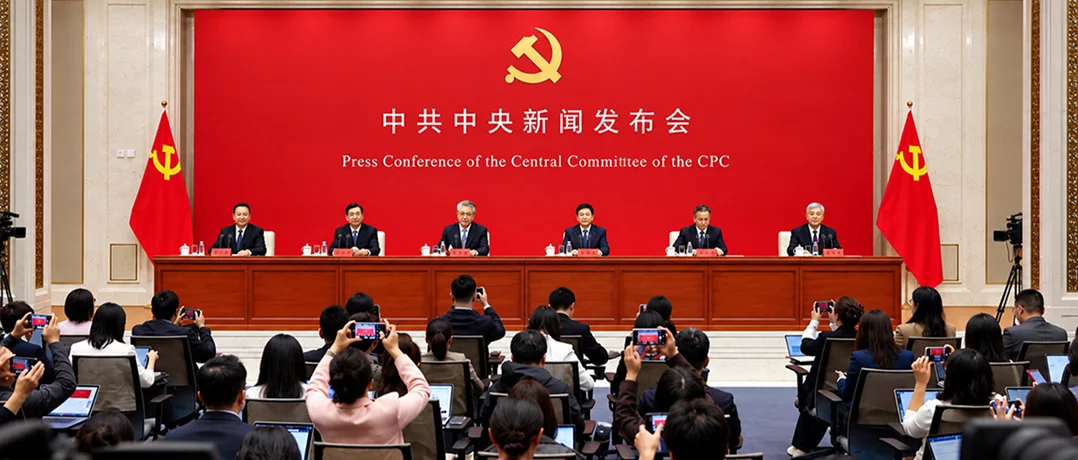
As members of China’s Communist Party Central Committee took their seats for the Fifth Plenum in Beijing, something stood out in the vast assembly hall: an entire row of chairs remained empty.
Of the 376 full and alternate members originally elected to the Central Committee in 2022, only 279 attended the October 26–29 gathering, a difference equivalent to more than a quarter of its original membership. It was the highest absence rate recorded at a plenum in the post-Mao era, an extraordinary figure for a political institution whose proceedings are ordinarily characterized by carefully choreographed displays of unity.
The purges reach the top
With recommendations for China’s 2026 - 2030 Five-Year Plan already adopted at last year’s Fourth Plenum, the October 26 - 29 gathering concentrated on internal Party governance. Alongside a resolution tightening discipline and supervision, the Central Committee confirmed the expulsions of 33 officials, a record for a single plenum.
The scale of the removals reflects how Xi Jinping’s anti-corruption campaign has evolved since he took power in 2012. Its early targets included powerful figures associated with previous leadership networks, notably former security chief Zhou Yongkang, purged in 2014. The latest cases, however, have also reached officials who rose under Xi himself, including former Politburo member Ma Xingrui, who governed Xinjiang, and Zhang Youxia, long regarded as one of Xi’s closest military allies.
Zhang’s downfall is particularly significant. Once the highest-ranking uniformed officer in China’s military, he was expelled alongside fellow general Liu Zhenli in September. The Party accused both men of forming cliques, political disloyalty and corruption, allegations subsequently ratified at the plenum. While the accusations explicitly raise the issue of factionalism, they do not independently establish that the generals organized a challenge to Xi.
The broader expulsions also reached diplomats, industrial officials and financial regulators, illustrating a campaign extending across different institutions and political networks rather than one identifiable rival faction.
Discipline as a governing system
The 33 expulsions were only the most visible outcome of a meeting that also sought to strengthen how discipline is enforced across Party institutions. Rather than introduce a new anti-corruption agency or announce new investigative powers, the Fifth Plenum emphasized making existing oversight mechanisms more effective and holding leaders accountable for failures within their organizations.
Under the resolution, Party committees would assume greater responsibility for supervision, while disciplinary inspectors would coordinate more closely with other Party and state watchdogs. Leaders whose organizations fail to enforce discipline could face accountability, with performance assessments examining how effectively they fulfill supervisory responsibilities. Appointments would also weigh political commitment, professional competence and conduct, while internal decision-making procedures would face tighter scrutiny.
These measures largely build on existing institutions. Since 2018, the National Supervisory Commission has operated alongside the Central Commission for Discipline Inspection, sharing staff and extending oversight to public officials, including non-Party members. A 2024 Party resolution had already called for stronger coordination between supervisory bodies. The Fifth Plenum places renewed emphasis on enforcing such obligations throughout the Party hierarchy, although the published communiqué leaves important implementation details unspecified.
The existing system already has considerable reach. Between January and September 2026, disciplinary and supervisory authorities opened 800,000 cases and sanctioned 680,000 people, including 105 officials at provincial or ministerial rank or above. These figures cover administrative and Party sanctions, not just criminal convictions.
The military command question
The emphasis on discipline is particularly visible at the top of China’s armed forces. Of the seven members appointed to the Central Military Commission in 2022, only Xi Jinping and General Zhang Shengmin remain. At the Fifth Plenum, Zhang, whose career centered on military discipline rather than operational command, was elevated to the Politburo. No replacements for the commission’s five vacant seats were announced.
The leadership gaps extend far below Beijing. In a February 2026 assessment, the Center for Strategic and International Studies (CSIS) identified 101 senior officers who had been dismissed or had disappeared from public view since 2022. Their cases affected approximately 52 percent of senior military leadership positions, spanning the services and regional theater commands. That measures positions affected by a purge, not those still vacant.
Filling these positions is not straightforward. The removals have narrowed the pool of experienced candidates for senior command, while officers generally need several years at a given rank before advancing. CSIS research warns that vacancies and inexperienced replacements could complicate the coordination required for large-scale military operations, including a blockade or amphibious assault against Taiwan.
Yet the purges have not stopped routine operations. Chinese forces have continued weapons tests, deployments and increasingly complex exercises despite the leadership upheaval. The question is how quickly the military can restore experienced leadership for operations that require coordination across different commands.
The road to 2027
The military upheaval comes as China approaches a broader leadership reshuffle. At the Fifth Plenum, the Communist Party scheduled its 21st National Congress for the second half of 2027. Delegates will elect a new Central Committee, which will then select the Politburo, its Standing Committee and the Party’s general secretary.
Preparations are already underway. The plenum promoted ten alternate members to fill vacancies on the Central Committee, as provided for under the Party constitution, and called for stronger training and selection of younger officials. These steps replenish the existing leadership ranks but do not determine who will occupy the top positions next year.
Those choices will be shaped by both retirement and dismissal. Several longtime associates of Xi Jinping are approaching the Party’s customary retirement age, while the purges have reduced the pool of experienced officials. An October Brookings assessment identified approximately 55 officials meeting conventional criteria for Politburo promotion, although those standards have become increasingly flexible under Xi. Appointments to provincial and ministerial positions over the coming months will offer clues about which figures are positioned to advance.
Xi himself is widely expected to seek a fourth term as Party leader. Yet no clear successor has emerged, following the absence of an identifiable heir from the leadership selections in 2017 and 2022. The next congress will therefore draw attention both to Xi’s choice of governing team and to any indications of how he intends to manage his eventual succession.
Discipline and the problem of initiative
Whoever takes the senior positions in 2027 will inherit a dilemma that Beijing has publicly acknowledged. At an October 30 briefing, Huang Jianfa, executive deputy head of the Communist Party’s Organization Department, said some officials were reluctant to act because they feared getting into trouble, while others lacked motivation or the skills to perform their duties.
Research suggests these concerns extend beyond individual cases. In January, Australian National University published findings from six Chinese provinces documenting “formalism”: officials emphasizing paperwork and procedural compliance over actual policy results. A separate study published in April, based on surveys of 329 grassroots civil servants in Guangdong conducted in 2022, found that perceived unfair punishment and insufficient rewards were associated with greater risk aversion and administrative inaction.
To address these problems, Huang said the plenum called for improved performance evaluations, greater support for grassroots officials and stronger protections for those willing to take responsibility, including measures against malicious accusations.
Whether these safeguards will succeed remains uncertain. As the Communist Party prepares to renew its leadership, the unresolved question is whether the measures promised by Beijing can restore officials’ willingness to make decisions within a system that subjects those decisions to increasingly stringent political scrutiny.
-
-

-
Nami El KhazenJournalistFocusing on geopolitics and international affairs.
-
