



While external military pressure deals significant damage to Iran’s entrenched regime, lasting political transformation entails other equally important factors and conditions.
The question of toppling the Iranian regime

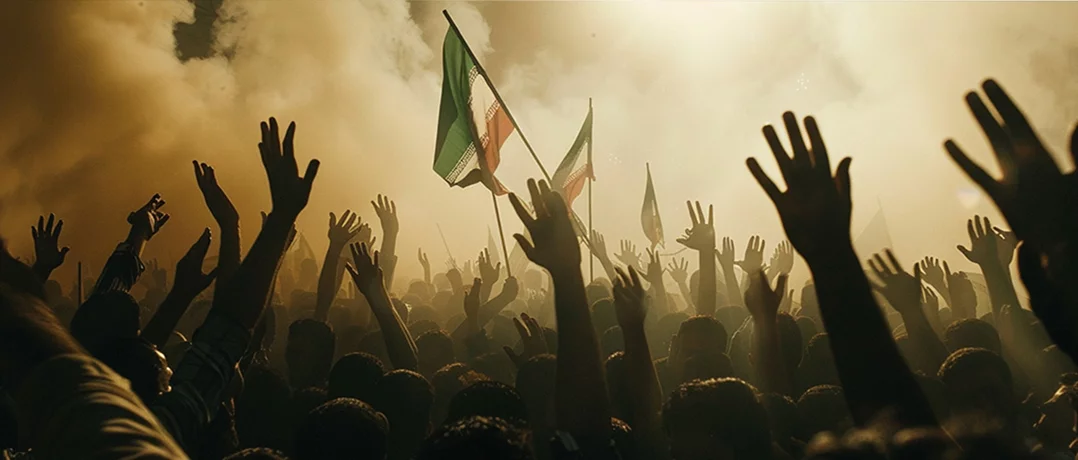
As the United States (US) and Israel intensify their military campaign against Iran, a familiar assumption has resurfaced in strategic and political discourse: that sustained external pressure, particularly through airstrikes and targeted assassinations, can trigger the collapse of the Islamic Republic. The killing of senior officials, including former Supreme Leader Ayatollah Ali Khamenei, and the degradation of key military infrastructure have fueled speculation that the regime is nearing its end.
Yet both historical precedent and contemporary analysis suggest otherwise: bombing alone cannot dismantle the entrenched system of clerical rule. Regime change requires a convergence of internal uprising and external pressure; a dynamic that has not yet materialized.
Therefore, there exists a necessity for internal transformation driven by the Iranian people, in face of the institutional resilience embedded within the Iranian regime itself.
Why bombs alone cannot topple the Iranian regime
The belief that air campaigns can bring about regime change is not new, but history consistently challenges its validity. From authoritarian states in Eastern Europe to the Middle East, external military pressure has rarely succeeded in dismantling a regime without simultaneous internal collapse.
The Iranian case illustrates this principle clearly. Despite nearly a month of intense bombardment, resulting in thousands of casualties and significant damage to military and security infrastructure, the regime has not fractured. On the contrary, it has demonstrated an ability to absorb shocks and reconstitute its command structures in a decentralized manner.
This resilience can be understood by examining the very nature of the Iranian regime. Totalitarianism, which emerged prominently in the 20th century under Italian Fascism and German National Socialism. Based on this political system, the state exercises total control over every aspect of public and private life, abolishing independent institutions and subsuming individuals into a singular national purpose; with the latter being a Shiite Islamic ideological doctrine based on “Wilayat al-Faqih” (Guardianship of the Islamic Jurist) in Tehran’s case.
Furthermore, a key reason for the Islamic Republic’s resilience lies in its institutional design. Unlike systems centered on a single leadership figure, Iran’s political structure is multilayered, combining ideological authority with bureaucratic and military power. While the death of prominent figures, such as Khamenei and former Secretary of the Supreme National Security Council Ali Larijani, mark a significant event, it does not automatically dismantle the system. The constitution provides mechanisms for continuity, including the temporary transfer of authority to a leadership council and the eventual selection of a successor by the Assembly of Experts.
Moreover, this resilience also stems from what can be described as the “principle of simultaneity;” the idea that regime change occurs only when external pressure coincides with sustained internal mobilization. Scholars such as Gene Sharp and Theda Skocpol have long argued that governments ultimately rely on the compliance of their populations. When that compliance erodes under both internal dissent and external strain, systems begin to collapse.
However, in Iran today, this convergence is absent. While external pressure is intense, internal resistance remains fragmented and suppressed. The regime’s security apparatus, particularly the Islamic Revolutionary Guard Corps (IRGC), has focused its full capacity on preventing mass mobilization, effectively neutralizing the internal dimension required for systemic collapse.
Moreover, external attacks can produce unintended consequences. Rather than weakening the regime’s legitimacy, they may reinforce nationalist sentiment, discouraging citizens from rising up during wartime. Many Iranians who oppose the regime are nonetheless reluctant to align themselves with foreign military campaigns, especially when entailing Israeli involvement, fearing accusations of collaboration or treason.
Thus, airpower alone, no matter how extensive, cannot substitute for the political and social dynamics required to dismantle a deeply entrenched system.
The need for internal change: The people as the decisive factor
If external force is insufficient, the decisive variable becomes internal. Only a popular uprising supported by organized internal resistance can ultimately bring down the regime.
Iran’s recent history demonstrates both the potential and the limitations of such uprisings. Over the past 2 decades, waves of protests have erupted across the country; ranging from the 2009 Green Movement to demonstrations over economic hardship, water shortages, and, most notably, the 2022-2023 protests following the death of Mahsa Amini as well as the recent 2025-2026 (which represented the largest uprising in Iran since the 1979 Iranian Revolution). These movements revealed widespread dissatisfaction with strict clerical and intelligence rule, and, increasingly, a rejection of the system itself. Yet dissatisfaction alone has not translated into regime change. The reasons are structural and strategic:
Severe repression: The regime has demonstrated a willingness to use overwhelming force, including mass arrests and lethal crackdowns, to suppress dissent.
Lack of unified leadership: The opposition remains fragmented between groups such as the National Council of Resistance of Iran (NCRI) and monarchist factions aligned with exiled Reza Pahlavi (the eldest son of Mohammad Reza Pahlavi, the last Shah of Iran).
Absence of organizational infrastructure: Spontaneous protests, while powerful, lack the coordination necessary to sustain long-term resistance.
External military action may, in theory, weaken the regime’s coercive capacity, creating space for internal mobilization. However, this outcome is not automatic. Without leadership, organization, and a clear alternative vision, even widespread unrest may fail to produce meaningful political change. Indeed, the IRGC has intensified its grip on power, while internal divisions, though present, have not yet reached a breaking point. Reports of elite tensions and succession struggles indicate underlying fragility, but these fissures remain contained within the given regime.
Over time, however, prolonged pressure may erode the regime’s capacity to govern effectively. Economic strain, military losses, and internal dissatisfaction could gradually weaken its foundations. Yet this process is likely to be slow and uncertain, rather than sudden and decisive.
Hence, Iran’s political system is built to endure shocks, with multiple layers of authority and a powerful security apparatus capable of suppressing dissent. External pressure, while impactful, cannot replace the necessity of internal transformation. Meaningful change requires a convergence of forces: sustained popular mobilization, organized opposition, and structural weakening of the regime. Until such simultaneity emerges, the Islamic Republic is likely to persist, perhaps more rigid, more securitized, and more internally strained, but not yet on the verge of collapse. The lesson is clear: wars can reshape regimes, but only people can ultimately replace them, ultimate rendering regime change a political process rather than a purely military one.
-
-

-
The Beiruter
-
