

Oman finds itself dangerously caught between the two warring powers as Trump's unprecedented threat to "blow up" the Gulf ally underscores the escalating tensions over control of the Strait of Hormuz.
The reluctant mediator caught in the crossfire of the US-Iran war
The reluctant mediator caught in the crossfire of the US-Iran war
By Peter Chouayfati | June 05, 2026

Reading time: 5 min
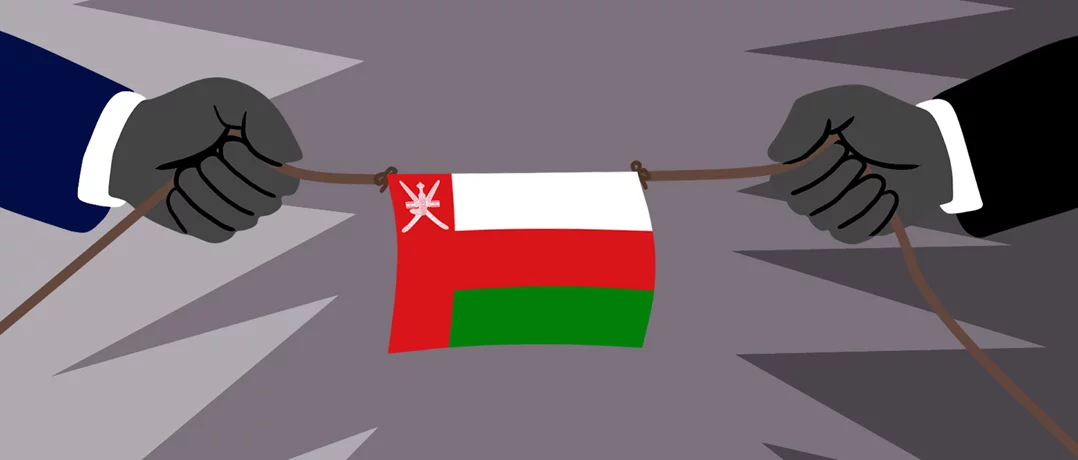
For decades, the Sultanate of Oman has cultivated a singular diplomatic identity in one of the world's most volatile regions. Muscat has maintained functional relationships with virtually every major power in the Gulf, including, crucially, both Washington and Tehran. But as the US-Iran war grinds on and tensions over the Strait of Hormuz reach a fever pitch, Oman's cherished neutrality is under severe strain, and the country now finds itself in an unprecedented and dangerous spotlight.
A tradition of neutrality
Oman's role as a regional mediator is neither accidental nor recent. As Marcus Schneider, head of the Friedrich Ebert Foundation's Regional Project for Peace and Security in the Middle East in Beirut, explained to DW's Kersten Knipp, "Oman has traditionally played a mediating role between the Arab Gulf states and Iran." Among its Gulf neighbors, Oman has long maintained the closest ties with Tehran, a calculated positioning that has made it indispensable as a backchannel.
That reputation was on full display just before the war began. As Al Jazeera's Federica Marsi reported, Omani Foreign Minister Badr Albusaidi was at the center of US-Iran nuclear negotiations in the days immediately preceding the February 28 joint US-Israeli attack on Iran. Albusaidi had met with US Vice President JD Vance in Washington on February 27, describing the talks as yielding "creative and constructive ideas and proposals" and unprecedented progress. Hours later, Trump ordered the strikes, a decision that blindsided the Omani diplomat and threw the sultanate into an impossible position. It was a stark reminder that Oman can bridge divides, but cannot bend them.
Trump's explosive threat
The tenuous nature of Oman's situation was laid bare on May 28, 2026, when President Donald Trump issued a stark and startling threat during a White House Cabinet meeting. Asked by a reporter about reports that Iran and Oman were considering jointly overseeing shipping through the Strait of Hormuz, Trump replied: "Oman will behave just like everybody else, or we'll have to blow them up. They understand that. They'll be fine."
Within 24 hours, Treasury Secretary Scott Bessent amplified the warning, posting on social media that the US would "aggressively target any actors involved, directly or indirectly, in facilitating tolls for the Strait," naming Oman specifically.
The threat was remarkable on multiple levels. This marked the first time the United States had explicitly threatened to attack a member state of the Gulf Cooperation Council. Senator Chris Murphy, Democrat of Connecticut, called it "one more sign of why this war has gone off the rails," accusing the administration of being "in constant panic mode, making mistake after mistake."
Brian Katulis, a senior fellow at the Middle East Institute quoted by CNBC, was equally pointed: "Trump's threats against Oman are a sign of his frustration and his desperation about his own inability to produce the results he had hoped for in Iran. It's yet another example of his performative diplomacy and use of troll power that is not likely to be anything more than just words."
According to a report published in The Wall Street Journal on June 2, 2026, the United States has sharply intensified diplomatic pressure on Oman, demanding that Muscat abandon its long-standing neutrality and cut ties with Tehran. The Trump administration has reportedly gone as far as threatening sanctions or military strikes against the Gulf state, following intelligence assessments suggesting Oman could join Iran in levying tolls on commercial vessels transiting the Strait of Hormuz.
Omani officials have denied the allegations, insisting that their neutral posture is precisely what makes the sultanate an effective regional mediator. US officials, however, remain unconvinced, pointing to Muscat's refusal to explicitly condemn Iranian military actions.
The Hormuz question
At the heart of the controversy is the Strait of Hormuz itself, and who has the right to govern it. Following the US-Israeli strikes in February, Tehran closed the waterway and began asserting sovereignty over it, even imposing tolls of up to $2 million per ship at times. Under international maritime law, such tolls on natural straits are prohibited, though countries may charge fees for services rendered to passing vessels.
Iranian state television had reported that an unofficial draft agreement was circulating that would see Iran and Oman jointly regulate traffic through the strait, framing any payments as "fees for services" rather than tolls. The Trump administration dismissed the report as "a complete fabrication," but the very vigor of its denial, culminating in a threat to bomb an ally, suggested a deeper anxiety.
Muhanad Seloom, a non-resident senior fellow at the Middle East Council on Global Affairs, explained this anxiety to Al Jazeera, suggesting that joint Iranian-Omani control would accomplish three things Washington fears. First, it would transform Iran's wartime grip on the strait into a permanent post-war fact. Second, it would set a precedent for littoral states to "metre and monetise" international waterways. Third, it would hand Tehran a strategic victory that would outlast any ceasefire.
Despite the alarmist framing, the joint-control scenario remains unlikely. The idea is regarded with skepticism, as it would run counter to the interests of other Gulf states. Seloom similarly called it "more posture than probability," arguing that Muscat's real goal is not co-ownership of the blockade but rather brokering the strait's reopening.
An unlikely target
Schneider told Knipp that Omani experts view Trump's words as an expression of frustration, not genuine intent. A strike on a long-standing partner, they argue, would further erode American influence at the very moment Washington needs it most. The sultanate's strategic importance as a communication channel is simply too great.
As an Iranian-US agreement remains unfinalized, Oman, battered by threats it never sought, remains what it has always been: the indispensable intermediary, stuck squarely between two powers neither of which can afford to lose it.
-
-

-
Peter ChouayfatiPolitical Analyst and Researcher
-
