

How Lebanese equestrian Aya Saffiedine turned heartbreak into an international show jumping comeback.
The rise of Lebanese equestrian Aya Saffieddine

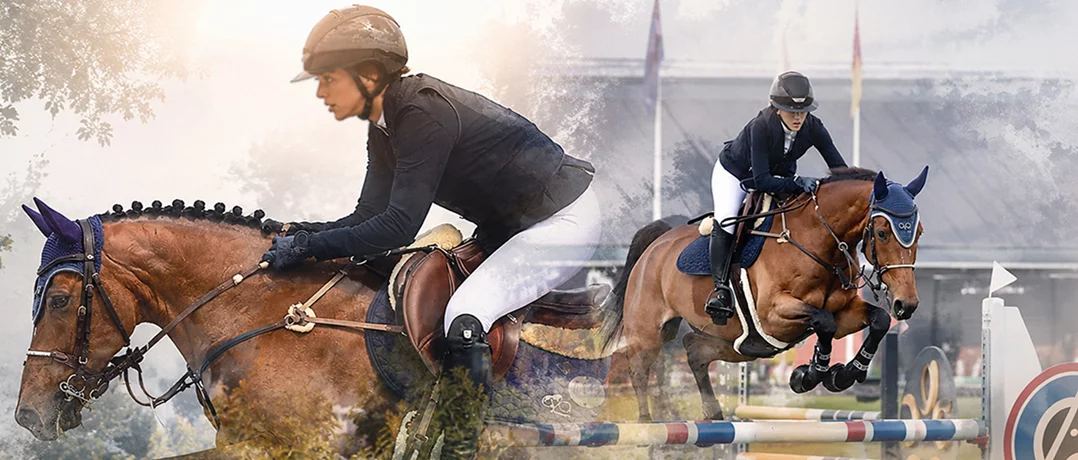
At just twenty-six years old, Lebanese equestrian Aya Saffieddine has already lived an entire lifetime in the saddle, one marked by early promise, devastating loss, a years-long hiatus, and a comeback that has taken her from the sand arenas of Beirut to the podiums of the French Riviera. The Beiruter spoke with Saffiedine to discover the trials and tribulations she has faced.
A childhood on horseback
Aya's story with horses began in Beirut when she was just seven or eight years old. Unlike most young riders who cut their teeth on ponies, Aya went straight to horses. But in 2013, that foundation was shattered. Aya's only horse in Lebanon died, and in the aftermath, she made a decision that many young riders in her position might have made: she stopped riding altogether. "I only had one horse in Lebanon, and she died," Aya recalled. "So then I thought, no, you have to stop. If your horse dies, you stop. That was how I felt about it at the time."
She was not in Beirut when she got the news, which she says softened the initial shock. "But in my mind, I associated riding with that horse. Not having that horse meant not riding," she explained.
The emotional weight of that decision lingered far longer than the moment itself. "For years I would have dreams of me riding," she said, "and I would ask myself, is this a reason I have to ride again?"
A detour through psychology
Rather than returning to the arena, Aya pursued an entirely different path. In 2018, she moved to the United States for university, where she studied psychology and communications with the goal of eventually becoming a clinical psychologist. It was a serious, deliberate plan, one aimed at a master's degree and a career far removed from international show jumping.
That plan changed after graduation, when Aya moved to Dubai to spend a year with family before starting her master's. It was her aunt who planted the idea that would redirect her life: what if she started riding again? Aya took the suggestion seriously, and the moment she got back on a horse in the UAE, something clicked. "I realized that this is what I should have been doing this whole time," she said. "I told myself I would just put the master's on hold for now and get back into riding."
Rebuilding a passion
Aya acquired two new horses in the UAE and threw herself into training with an intensity that left little room for anything else. "I trained every day," she explained.
I didn't even go to Beirut for Christmas or for summer. I just dedicated three years to get back in the sport and to make up for the years that I lost when I stopped.
That discipline paid off. She began competing internationally and eventually joined the training program of Abdel Said, an Egyptian-born rider who competes for Belgium and runs one of the most respected training operations in the sport, with bases in both Belgium and the United States. Aya now splits her year between the two continents that matter most to her training: summers in Belgium, winters in the UAE.
Milestones on the international stage
The results have followed quickly. In 2025, in just her second year back in the sport, Aya won the Ladies' Show in the UAE, an international competition and a major personal milestone. More recently, she turned heads in Saint-Tropez, one of the more competitive stops on the show jumping calendar, finishing fourth place one day and third place the next, two days in a row. "That was very big for me because it's a very competitive sport," she says, "and it's a very competitive competition in Saint-Tropez."
Behind these results is a demanding daily routine. On training days, Aya typically rides for around three hours across her two horses, but the work extends well beyond time in the saddle. "You always want to make sure that the horses are good, the transport is organized, the show papers are done," she says. "You just want to make sure you're on top of it. You don't just ride and leave."
Ask Aya who has powered her comeback, and the answer comes without hesitation: family. "My dad comes to every single competition," she expressed. "He doesn't even miss one, and if he misses one, he's on the livestream before me." She described him as deeply involved in every part of her career: "He calls me every day to check on the horses. He knows the ins and outs of the industry, of my schedule, of my riding." Her aunt and grandmother have been equally present, including at Saint-Tropez, "which was very special for me," she added.
Looking to the future
Aya's ambitions are already mapped out. "Between the end of 2026 and the beginning of 2027, I want to be able to jump my first ranking class," she told The Beiruter. "And by the end of the season of 2027, I'm hoping to do my first two-star Grand Prix." She's also looking beyond her own results: "I would like to get a few horses that are not fully produced, and with the help of my training program, produce my own horses, not only buy horses that are ready."
Reflecting on the journey so far, Aya offered a message she would give her younger self, back when she first returned to the sport and didn't yet trust her own ability. "I just didn't have the confidence," she said. "I think the most important thing you need to do in this sport is to work hard, because once you work hard and you know you did everything you need to do, then you can feel confident.”
It's a lesson shaped by loss, patience, and a return to the sport that, in her own words, answered every question she had about what came next: "When I started riding, I felt like all my questions, were answered."
-
-

-
The Beiruter
-
