



Lebanon's growing stand-up comedy scene is turning laughter into a powerful form of connection and healing, as comedians transform personal experiences and collective hardships into shared moments of resilience.
The rise of Lebanese stand-up comedy

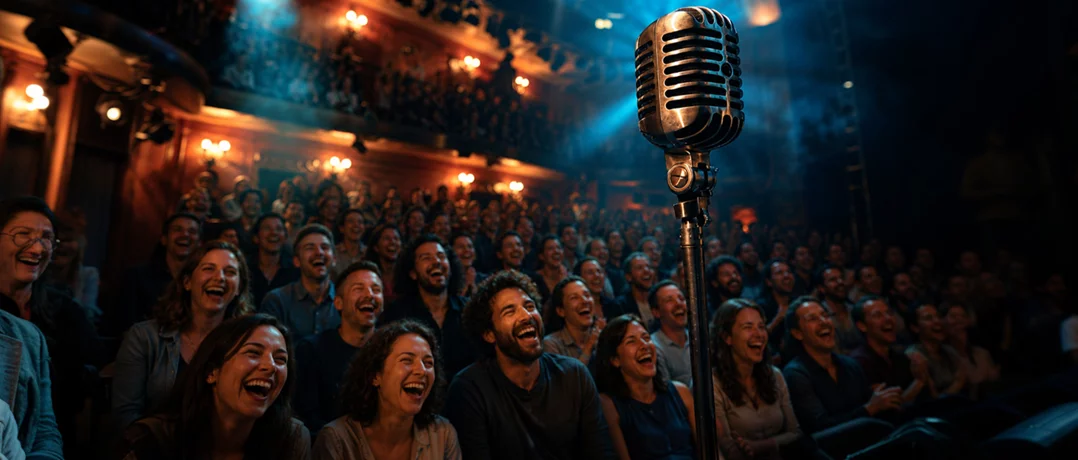
Comedy has long served as a way for societies to process hardship, allowing people to confront difficult realities through humor. Laughter reduces stress, strengthens social bonds, and helps communities heal after collective trauma. In Lebanon, it has become a shared space for reflection and connection. Unlike scripted television or online content, stand-up creates a direct conversation between performer and audience, turning personal experiences into collective moments of recognition.
The Beiruter spoke with two stand-up comedians who sit at different points along that arc. John Ashkar is one of the scene's most recognizable names, now performing internationally. Sam Ghazal is the one audiences are watching closely right now, still finding, and expanding his range. Together, they offer a picture of where Lebanese stand-up has been, and where it might be going.
John Ashkar: The architect
John Ashkar discovered comedy as a child. "I used to actually wait to stay up late so I could watch comedy programs at night," he recalls. "I was obsessed." While his friends read Dragon Ball and Harry Potter, Ashkar watched comedy specials and whatever else he could find. "I thought I was just a normal kid. Then I noticed my friends were doing other things."
He first took the stage in 2011, at a Scout fundraiser. The response was encouraging, but there was nowhere to go next. "There was no platform back then," he says. "Sometimes I'd do stand-up at a talent show, or perform at an event, but I never felt there was a place where I could really continue and develop." It took until 2017, when Awkward launched, for Ashkar to find a real home. He went out on his own in 2023.
Leaving Lebanon in 2021 changed how he wrote. "Whenever I wrote a story for the stage, I had to consider that not everyone in the audience was Lebanese. Even Lebanese audiences abroad are different, they want someone who understands why they're living abroad, how they ended up there." He found common ground in questions everyone asks themselves: "How did we end up here? How has it already been five years? How did time pass so quickly?"
His approach to comedy is built on two pillars: talent and business. "The magic happens when you have both and give both equal attention," he says. That conviction led him to open a venue in Achrafieh dedicated entirely to stand-up. "I want people to see stand-up as a performance art, not just as chaos, swearing, and someone acting crazy on stage."
On limits, there are none. "Personally, I think any topic can be joked about." His argument is that offence is a function of trust, not content. "If you trust someone's intentions, you won't be offended by a joke."
His philosophy, distilled: "Our circle of influence is much bigger than we think. We always see ourselves as victims, but that's not true. Our lives belong to us." He says it applies to Lebanon as much as to comedy. "Comedians complain there are no venues. But opening a space isn't that difficult, find a small pub, convince them to give you a Friday night. We're not victims of the system. We're a major part of that system."
Sam Ghazal: The rising voice
Sam Ghazal's entry into comedy was shaped the particular stillness of a country in lockdown. During COVID, he found himself watching comedy specials on Netflix, then stumbled onto Lebanese stand-up YouTube uploads. "I thought, wow, there are people in Lebanon talking about the same things I think and talk about." He started writing. When open mic nights returned, he went alone, without telling anyone. "I really loved the feeling of standing on stage, talking, and hearing people laugh." He came back the next Friday, and the one after that. Within a month, Awkward invited him onto their bigger shows.
Unlike comedians who arrive with a fixed voice, Ghazal describes his comedy as something that moves with him. "It evolves as you evolve and as you go through different experiences in life." He has learned over time to understand his own style, what lands, what doesn't, what audiences are ready for.
The past year has been harder. The war affected him in ways that went beyond distraction. "I felt lost for a while and reached a point where I didn't feel capable of doing comedy anymore," he says. He describes this year as a recovery.
On his passion to delve into anything and everything, he tells The Beiruter, "comedy comes from your thoughts and the things you want to talk about. everything is fair game." The real filter, he says, is confidence and timing: whether he's ready to perform certain material, and whether the audience is ready to receive it.
Asked to distill his journey into a single phrase, he doesn't reach for something grand: "Writing, performing, working, and then repeating it all over again."
The healing power of humor
Stand-up comedy offers something more valuable than laughter alone. It provides a rare space to process what often feels impossible to articulate. A joke can make people feel less alone. That may be the real power of stand-up. It transforms private frustrations into shared experiences, reminding audiences that the things weighing on them are often being carried by others too. In that sense, every laugh is a moment of recognition, connection, and, however briefly, relief. Lebanon’s growing comedy scene stands as a small but meaningful form of collective healing, proof that even in difficult times, people will keep finding ways to make sense of their reality together.
-
-

-
The Beiruter
-
