



Record defense budgets are financing far more than weapons, directing trillions of dollars toward the factories, technologies and supply chains that underpin modern military power.
The rise of the defense economy

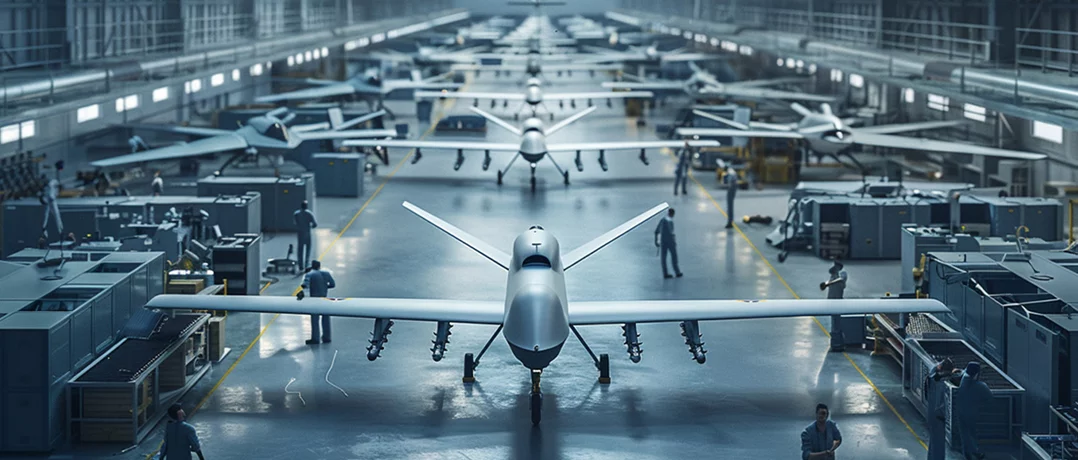
Governments have long treated military budgets as the cost of protecting national territory. Today, they are using them to finance the technologies and manufacturing that underpin military power.
Global military expenditure reached $2.89 trillion in 2025, according to the Stockholm International Peace Research Institute (SIPRI), the highest level ever recorded. Adjusted for inflation, spending rose by 2.9% from the previous year, marking the eleventh consecutive annual increase.
The buildup is no longer confined to countries directly engaged in war. Russia's invasion of Ukraine first accelerated the trend, while the Israel-Iran conflict in 2026 reinforced concerns about the resilience of military supply chains, missile production and strategic manufacturing capacity. Governments across Europe, Asia and parts of Africa are committing larger shares of public resources to defense, even as the strategic motivations differ.
The consequences extend well beyond national security. Military budgets are directing public capital toward advanced manufacturing, aerospace, artificial intelligence, satellites and critical supply chains, financing production capacity and technologies that increasingly serve both civilian and military purposes.
Rearmament is becoming global
Russia's invasion of Ukraine marked the beginning of the current rearmament cycle, but the 2026 Israel-Iran conflict demonstrated that the demand for military production capacity extends well beyond Europe. Some of the latest data show military expenditure rising across multiple regions, suggesting governments now view defense investment as a long-term priority.
Using SIPRI's inflation-adjusted data, global military expenditure increased by roughly $79 billion between 2024 and 2025. Europe accounted for the largest increase, adding almost $98 billion in real military expenditure. Asia and Oceania added another $50.5 billion, while Africa recorded a more modest increase. Real military expenditure in the Middle East changed little over the same period.
The largest absolute increases came from Europe's biggest economies. Germany added $20.6 billion in military expenditure between 2024 and 2025, followed by Spain ($12.5 billion), Norway ($5.3 billion) and Belgium ($5.0 billion) in constant 2024 dollars. Belgium also recorded the largest percentage increase globally at 58.7%, ahead of Nigeria (54.8%), Haiti (53.8%), Spain (49.6%), Norway (49.0%) and Denmark (46.1%), according to SIPRI.
Despite those increases, military expenditure remains concentrated among the world's largest powers. The United States remained the largest military spender in 2025 at $954.4 billion, followed by China ($335.5 billion) and Russia ($190.4 billion). Together, the three countries accounted for 51% of global military expenditure, illustrating that although rearmament has broadened geographically, military spending remains overwhelmingly concentrated among the world's largest economies.
Defense is changing national priorities
Military spending rankings usually change gradually because defense budgets are closely tied to the size of national economies. The changes since 2020 therefore illustrate how rapidly government priorities have shifted.
Ukraine provides the clearest example. Between 2020 and 2025, the country climbed from the 31st largest military spender to seventh, the largest advance among countries with comparable data across both years. Using SIPRI's constant 2024 dollar series, Ukraine's military expenditure increased from roughly $7.3 billion to $77.6 billion, reflecting the extraordinary demands of sustained war.
Several European countries also moved sharply up the rankings. Germany rose from seventh to fourth, while Poland entered the world's top fifteen military spenders. Denmark, Finland, Czechia and Belgium all recorded notable advances as governments accelerated long-term procurement programs and expanded defense investment.
These changes matter economically because they require governments to finance personnel, maintenance, ammunition and production capacity for years. Larger defense budgets created predictable demand for manufacturers, engineering firms and defense supply chains.
The OECD's Economic Outlook cautions that higher defense spending will place additional pressure on public finances, particularly in highly indebted economies. Whether those expenditures generate lasting economic benefits depends heavily on how governments allocate them. Investment in domestic manufacturing, research and skilled employment is likely to generate broader economic benefits than imported equipment, while persistent borrowing may weaken fiscal sustainability.
Following the money
Those budgets are flowing into a highly concentrated industry.
According to SIPRI's Top 100 Arms-producing and Military Services Companies, the world's largest defense companies generated $679.2 billion in arms revenues during 2024. Almost half of that total came from just 10 companies, while the five largest alone accounted for nearly one-third of all Top 100 arms revenues.
Lockheed Martin remained the world's largest arms producer, followed by RTX, Northrop Grumman, BAE Systems and General Dynamics. American firms dominate the sector, accounting for 39 companies and nearly half of Top 100 arms revenues. China ranked second with eight companies.
For governments seeking to use defense spending as industrial policy, this concentration matters. A growing share of public investment in advanced manufacturing and defense technology is flowing to a relatively small number of firms capable of delivering increasingly complex military systems.
Production capacity has become a strategic asset
Governments are responding to these trends by placing greater emphasis not only on the weapons they possess, but on their ability to produce them.
NATO's Strategy for Industry-NATO Cooperation, released in July 2026, calls for closer collaboration with industry throughout the development, production and sustainment of military capabilities. The strategy also seeks to mobilize private investment, strengthen supply chains and improve access for smaller firms and innovative technology companies.
The shift reflects a broader understanding of deterrence. The wars in Ukraine and between Israel and Iran have underscored how quickly countries can consume precision munitions and air defense interceptors, reinforcing the importance of sustaining production during prolonged crises. The financial costs are mounting just as quickly. On Tuesday, U.S. Defense Secretary Pete Hegseth estimated that the conflict with Iran has already cost the United States $37.5 billion, although the Pentagon has not explained how it calculated the figure.
That transition also carries economic risks. Higher defense spending may crowd out investment in health care, education or civilian infrastructure, while concentrated procurement can reinforce the market power of established contractors. Countries that rely heavily on imported equipment may see fewer domestic economic benefits than those that develop local production.
Even so, the direction of travel is clear. Governments are directing trillions of dollars toward advanced manufacturing, artificial intelligence, semiconductors and aerospace in pursuit of national security objectives. During much of the post-Cold War period, defense spending was viewed primarily as a fiscal cost. Today, it is financing industrial capacity alongside military capability. Rearmament is becoming one of the defining instruments of economic policy.
-
-

-
The Beiruter
-
