

A new documentary traces how Saint Charbel’s faith journey spread from a hermitage in Annaya to millions across the globe.
The Saint who crossed every border

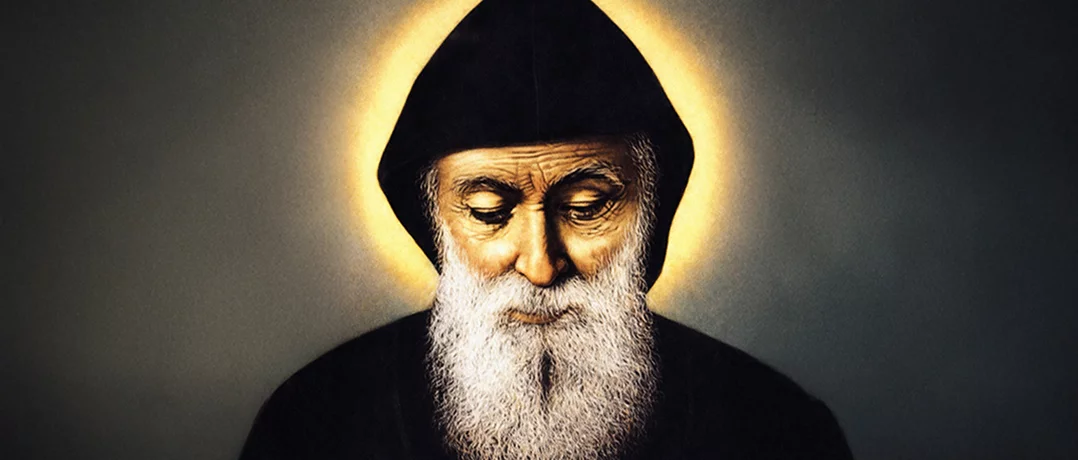
He left behind all earthly things in a hermitage in Annaya, Lebanon, yet Saint Charbel has traveled farther than any pilgrim, taking root in the hearts of millions across six continents. A new documentary by Elie Ahwash, produced by MTV Lebanon, traces this extraordinary journey of faith, miracle, and diaspora love.
People across the world, far beyond the Lebanese diaspora, have embraced Saint Charbel. In China, Togo, Poland, France, Belgium, Rome, the United States, Australia, Mexico, and countless other countries, Ahwash found the same flame burning, communities who revere this cedar-country saint not only as an anchor of identity but as a channel of the miraculous. Today, Saint Charbel is recognized as one of the fastest-growing saints ever, inspiring devotion that transcends borders and cultures.
The saint who belongs to everyone
In the Polish town where Aleksander Banka lives, there is no ancestral thread to Annaya. Yet on the 8th of May, Banka anointed himself with oil blessed through Saint Charbel's intercession. Six months later, skiing down a slope, he fractured a bone. He applied the same oil to the fracture, and it disappeared. It asks the viewer a simple question: how does a hermit from a Lebanese mountain reach a Polish skier? Ahwash lets that silence do its work.
From Poland the documentary moves with steady grace through a world the Lebanese diaspora has quietly sanctified. In Belgium, the Monastery of Saint Charbel has become a lighthouse for the community there, a living place of prayer where the miraculous still occurs. Anne Marie Marijnissen, a Belgian woman diagnosed with lymphoma cancer, had received three chemotherapy sessions when her doctors discovered what they could not account for: she was healed. She credits Mar Charbel. The documentary does not editorialize. It simply shows her face.
France offered its own chapter of longevity. Maison Saint Charbel, now forty years old, has been quietly introducing French and international visitors to the hermit of Annaya since before most of his current devotees were born. Rome carries a different arc: a small house in the 1950s, established in the wake of Charbel's first major post-mortem miracles, that spent decades growing in faith until 2018, when the community was finally able to acquire a full monastery, a permanent home for the saint in the city that had canonized him.
The Lebanese presence in America spans more than a century, and Mar Charbel has traveled alongside every wave of it, from the oldest Catholic shrine in the country in Maryland to a Maronite church in Boston that his name. It is in Los Angeles that Daphne Gutierrez's story unfolds. She came to Mar Charbel having lost her vision to severe migraine headaches. She felt a burning in her eyes. Then clarity returned. Sight, given back.
Elie Ahwash, producer and creator of the documentary tells The Beiruter,
Perhaps Mexico stands out as a defining moment in Charbel's global presence. The love Mexicans have for this saint is truly moving, he is present in every church across the country. There are no words to describe what I saw and experienced there.
He details, "another major stop was Australia. There, it was almost impossible to hold back tears in the face of the Lebanese community's love for Charbel, their steadfast faith, their devotion to their Church, and their enduring love for Lebanon. Those fifteen days felt like a dream."
Behind the documentary
Elie Ahwash reflected on the immense journey behind the project, revealing just how much it relied on the dedication and warmth of Lebanese communities worldwide.
The whole project took us three and a half years. Lebanese people from wherever they were came alongside us, carrying us in their hearts, opening their homes to us. The monastery welcomed us too.
Despite the challenges of war, airports, and constant change, “because every day in Lebanon was different, and we never knew what tomorrow would bring”, the team pushed forward with incredible guidance.
Every journey began with a Mass or ceremony, connecting the team to thousands of followers of Saint Charbel around the world. In Belgium, for instance, Elie recalled, “There was no space left at the 10 a.m. Mass, so I joined the 11 a.m. The church was packed with Poles who have a special connection to Saint Charbel. They follow him wherever he is, along with Christians from the Middle East, France, and Belgium. The scenes were truly exceptional, engraved not just in my mind but in my heart.”
He emphasized the crucial role of Lebanese diaspora in bringing the project to life. “If it weren’t for these heroic Lebanese I saw in North America across seven states, in three Mexican provinces, in Sydney, Melbourne, Cyprus, Armenia, Poland, Belgium, and Rome… If it weren’t for these heroic Lebanese spread across the world like love, this work would never have seen the light of day.”
The documentary is a production of MTV Lebanon, whose role Ahwash is emphatic in acknowledging: "MTV, as a guardian of Lebanon's identity, its voice and image, took on this work, as it does with all projects that reflect our great history and identity. It placed every possible resource at the service of this documentary."
He is equally insistent on naming his collaborators: the film was edited by Sabine Salameh, with cinematography by Hassib Melhem, and directed by Georges Daou. "Without them," Ahwash says simply, "it would not exist."
And above all, he credits the diaspora itself, the Lebanese communities who opened their homes and their hearts across five continents, who guided him to witnesses and worshippers, who proved that the love for Lebanon and for Charbel does not diminish with distance, but deepens. "They are the true partners in this project," he says, "a reflection of their pride, their deep faith, and their unwavering love for Lebanon, even from thousands of kilometers away."
On the spiritual weight of the work
Elie Ahwash tells The Beiruter, "Charbel dissolved into Christ. He gave up everything in this world except for Jesus, present in the Eucharist and in his simple monastic life." Ahwash sees those silent decades as the wellspring of everything that followed, the miracles, the healing, the global reach.
When we reflect on the life he chose in the hermitage," he says, "we realize how deeply a person must love to give their entire self to the one they love. In Charbel, we see an extraordinary measure of love. And I believe that love is what breaks the impossible. It is what creates miracles. It is what moves mountains. It is what sanctifies the human being.
"If we want to understand why Charbel is present everywhere in the world, we need to look at one place: the hermitage in Annaya." He ends by expressing, "Saint Charbel, in all his profound and immense silence, encapsulates the beauty of every sacred word. And so I invite everyone into a space of unmatched beauty and love, found in the eyes of Charbel, which today have closed over Lebanon and its people."
-
-

-
The Beiruter
-
