



Months of conflict have transformed education across southern Lebanon, where teachers, students and families are fighting not only to preserve learning, but to keep their communities intact.
The schools that keep South Lebanon rooted
The schools that keep South Lebanon rooted
By Katharine Sorensen | June 29, 2026

Reading time: 8 min
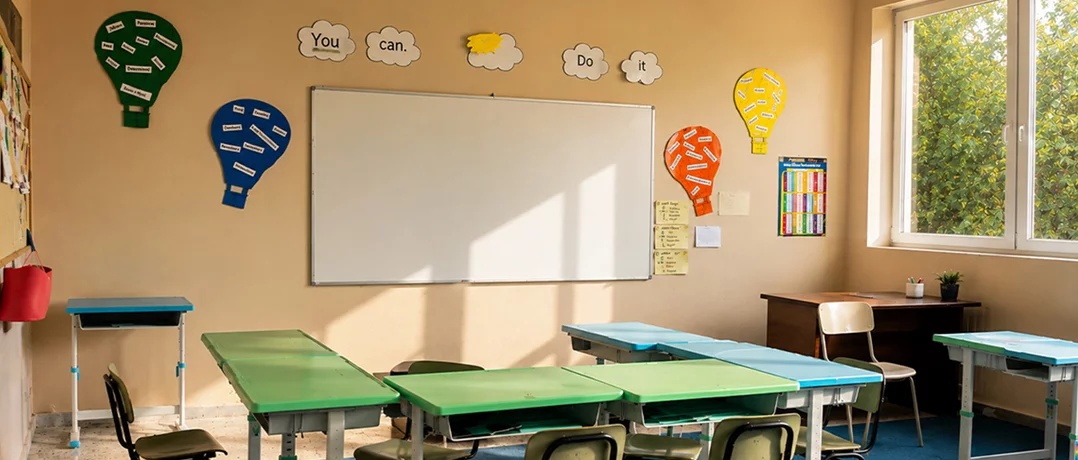
When Serena Nehme graduated high school from Saints-Coeurs in Jdeidet Marjeyoun in mid-June, there was no ceremony, no graduation party, and no prom. For her class of approximately 30 students, the school year ended much as it had unfolded over its final three months: online.
School moved online almost immediately after war broke out between Hezbollah and Israel on March 2. It remained that way for the rest of the school year.
The transition did not come easily. Earlier in the war, Serena lost internet access for a month and a half. She relied on recorded lessons to teach herself the material, a process she described as difficult.
Serena’s school sits in the Marjayoun district along Lebanon's southeastern border with Israel, one of the areas most affected by the war. For much of the country, the ceasefire that took effect on April 16 marked a turning point. In southern Lebanon, it never fully arrived.
Between April 17 and June 7, Israel carried out 3,491 airstrikes, 407 controlled demolitions and six large-scale razing operations, according to figures released by Prime Minister Nawaf Salam's office. The campaign left entire villages along Lebanon's southern border almost flattened.. Although Israel and Lebanon signed a U.S.-brokered framework agreement on Friday, June 26, establishing a roadmap toward a broader settlement, its implementation, and its effect in southern Lebanon, remain uncertain.
On Monday morning, the Israeli military carried out extensive heavy machine-gun fire in the town of Khiam, according to Lebanon's National News Agency.
Khiam is visible from the top floor of Saints-Coeurs, just 6–7 kilometers to the southeast. Much of it has been reduced to rubble. About 10 kilometers to the west, Beaufort Castle, the medieval fortress seized by Israeli forces on May 31, rises above the surrounding hills. Driving toward Deir Mimas, the castle remains in view above the ridgeline for much of the journey.
No pictures of the castle — or Khiam — are allowed, however. School staff say images of the surrounding area could expose nearby locations to Israeli strikes.

Scenes of destruction in Deir Mimas, Marjeyoun District
Beyond the physical destruction, the sounds of the war are never far. Cracks and explosions pepper the otherwise quiet landscape. Sometimes the smoke from the shelling leaves behind a burning smell. Some are louder than others but all serve as a reminder that the war is never far away.
It’s “background music,” a group of residents joked. The remark drew laughter, if only briefly. In Marjeyoun, they added, the war never stopped.
For the residents of these southern communities, this continued military campaign has meant months of uncertainty and the constant threat of renewed violence. For the students, it has also meant a school year marked by isolation, stress, and stalled learning.
“Everything is uncertain, and it’s difficult to cope,” Serena said.
We are a country alone here. We are losing our hope and spark.
Keeping the school, keeping the village
Across southern Lebanon, Serena’s circumstances are shared by thousands of students.
According to Lebanon's 2024 Statistical Bulletin, 211,700 of its 1,079,048 students attend schools across the South Lebanon and Nabatieh governorates. Nationwide, however, only 28 percent of students are enrolled in public schools, leaving most families dependent on private institutions like Saints-Coeurs.
Many also remain among the few institutions serving both Christian and Muslim students. At Saints-Coeurs, roughly 490 students are enrolled, about 60 percent Christian and 40 percent Muslim. At nearby Marjayoun National College, approximately 450 students are split almost evenly between the two communities.
In a region where displacement remains a constant possibility, schools have become one of the strongest anchors keeping communities intact.
That idea has guided the Lebanese nonprofit Nawraj for the past 16 years. Rather than focusing solely on emergency assistance, it works alongside mayors, parishes and local organizations to strengthen frontline communities through education, healthcare and local economic development. During the current war, that has meant organizing humanitarian convoys, installing satellite communication systems when conventional networks failed, and raising funds to keep schools open.
Its latest campaign is raising funds to support eight frontline schools serving nearly 2,500 students across 15 villages in Ain Ebel, Debel, Marjayoun, Al Qleyaa and Rmeich, helping families keep their children enrolled despite the financial strain of war.
“If they leave the village, then they're completely cutting all the bridges with their motherland,” said Dr. Fouad Abou Nader, founder of Nawraj.
Particularly given Israel’s efforts to physically cut the south off from the rest of the country through the destruction of key infrastructure such as roads and villages, engagement from organizations like Nawraj has taken on added significance.
“Restoring hope can make a tremendous difference,” he said. “Fifty percent is hope and motivation. Fifty percent is schools, jobs, and money.”
The depth of that attachment became evident after rockets struck Saints-Coeurs on May 28, partially damaging the school. Soeur Hiam Habib recalled children as young as three calling to ask how they could help rebuild it.
To Abou Nader, those children had summed up the logic behind the campaign.
"If you keep the school open, you keep the family. If you keep the family, you keep the village," he said.
School is the foundation of the land and of life.
Learning through war
Keeping schools open, however, has required constant adaptation.
 Scenes from schools in the Marjeyoun District, where months of conflict forced many students to complete the school year online.
For teachers, that has meant far more than moving lessons online. They have had to rethink how they teach.
“It takes students longer to process information,” said Rima Saïd, who has taught economics at Saints-Coeurs for 25 years. “How can the material reach their brains when their minds are somewhere else?”
To help students cope, Saïd has shifted her focus beyond academics. Before lessons begin, she checks in on her students and their families. She also encourages them to pray and to focus on their personal growth.
“We have to build our future,” Saïd said. “We cannot lose hope.”
At times, however, even holding a lesson proved difficult. "Some days we could barely hear one another because of the sound of shelling," recalled Soeur Habib.
For Jana, an administrator at Marjeyoun National College, the past two school years have been spent adapting to war. The school escaped a direct hit during the latest conflict, she explained, though a nearby strike in 2024 shattered many of its windows.
A first strike cut through the conversation. Then a second. Then a third.
“This isn’t even that bad,” she said. “You should have heard them last night.”
Restful nights in Marjayoun have become increasingly rare. Both students and teachers frequently spend the night awake before logging on for online classes the following morning.
“These students can’t concentrate when they’re tired, and no one can sleep,” Jana said. “It’s really bad. I don’t know how long we can take it.”
The uncertainty extends well beyond the classroom and permeates everyday life. With Israeli forces nearby and Hezbollah still active across parts of the region, a sense of normalcy remains elusive.
“We don't know what Israel and Hezbollah will do at any point,” said Father Philip Habib Okla, head of the Marjayoun Orthodox School.
There is no safety, no security, no sense of stability.
That instability has become part of childhood. For many of the region's youngest students, years of disrupted learning have become the norm.
Nine-year-old Elise can't remember the last time she spent an entire school year in a classroom.
Between the COVID-19 pandemic and the wars of 2024 and 2026, much of her education has taken place online. As she toyed with her bracelet, Elise imagined what a school year without screens might be like. More than anything, she said, she missed seeing all of her friends in one place.
Elise insisted the sounds of war no longer frightened her, even if the “new sounds” were slowly “getting closer.” But the conflict has touched her in other ways. One of her classmates lost his home, along with cousins who were also his closest friends.
“I am sad for his loss,” she said. “I wish I could make it better.”
Elise's losses remained one step removed. Not every child had been spared that distance.
At their family home in Qlayaa, sisters Mariella and Marie-Lynn are dressed in black. Their family is still mourning three relatives killed earlier that month.
On June 1, an Israeli drone strike hit a civilian car on the Nabatieh-Khardali road, killing Dr. James George Karam and two of his children, Theodosia and Tony, as they returned to Qlayaa after Theodosia completed her final examinations at the Lebanese University.
Dr. Karam was the girls' uncle. Theodosia and Tony were their cousins.
“The situation is so difficult,” Mariella said.
"Everything is escalating quickly and there's no time to process."
The conviction to remain
Despite the continued fighting and the constant stress–and casualties–of living in war, leaving, for many, is not an option.
And so, milestones are reimagined. To make up for the graduation they never had, Serena's church and choir are planning a celebration for students from Qlayaa, Burj El Moulouk, Jdeidet Marjayoun and Deir Mimas after the war denied them one at school.
“We are like a family here,” Serena said. “I don’t want to leave my community and people”
For many residents, staying is also a way of protecting what they have left.
“They learned from the first war that it is better to stay,” said Father Okla.
“They know that this time, if they leave, they'll lose their homes and everything.”
The fear of losing land is not theoretical. Throughout the war, Israel repeatedly signaled its intention to establish a security buffer zone to protect its northern communities.
While Qlayaa, Kawkaba and Marjayoun lie outside Israel's proposed buffer zone, 55 other villages do not. Although the new framework agreement envisions an eventual Israeli withdrawal from southern Lebanon, the timing of that withdrawal and the future of the proposed buffer zone remain unclear.
In a country this small, land feels particularly finite. At just 10,452 square kilometers—roughly the size of Connecticut—every village carries disproportionate weight.
Keeping a village intact, many here argue, requires more than protecting its borders.
“The preservation of land through the preservation of schools is a different kind of fight,” said Tania El Helou, Nawraj's general coordinator.
Through education, you can keep Lebanon rooted.
-
-
-
Katharine SorensenReporterSpecializing in global affairs, technology and economics, with a focus on on-the-ground investigative reporting.
-
