



How Russia's ghost fleet delivered 27,400 tons of stolen Ukrainian grain to Syria — and why the world's diplomatic architecture failed to stop it.
The ship that wouldn't stop

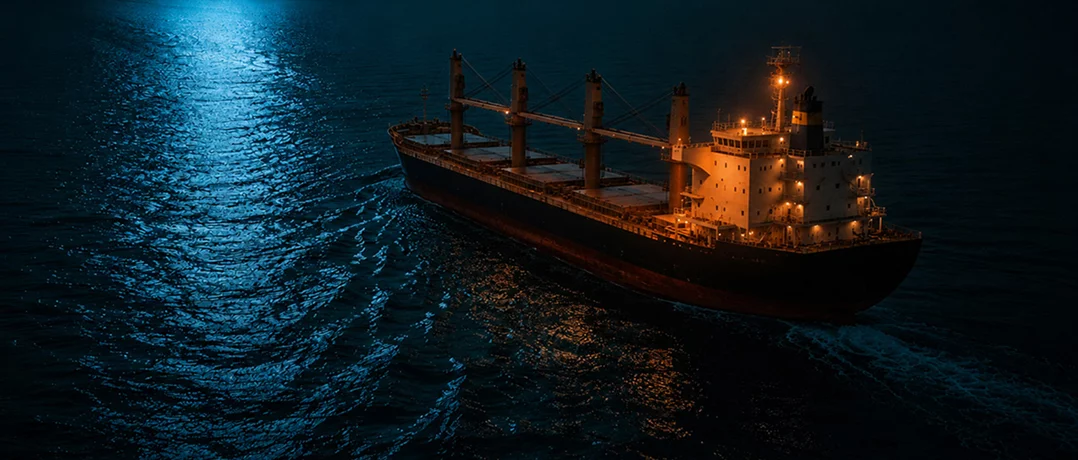
Ukraine had sent the warnings. The verbal note had been filed. The Prosecutor General's formal request for international legal assistance was already in Syrian hands. None of it mattered. The Mikhail Nenashev docked in Tartus and unloaded its cargo, 27,400 tons of wheat stripped from the occupied territories of Zaporizhzhia, Kherson, and Crimea, and sailed away.
What Ukrainian diplomats were powerless to prevent was not an anomaly. It was, investigators say, the routine functioning of a Russian state-backed operation that has turned stolen Ukrainian grain into a global commodity, delivered to Syria, Egypt, Israel, Algeria, and Turkey, moving through falsified documents and disabled tracking systems, sanctioned and undeterred.
The Mikhail Nenashev (IMO: 9515539) has become one of the most documented vessels in this shadow supply chain. Placed under Ukrainian sanctions in November 2025, followed by the European Union in December, and Switzerland and the United Kingdom in January 2026, the ship kept sailing. On April 22, it loaded its cargo at the Avlita grain terminal in occupied Sevastopol. One week later, it was in Tartus.
A course change designed to outrun diplomacy
Kateryna Yaresko, an investigative journalist with the SeaKrime project of the Myrotvorets Center and one of Ukraine's foremost trackers of Russia's stolen grain fleet, never believed the ship was going to Alexandria.
"We predicted from the beginning that the Mikhail Nenashev would go to Syria," Yaresko told The Beiruter. "This vessel has been making regular voyages between occupied Sevastopol and Syria. The export company, Russian firm Pallada LLC, systematically removes grain from occupied Ukrainian territories, primarily to Syria."
The AIS transponder registered the destination switch to Tartus at 3:41 a.m. UTC on April 29, at coordinates 36.5369 north, 27.0065 east, east of Rhodes, in the open Mediterranean. But the ship had already physically changed heading hours earlier. The paperwork caught up with reality only after the critical window had passed.
"We believe the destination is switched at the last moment to complicate the work of Ukrainian diplomats, to leave as little time as possible for countermeasures," Yaresko said.
The maneuver is standard practice for the network. Ukraine's Main Intelligence Directorate has confirmed the Nenashev regularly disables its AIS to conceal routes. Official Russian export decrees obtained by investigators show Pallada LLC held grain quotas of 13,820 tons from Zaporizhzhia, 11,831 tons from Crimea, and 7,848 tons from Kherson for 2026 alone, revenue from which flows directly into the Russian state budget financing the war.
Syria's reversal: Negotiated, not accidental
The new Syrian government initially cut ties with Russia's stolen grain pipeline after Assad's fall in December 2024. That pause, Yaresko's tracking data shows, lasted just over six months. Its end was not a drift, it was a deal.
The Mikhail Nenashev had itself been in Tartus on December 6, 2024, unloading wheat from occupied Sevastopol, when the regime collapsed. The vessel fled the port alongside withdrawing Russian warships on December 8. Most of its cargo was later offloaded in Alexandria, which became the network's primary hub through early 2025.
"We know that during this period, negotiations were underway and pressure was being applied on Syria," Yaresko said. "In particular, Pallada filed a lawsuit against the Syrian state company, which owed it money. It is documented that Russia was selling grain to Syria at inflated prices under Assad. The parties reached an agreement, and by July 2025, vessels carrying grain illegally removed from occupied Ukrainian territories were heading to Syria again."
The identity of the Syrian buyer makes the political nature of the arrangement explicit. "This was a political decision," Yaresko said, "because in Syria, grain procurement is carried out by a state company."
"This was a political decision, because in Syria, grain procurement is carried out by a state company," Kateryna Yaresko, SeaKrime project.
Kyiv's response and its limits
Ukrainian Ambassador in Beirut, Roman Goriainov, confirmed to The Beiruter that formal diplomatic channels had been exhausted before the vessel arrived. A verbal note and a Prosecutor General's request for international legal assistance had both been transmitted to Syrian authorities. The ship unloaded regardless.
"We view the unloading of the vessel despite these appeals as deeply concerning," the embassy stated. It pointed to Syria's obligations under IMO Resolution 1183 (December 2023), which requires member states, Syria has held IMO membership since 1963, to ensure their operators refrain from violating the closed-port regime in Russian-occupied Ukrainian territory.
On the broader question of whether Ukraine's sanctions framework is fit for purpose, the embassy did not equivocate: "What we are witnessing is an adaptive Russian sanctions-evasion network that exploits jurisdictional gaps, intermediary structures and the food security sensitivities of importing states." Kyiv is pressing for stronger secondary sanctions mechanisms, tighter maritime tracking cooperation, and deeper scrutiny of ship-to-ship transfers and documentation fraud.
A network without borders
The Tartus delivery came as Ukraine was simultaneously engaged in diplomatic confrontations over the same pipeline across the region. In late April, the bulk carriers Abinsk and Panormitis arrived at Israel's Port of Haifa carrying stolen Ukrainian grain, the latter despite explicit advance warnings from Kyiv. Israel maintained that wheat falls outside its sanctions list. A Haaretz investigation subsequently found that 90,000 tons of stolen Ukrainian grain had been designated for Israeli buyers between 2022 and 2023, with four additional shipments already unloaded in 2026.
Egypt fared no better under scrutiny. The vessel Asomatos unloaded 26,900 tons of stolen wheat at Abu Qir despite pledges by President el-Sisi to halt such imports and a formal legal request from Ukraine's Prosecutor General. Foreign Minister Sybiha did not spare the diplomatic language: "Ukraine has been a reliable food security guarantor for Egypt for many years and we do not understand why Egyptian partners pay us back by continuing to accept stolen Ukrainian grain." Algeria and Turkey have also received deliveries from the same network.
For Syria's new government, which has spent months cultivating Western goodwill after Assad's fall and now operates under slowly lifting sanctions, the calculus of purchasing documented war plunder carries consequences that extend well beyond any single cargo. Russia's resumed military logistics through Tartus, its renegotiated grain contracts, and its reassertion of political leverage over Damascus all point in the same direction: Moscow is rebuilding its position in Syria, one shipment at a time.
The Mikhail Nenashev has completed its delivery. The next ship is already at sea.
-
-

-
Josiane Hajj MoussaReporter
-
