



A record surge in journalist killings reveals a pattern of targeted violence, restricted access, and global impunity that is systematically erasing the witnesses of war.
The silenced press

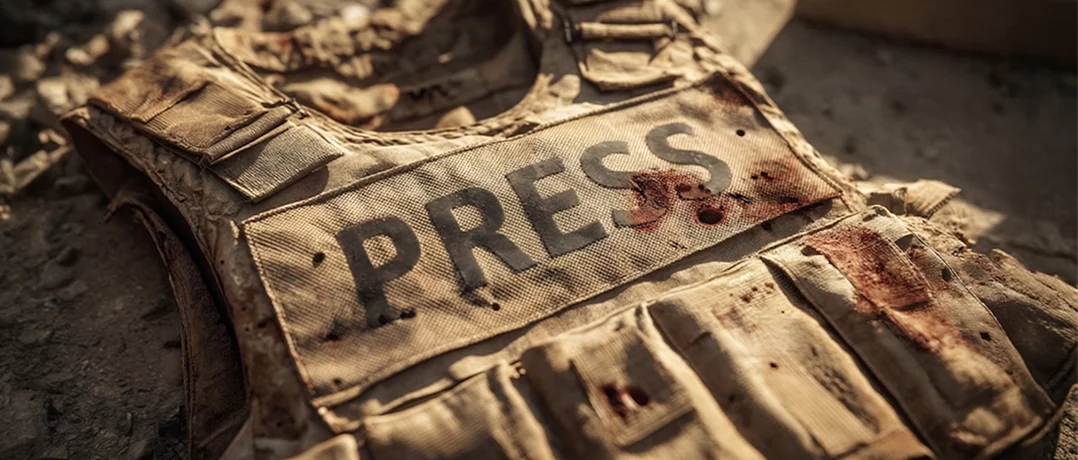
Over the past fifteen years, 373 journalists have been killed by military actors worldwide. More than 60 percent of those deaths occurred in just the last three years. In 2025, the Committee to Protect Journalists (CPJ) recorded 129 press workers killed globally, the deadliest year in its three-decade history. The record it broke had been set the year before. For both 2024 and 2025, one government was responsible for two thirds of all journalist deaths worldwide.
Lebanon: A compound attacked in the night
To understand the scale of what is happening, Lebanon offers one of its most documented moments. At 3 a.m. on October 25, 2024, an Israeli airstrike hit a compound in Hasbaya, in southern Lebanon, that was housing 18 journalists from seven media organizations. Three were killed: Al-Mayadeen TV camera operator Ghassan Najjar, broadcast engineer Mohammed Reda, and Al-Manar TV camera operator Wissam Kassem. Three others were wounded. Cars marked "Press" lay buried in rubble. Lebanon's information minister described the attack as a war crime.
According to the CPJ, the Israeli military knew the compound housed journalists from multiple outlets. There was no warning. There was no military target in the vicinity. The attack was, by any definition of international humanitarian law, an assault on protected civilians.
Since Israel and Hezbollah began exchanging fire in October 2023, Israeli strikes had already killed multiple journalists in Lebanon and injured at least eleven. Among the earlier cases was Reuters video journalist Issam Abdallah, killed in October 2023 in southern Lebanon. A UN investigation found that an Israeli tank fired two consecutive rounds at a group of journalists who were "clearly identifiable," stationary for at least 75 minutes, and far from any active fighting. Human Rights Watch concluded
the strike was apparently a deliberate attack on civilians and a war crime.
More than 120 individuals and organizations, including victims' families and press freedom groups, wrote to the United Nations demanding accountability. None came.
The pattern in Lebanon mirrors the broader one across the region: documented targeting, clear evidence of premeditation, and total impunity.
The Middle East as the global epicenter
The numbers for the wider region are staggering. In 2024, more than 78 percent of journalist killings worldwide occurred in the Middle East and North Africa. In 2023, nearly 75 percent of journalists killed globally were Palestinians who died in Israel's war in Gaza. By August 2025, the United Nations counted 242 Palestinian journalists killed by Israel since the war began. The CPJ's own figure reached 192 by that date. An aggregated count across multiple monitoring bodies placed the total as high as 274.
The CPJ has stated plainly that Israel is "engaging in the deadliest and most deliberate effort to kill and silence journalists that CPJ has ever documented." The Gaza war has been described by the Costs of War Project as the deadliest conflict for journalists in recorded history, surpassing Vietnam, Iraq, and every other theater of modern war.
In Lebanon, southern towns and villages were reduced to rubble, and press access was systematically restricted. Journalists who spoke to the CPJ, on condition of anonymity, citing fear, described having to obtain accreditation from multiple political parties before filming in any area, and being regularly barred from bombed sites. The message was structural: even where journalists survived, the information could be suppressed.
Drones, smears, and targeted silence
Two patterns defined this era's method of press killing in the region: the drone and the smear.
Drone strikes on journalists increased by more than 4,000 percent globally between 2020 and 2024. In 2025, of 39 journalist deaths involving drones documented by CPJ, 28 were by Israel in Gaza. A drone is a precision weapon. When it kills a journalist wearing a press vest, walking to a hospital, or sheltering in a media compound, the burden of proof for accident is extraordinarily high.
The smear is the political complement to the strike. In August 2025, Israel's +972 Magazine revealed the existence of a covert military intelligence unit, known internally as the "Legitimization Cell", established specifically to link Palestinian journalists to Hamas in order to justify their targeting. According to intelligence sources, the unit's motivation was not security but reputation management: driven by anger that Gaza-based reporters were, in their words, "smearing Israel's name in front of the world." Hence, they use the label to retroactively justify killing. The CPJ described this as manufacturing consent for assassination.
Al Jazeera journalist Anas al-Sharif, killed in August 2025, had been subjected to months of this campaign before his death. The UN had issued warnings about threats to his life. Press freedom groups had sounded alarms. He was killed anyway.
A legal framework abandoned
The 1977 Additional Protocol I to the Geneva Conventions is explicit: journalists in conflict zones are civilians and must be protected as such. The Rome Statute of the ICC establishes that deliberately targeting them is a war crime. UN Security Council Resolution 1738 reaffirmed this in 2006.
The legal consensus has never been clearer. The enforcement has never been weaker.
Reporters Without Borders filed five successive complaints with the International Criminal Court concerning Israeli killings of journalists. Investigations were opened. Proceedings moved slowly. Western governments continued arms transfers and diplomatic support. No one was prosecuted.
The CPJ's MENA regional director Sara Qudah said in early 2026
It is now the most dangerous time for journalists to work since we started documenting in 1992.
Civilizational question
The legal architecture protecting journalists in conflict zones was not built by idealists. It was built by states that had witnessed what happened when armies could kill, imprison, and silence the press without consequence: propaganda became the only available truth, atrocities went unrecorded, and history was written entirely by the victors.
What is being destroyed in the Middle East is not only lives. It is the evidentiary record itself, the documentation of what is happening to millions of people in one of the world's most volatile regions. Every journalist killed in a warzone is a witness eliminated. When the witnesses are gone, only one version of events remains.
That is not a side effect of this war. For some, it is the point.
-
-

-
The Beiruter
-
