



As anxiety and burnout rise worldwide, consumers are spending billions on sleep technologies and wellness products that often treat symptoms rather than the underlying causes of exhaustion.
The sleep recession and the business of exhaustion
The sleep recession and the business of exhaustion
By The Beiruter | May 23, 2026

Reading time: 5 min
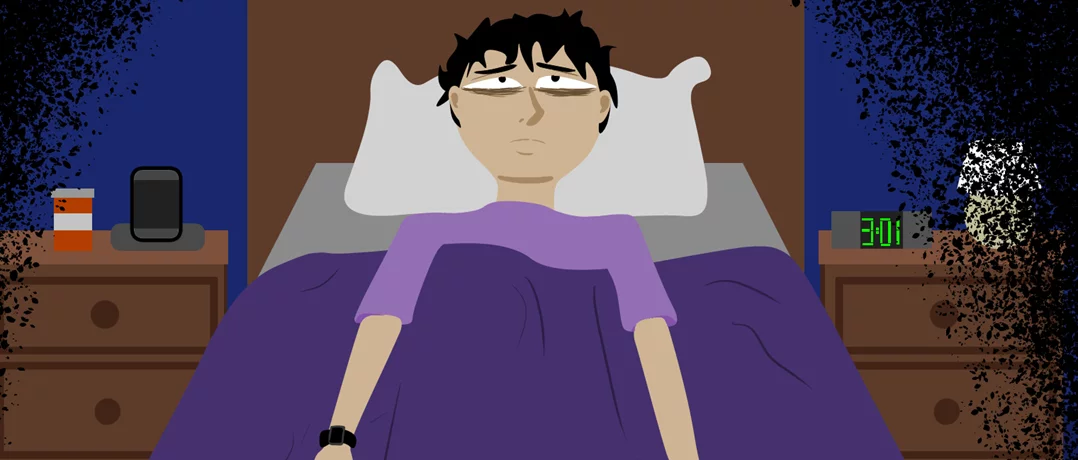
Illustration by Karim Dagher
Sleep has become one of the world’s fastest-growing wellness obsessions, even as millions of people struggle to get enough rest. Nearly two-thirds of consumers worldwide say they place greater importance on quality sleep and mental health than they did five years ago, according to the 2025 Global State of Health & Wellness report from global consumer intelligence company NielsenIQ. At the same time, spending on sleep products, wellness technologies, and meditation apps continues to surge across global markets
Yet the boom in sleep spending is unfolding alongside worsening anxiety, burnout, and psychological strain. The contradiction sits at the center of what many researchers now describe as a growing “sleep recession,” a period in which consumers invest record amounts into optimizing sleep while many of the underlying drivers of exhaustion remain unresolved.
That tension matters because sleep increasingly functions as both a health issue and an economic signal. Poor sleep is linked to reduced productivity, cognitive decline, cardiovascular disease, depression, and weakened immune function. But it has also become a commercial opportunity. From AI-powered sleep trackers and smart mattresses to melatonin supplements and biometric wearables, an expanding global industry now profits from widespread exhaustion. In many cases, experts warn, the pursuit of perfect sleep may itself be creating new forms of anxiety.
When sleep became a global industry
The modern wellness economy has transformed sleep into a measurable performance metric. Consumers now monitor sleep cycles, nighttime movement, and stress scores through watches, rings, apps, and connected devices designed to quantify rest in real time.
The financial scale of that market has expanded rapidly. According to strategic market research firm Research Nester, the global sleep tech devices market was valued at roughly $26.98 billion in 2025 and is projected to reach nearly $114 billion by 2035, expanding at an annual rate of 15.5 percent. The market includes biometric wearables, AI-assisted sleep coaching systems, and smart beds that automatically adjust temperature and support throughout the night.
The adoption of sleep technologies has spread well beyond Western markets. Research Nester estimates that approximately 15 percent of adults in the United States now use sleep-related applications, while roughly one-quarter of respondents in both China and India reported using sleep-tracking apps within the previous year.
The broader wellness industry has embraced sleep as one of its most profitable growth areas. The Global Wellness Institute’s 2026 Sleep Initiative Trends report identified sleep tourism as a major area of expansion, with luxury hotels and resorts building entire experiences around circadian lighting, sound-engineered rooms, and personalized sleep consultations.
Consumer demand is also tied closely to the broader mental health economy. NielsenIQ’s Mental Health & Wellness in 2025 analysis found that 65 percent of women now actively seek products intended to improve mental well-being, marking a 33 percent increase from just three years earlier. Across many countries, emotional maintenance is increasingly treated as an everyday consumer activity rather than a response to crisis alone.
The rise of sleep anxiety
The pursuit of better sleep, however, is beginning to generate its own psychological pressures.
Sleep specialists and researchers have warned about “orthosomnia,” a condition in which people become fixated on achieving ideal sleep metrics through tracking devices and wellness technologies. Rather than improving rest, constant monitoring can heighten anxiety surrounding sleep performance itself.
The Global Wellness Institute’s 2026 Sleep Initiative Trends report identified sleep anxiety as a growing concern linked to economic pressure, constant online connectivity, and the pressure to optimize personal health. At the same time, the Global Wellness Summit’s 2026 trends forecast warned that over-monitoring wellness data can itself become emotionally exhausting when health is transformed into a continuous performance exercise.
The technology itself is not necessarily the problem. While sleep trackers can help identify healthier habits and improve awareness of rest patterns, the constant flow of biometric feedback can also create a cycle of self-surveillance in which consumers begin treating normal variations in sleep as signs of personal failure.
For some users, a disappointing sleep score can trigger anxiety that makes falling asleep more difficult the following night. The effort to engineer perfect sleep ultimately becomes self-defeating.
A business model built on exhaustion
Critics argue that parts of the wellness industry treat symptoms as commercial opportunities while paying less attention to the conditions driving emotional exhaustion in the first place.
A 2025 analysis published by the British Psychological Society argued that elements of the wellness economy commodify emotional distress by framing individual self-improvement as the primary solution to burnout, anxiety, and fatigue. Consumers are encouraged to purchase products, subscriptions, and supplements, while broader pressures linked to work culture, financial insecurity, and digital saturation remain largely unaddressed.
The scale of the underlying mental health crisis is particularly visible across Asia’s largest economies. Research Nester estimates that India has approximately 38 million people living with anxiety disorders and nearly 56 million with depression. In China, roughly 54 million people live with depression while another 41 million suffer from anxiety disorders.
Those figures help explain why sleep technologies and wellness services are expanding rapidly across both countries. The market is not simply growing because consumers want optimization. It is also growing because large populations are struggling with stress, uncertainty, and mental fatigue.
At the same time, access to high-end sleep optimization remains highly unequal. Affluent consumers in North America, where sleep tech is projected to account for roughly 33 percent of global market share by 2035 often have access to advanced wearable devices, personalized sleep coaching, and destination wellness experiences that remain inaccessible to much of the global population.
Buying relief instead of solving burnout
The global sleep economy ultimately reveals something larger about modern anxiety itself. Consumers are spending record amounts trying to control rest because sleep has become intertwined with fears surrounding productivity, aging, and emotional stability. In a world defined by economic uncertainty and constant stimulation, sleep represents one of the few aspects of life people believe they can still optimize and measure.
But the growing sleep recession suggests there may be limits to treating exhaustion as a consumer problem solvable through products alone.
Technology can track sleep patterns. Supplements can support relaxation. Wellness resorts can engineer recovery-focused environments. None of those tools, however, fully address the social and psychological pressures leaving many people mentally overstretched in the first place. The irony at the center of the modern sleep economy is becoming harder to ignore. The more consumers obsess over achieving perfect sleep, the more elusive restful sleep can become.
-
-

-
The Beiruter
-
