



From inherited gold and Arabic name necklaces to cedars and evil eyes, Lebanese jewelry carries stories of faith, family, protection and belonging.
The stories we wear: Lebanese jewelry and identity
The stories we wear: Lebanese jewelry and identity
By Lynn El Khalil | September 26, 2026

Reading time: 6 min
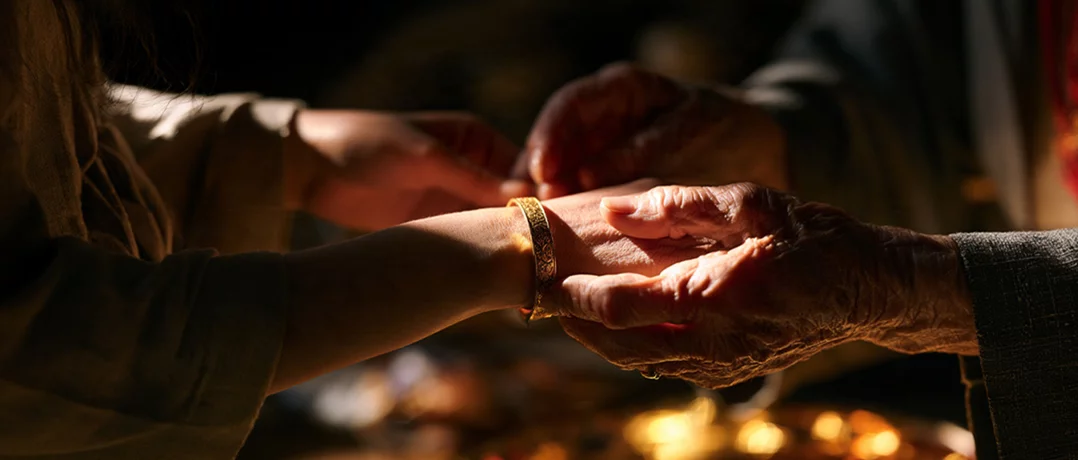
Open a Lebanese jewelry box and it can look surprisingly similar to opening a family archive. There might be a gold bracelet given at a wedding, a chain passed down from a grandmother, a religious pendant that has rarely been taken off, an evil eye pinned to a child, an Arabic name hanging from a necklace or an old Lebanese coin transformed into a pendant. Some pieces are expensive. Others are worth very little. Yet their value often has less to do with what they would sell for than with what they represent.
In Lebanon, jewelry has long existed somewhere between decoration and language. What people wear can carry religion, family history, protection, wealth and national identity, sometimes all within a piece small enough to fit in the palm of a hand. And while contemporary Lebanese designers continue to reinterpret these symbols, many of them existed long before they became fashionable.
Wearing Faith
Religious jewelry is common across Lebanon and is often worn as a simple expression of faith. Crosses, saints, Qur'anic verses and other religious symbols appear on necklaces, bracelets and pendants, allowing people to carry a symbol of their beliefs with them. These pieces are also commonly given as gifts during religious occasions or passed down within families. A cross received at a baptism or a religious pendant given by a parent may be worn for years and eventually passed on to someone else. For many people, religious jewelry is simply a personal way of keeping their faith close to them.
Jewelry as Protection
Then there are the pieces meant not simply to represent something, but to do something. The blue evil eye appears throughout Lebanon on necklaces, bracelets and children's jewelry, as well as inside homes and cars. The belief surrounding it is connected to the idea that envy or an admiring gaze can bring misfortune to another person. It is particularly common around babies, weddings and other moments when a person may attract attention.
Today, an evil-eye bracelet can just as easily be purchased because someone likes how it looks. The symbol has travelled from folk belief into mainstream fashion, creating an overlap between superstition and design. Someone may insist they do not believe in the evil eye and still refuse to leave the house without the bracelet their mother gave them. But that contradiction is part of what makes these objects culturally interesting. Symbols do not need to mean exactly the same thing to everyone in order to survive.
Gold That Belongs to the Family
Few materials carry as much significance in Lebanese jewelry as gold. Gold is worn, gifted and inherited, but historically its importance has extended beyond appearance. Unlike many other possessions, gold can be carried, sold and passed between generations. In a country marked by repeated periods of war, displacement, banking instability and currency devaluation, that portability gives jewelry another dimension. A bracelet can be decorative while still representing stored wealth. Gold coins remain particularly familiar within Lebanon's gold trade, where historical coins and locally produced versions circulate. They are often inherited as well as purchased as a form of savings. This helps explain why family gold can occupy such an unusual position. It may be financially valuable, but selling it can feel entirely different from selling another asset.
A bracelet inherited from a mother is technically gold by weight. Within a family, however, it can become something that is understood as belonging to the next generation before that generation even receives it. Jewelry therefore creates a physical line between women in particular: grandmother to mother, mother to daughter, aunt to niece. Each person may wear the same object differently, alter it or leave it untouched, but the piece survives them all.
Carrying Lebanon on the Body
Other jewelry speaks less about family and more directly about place. The cedar tree is one of the most recognizable symbols used in Lebanese jewelry. It appears on necklaces, rings, bracelets and earrings, alongside maps of Lebanon and old Lebanese coins. Its meaning is hardly mysterious. The cedar has long represented Lebanon, appearing everywhere from the country's flag to its currency. Jewelry takes that national symbol and turns it into something personal. Contemporary Lebanese designers have also transformed old coins into pendants and incorporated the shape of Lebanon into their work. Objects and symbols associated with the country become something that can literally be carried on the body. For Lebanese people living abroad, these pieces can take on another meaning. A cedar necklace worn in Beirut may simply be an accessory. Worn thousands of kilometers away, it can become a visible connection to home. The object becomes a portable version of belonging.
Your Name Around Your Neck
Then there is perhaps one of the most familiar pieces of Lebanese jewelry: the Arabic name necklace. Almost everyone seems to have had one at some point. It might have been bought as a child, received as a birthday present, ordered from a jeweler or passed down from someone else. Names written in Arabic and shaped into gold or silver pendants have become so familiar that they can feel less like a trend and more like a staple of the Lebanese jewelry box. Part of their appeal comes from how personal they are. Unlike a cedar or an evil eye, the symbol belongs specifically to the person wearing it.
But the necklace also turns Arabic itself into part of the design. The curves and connections between Arabic letters allow a name to become a shape rather than simply a word. The writing is not placed onto the jewelry. It becomes the jewelry. For Lebanese people abroad, that can carry an additional meaning. Wearing your name in Arabic makes language visible in places where it might otherwise rarely appear. Something as ordinary as a name becomes a small marker of where someone comes from. And because these necklaces are so common, they have also become tied to memory. Many people still have the tiny name necklace they wore as children, even if the chain stopped fitting years ago.
The Jewelry We Never Wear
Perhaps the most meaningful pieces, however, are sometimes the ones sitting untouched in drawers. Many families have jewelry that nobody regularly wears but nobody is willing to sell: a grandmother's ring that is too small, an old watch that no longer works, a heavy gold necklace that no longer matches contemporary styles. Their practical purpose has disappeared, yet they remain. This is where jewelry becomes particularly close to an archive. Unlike a photograph, which preserves an image of someone, jewelry is an object that physically accompanied them. A ring carries scratches. A bracelet bends. A pendant can become worn down after decades of being touched. Its imperfections become evidence that somebody else had it first.
Lebanon's relationship with jewelry also stretches much further back than the modern country. Jewelry-making traditions existed across the ancient societies that inhabited the region, where metals, stones and symbols were already being used to communicate wealth, belief and identity. Some contemporary Lebanese designers continue to draw inspiration from these older forms. The objects change, but the impulse behind them feels remarkably familiar. People continue to use jewelry to carry ideas larger than the object itself: protection, faith, wealth, memory, family and belonging. In Lebanon, jewelry does not simply decorate the body, sometimes it tells you where that person comes from.
