Discover the stories of two Lebanese family-run dairy farms preserving generations-old cheesemaking traditions through resilience, craftsmanship, and an unwavering commitment to quality.


Discover the stories of two Lebanese family-run dairy farms preserving generations-old cheesemaking traditions through resilience, craftsmanship, and an unwavering commitment to quality.

Scattered across Lebanon's mountains and valleys, small family-run dairy farms continue a craft that has fed generations, transforming fresh milk into cheese, yogurt, and labneh using methods passed down from parents and grandparents. These farms rarely advertise, rarely scale into big business, and rarely make headlines. But behind each farm lies a story of survival, stubbornness, and love for the land, stories that reflect Lebanon's own history of hardship and resilience.
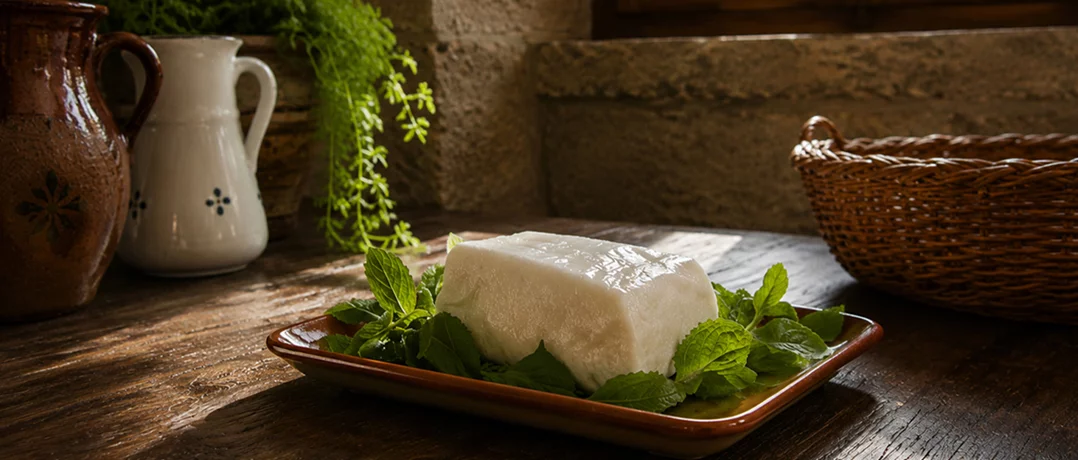
At the heart of that craft is Lebanon’s local cheese, “jebne baladiye”, Lebanon's traditional white "village cheese." Made from raw, unpasteurized milk, typically a mix of goat, sheep, and cow, and set with rennet before being lightly pressed and stored in brine, it's simple by design but never generic. Its taste shifts from farm to farm, shaped by the animals' diet, the altitude where they graze, the local water used in brining, and techniques refined within a single family. Produced mainly in Lebanon's mountains and the Bekaa Valley, it's sometimes called "mountain cheese," a nod to the shepherd communities that have made it this way for generations. Being raw and uncultured also keeps its shelf life short, part of why no two family batches, let alone two countries, ever taste quite the same.
The Beiruter spoke with two dairy farmers from very different corners of the country, one in the mountains of Jbeil, the other in the village of Harajel, about how their families built businesses rooted in tradition, and why they've refused to compromise on quality even when it would have been easier, and more profitable, to do so.
Elie Mhanna’s goat farm in Harajel traces back nearly a century, to the famine that swept Lebanon during World War I. "During the famine and the war, my grandfather lost his father, his brothers, and his mother. Everyone died. He was the only one left," Elie said.
Separated from his family, the boy survived alone in the Bekaa Valley until an uncle from Harajel came searching for him. "He found him working for a man who owned goats. The man gave him food in exchange for work when he was only 12 years old," Elie explained. "His uncle brought him back because he had nothing to eat and nowhere to go. He took him in and put him to work tending the family's goats."
There was no wage, only livestock. "He was paid with goats. Over time, using the goats he had earned, he bought him a piece of land. That's how it began."
On that land, his grandfather built a home, married, and raised four children, one of them Elie's father. Longevity runs in the family, "my grandfather lived a long life. His uncle lived to be 115 years old." His grandmother lived to 121, Elie said, "right until the last day of her life."
The tradition passed through both sides of the family. "My mother's family also raised goats, so she continued the tradition," he said. "Here in Harajel, that's what almost everyone did."
Today, Elie and his brother run the farm; their two married sisters have moved on. Hired workers help with the animals, but "the cheesemaking itself is done by the family”, Elie, his wife, his brother's wife, and his mother.
The daily routine has not changed much. "We wake up around 3:30 a.m. By about 5:30 a.m., we've finished milking. We bring the milk down to the house, boil and heat it, then begin making the cheese. By around 11 a.m. or noon, everything is finished." For Elie, it's simply what home looks like.
Hanna’s Al-Shamat farm in Jbeil began with a single cow and a mother's ultimatum. After years working in restaurants, his wife urged him to build something of his own. Then war broke out, and his mother intervened: "Stop working. Don't go anywhere," she told him, buying him a cow. "Here, this is yours. Work with it."
He knew nothing about farming at first. "I didn't know how much milk a cow could produce or anything else... we even asked the neighbors to come milk it because I didn't know how. Little by little, I learned." What began as necessity became devotion. "Honestly, I fell in love with it. Working with animals is better than dealing with some of the people you meet. Animals communicate with you in their own way, through their movements."
A friendship with a veterinarian deepened his skills. Hanna even completed a course in artificial insemination. For years he sold milk to a local factory, until the owner disputed its quality. "One day the owner started telling me that my milk was curdling every day," Hanna recalled. After the owner eventually told him to stop delivering, Hanna decided, "we'll process it ourselves at home. That's when I decided I wanted to build something of my own."
Today it's a family business. "My wife, my daughter-in-law, and I make the cheese ourselves," Hanna said. His son became a veterinarian; his daughter-in-law did too, and "trained in France to make yellow cheeses." The farm's reach now extends all the way to Beirut.
Hanna is outspoken about Lebanese agriculture's lack of support. He said that in Europe, governments subsidize dairy farmers, allowing them to sell milk below its production cost while remaining financially sustainable. "Here in Lebanon, everything depends on individual effort," he said.
He is equally blunt about food safety, "today almost every household has someone suffering from cancer. Why? Because nobody properly inspects our food or vegetables." He recalled a pesticide report where "the acceptable pesticide level was supposed to be around 18%, but one sample contained nearly 68%." His deeper frustration is with public attention span, "whenever scandals about contaminated dairy products appear, everyone talks about them for a week, then everything goes quiet again."
Through it all, Hanna returned to one principle, formed the day he left restaurants behind: "I made one promise to myself: I would feed my customers exactly what I would feed my own children." He's turned down offers to cut corners: "I've received many offers that could have made me millions of dollars by cutting corners and adulterating the cheese. I refused every one of them."
Different paths, different animals, different corners of the country, but Elie Mhanna and Gaby Hanna share a fierce commitment to doing the work the traditional way, by hand, at dawn, without shortcuts. Their farms stand as small, stubborn proof that some things, the taste of real cheese, the discipline of a family trade, the honesty of a good day's work, are truly worth preserving.

