



US airstrikes on Iran’s Kharg Island targeted military facilities while sparing oil infrastructure, signaling strategic pressure rather than full escalation around a hub that handles about 90% of Iran’s oil exports.
The strategic rationale behind the Kharg Island strike
The strategic rationale behind the Kharg Island strike
By The Beiruter | March 16, 2026

Reading time: 5 min
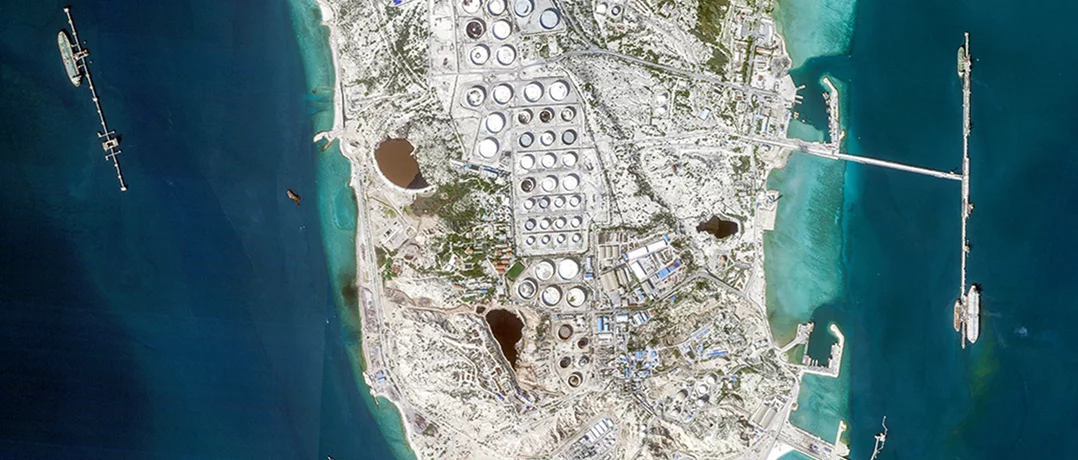
The regional war in the Persian Gulf has reached a new level when the United States (US) launched airstrikes on Iran’s Kharg Island, a small but strategically vital location in the northern Gulf. The operation, announced by former US President Donald Trump, reportedly targeted military installations on the island while deliberately avoiding its oil export infrastructure.
Despite its modest size, Kharg Island plays an outsized role in Iran’s economy and geopolitical strategy. The strikes therefore carried significant symbolic and strategic implications. Understanding why Washington targeted the island requires examining its geographic location, economic importance, and the broader regional context; particularly tensions surrounding the Strait of Hormuz.
The US strike and its strategic message
According to statements from the US military and President Trump, American forces targeted more than 90 military-related sites on Kharg Island. These reportedly included missile storage bunkers, naval mine depots, air defense systems, and other military facilities.
Importantly, the strikes avoided the island’s oil infrastructure. Trump stated that the decision was deliberate, stressing that the objective was to destroy military assets while sending a warning to Tehran. He also indicated that Washington could reconsider its restraint if Iran interfered with commercial shipping in the Strait of Hormuz.
The message was therefore twofold. First, Washington sought to degrade Iran’s military capabilities on the island, particularly those linked to potential maritime disruptions. Second, by sparing the oil infrastructure, the United States signaled that it was willing to escalate further if Iran continued to threaten international shipping.
In essence, the strike functioned as a demonstration of leverage rather than a full economic attack.
Could the United States attempt to seize the Island?
Speculation has emerged about whether US forces might attempt to capture Kharg Island. Reports of amphibious ships and Marines deploying to the region have fueled this debate.
Taking control of the island would theoretically allow the United States to cut off Iran’s main oil export hub and establish a forward operating base close to the Iranian mainland. Such a move could drastically weaken Iran’s economic capacity and military funding.
However, occupying the island would also carry serious risks. It could provoke widespread escalation, including retaliatory attacks against US bases, Gulf oil infrastructure, or shipping in the region. For this reason, many analysts believe that Washington is currently using the threat to Kharg as leverage rather than preparing for immediate occupation.
Kharg Island: A strategic location in the Persian Gulf
Kharg Island lies roughly 15 to 20 nautical miles off Iran’s southern coast in the northern Persian Gulf, within the territorial waters of Iran. Although it measures only a few kilometers across, its position near deep waters makes it uniquely suitable for large oil tankers. The island’s long jetties extend into waters deep enough to accommodate supertankers that cannot easily dock along much of Iran’s shallower mainland coastline.
Because of these geographical advantages, Kharg has developed into Iran’s primary oil export terminal. Crude oil from major Iranian oil fields is transported to the island through pipelines and stored in large tanks before being loaded onto ships bound for international markets. Tankers departing from Kharg must travel through the Persian Gulf and eventually pass through the Strait of Hormuz, a narrow maritime passage through which roughly one-fifth of global oil supplies move.
This location places the island at the center of both Iran’s energy infrastructure and regional maritime trade routes.
The economic lifeline of Iran
Kharg Island is widely considered the backbone of Iran’s oil export system. For decades, it has handled the vast majority of the country’s crude exports; estimated at around 85-90% of total shipments. In practical terms, this means that any disruption to the island’s facilities could severely affect Iran’s ability to generate revenue from its most important industry.
Oil exports remain critical to Iran’s national budget, especially under years of international sanctions. Much of this crude is sold to Asian markets, with China being one of the primary buyers. The revenues generated through these sales fund major components of Iran’s economy and help sustain government operations.
The island also plays an important role in financing military institutions, particularly the Islamic Revolutionary Guard Corps (IRGC), which oversees many strategic sectors of the Iranian economy. Because of this connection, Kharg Island is not merely an economic asset; it is also tied to the country’s security apparatus.
For these reasons, Kharg is often described as Iran’s economic “jugular vein.” Any threat to its infrastructure can have immediate economic and political consequences.
The Strait of Hormuz and global energy security
The tensions surrounding Kharg Island are closely linked to the strategic importance of the Strait of Hormuz. This narrow waterway connects the Persian Gulf to the Gulf of Oman and the Arabian Sea, making it one of the world’s most critical energy transit routes.
Any attempt to block or disrupt the strait could have immediate consequences for global energy markets. Oil prices historically surge whenever conflict threatens shipping in this corridor. As a result, ensuring safe passage for tankers has long been a priority for the United States and its allies.
Washington has accused Iran of threatening or interfering with commercial shipping in the region. By striking military sites on Kharg Island, while leaving the oil terminals intact, the United States appears to be using the island as strategic pressure to deter further interference with maritime trade.
Hence, by targeting military facilities on Kharg while sparing its oil infrastructure, the United States aimed to send a powerful signal without triggering immediate economic collapse or wider regional escalation. The operation underscores the delicate balance between deterrence and escalation in the Persian Gulf.
-
-

-
The Beiruter
-
