

The ancient third eye, rooted in Hindu and Buddhist traditions, continues to shape modern ideas of intuition, meditation and inner awareness, including in Beirut.
The third eye… sight beyond seeing

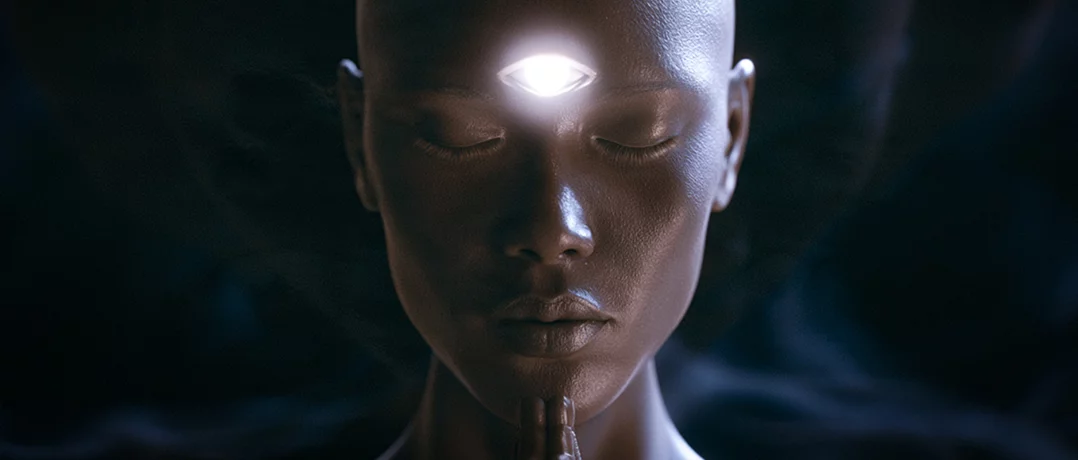
In temples across the Indian subcontinent, and now in meditation rooms in Beirut, a single symbol persists with uncanny endurance, an eye that perceives not with light, but with insight. Known in Sanskrit as the Ajna chakra and honored in Buddhist iconography as the eye of wisdom, the third eye embodies one of humanity's oldest aspirations, to see beyond the surface of things, into their true nature. To trace this ancient idea into the present, The Beiruter sat down with Priya Reddy, a Hindu meditation teacher and healer who has spent more than a decade guiding students through contemplative practice.
Roots in the Vedic imagination
The mythological ancestor of the third eye belongs to Shiva, the ascetic god of the Hindu pantheon, whose forehead bears a vertical third eye said to have opened only in moments of extraordinary consequence, most famously to reduce Kama, the god of desire, to ash. Later tradition reframed this destructive flame as an illuminating one, a faculty of perception that burns away illusion rather than the world itself.
In the subtler architecture of yogic and tantric thought, this mythic eye came to be mapped onto the body as the Ajna chakra, a six-petaled center of energy positioned between the eyebrows and long regarded as the seat of intuition, memory, and inner command. “In the Puranic imagination, Shiva’s third eye is not a punishment,” Reddy explained. “It is discernment burning away illusion. That is the whole of the teaching, if people would only sit with it.”
Buddhism, emerging from the same subcontinental soil, carried the symbol forward under a different grammar. The urna, a dot or a curl of hair depicted between the Buddha’s brows in countless statues and paintings signifies prajna, the penetrating wisdom capable of piercing avidya, or ignorance, the root affliction from which suffering grows. In Tibetan Vajrayana practice, this same point becomes a site of visualization, where practitioners are trained to perceive with a clarity unavailable to the physical eyes. “Hinduism and Buddhism diverge on many points of doctrine,” Reddy said, “but on this, they meet. Sight is not the same as seeing. One is mechanical. The other is earned.”
Conversations beneath the Cedar trees
Reddy’s own path to teaching wound through classical study in India before settling, somewhat unexpectedly, in Lebanon, where she now leads seated meditation groups for a clientele largely unfamiliar with Eastern metaphysics. The distance between traditions is smaller than it appears. “My students arrive skeptical of a chakra they cannot locate on an X-ray,” she laughed. “I tell them the ajna is not anatomy. It is orientation. It is the direction you face when you finally stop looking outward for an answer that was always internal.”
She described a recurring moment in her sessions, one that seems to substantiate the ancient claim in the language of ordinary experience. “When people close their eyes for the first time in years, truly close them, some cry,” she recalled. “Not from sadness. From recognition. Something in them remembers this stillness, even if the mind insists it is new.”
Between myth and method
The third eye has migrated from scripture into wellness marketing, its ancient vocabulary flattened onto crystals, candles, and self-styled “awakenings” promising instant transformation. Reddy regarded this popularization with measured wariness. Contemporary science, for its part, has drawn its own loose parallel, noting the pineal gland’s position deep within the brain, though she was careful to separate metaphor from anatomy in her teaching.
“The third eye has become a hashtag,” she said, with some resignation. “But it was never meant to be sold. It was meant to be earned, through stillness, through years, through humility. There is no shortcut the scriptures ever promised us.”
The third eye has traveled an extraordinary distance without losing its essential claim, that the truest perception happens inward. Whether approached as myth, as anatomy, or as daily discipline, it remains what Priya Reddy calls it in closing a mirror. “It does not show you the world,” she reflected. “It shows you yourself, and asks whether you are finally ready to look.”
-
-

-
The Beiruter
-
