



Renewed Lebanese-Emirati engagement signals growing confidence, advancing investment, institutional cooperation, economic reform, and Lebanon’s reintegration into the Arab world.
The UAE’s promising return to Lebanon

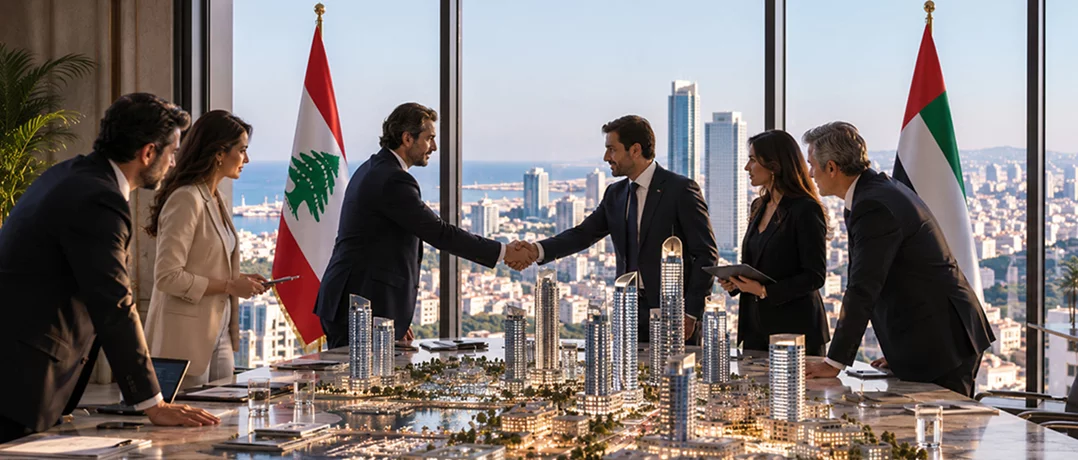
The visit of a high-level Emirati economic delegation to Beirut and the reciprocal Lebanese delegation visit to United Arab Emirates (UAE), expected to last three days, marks one of the clearest signs yet that Lebanon is gradually rebuilding its ties with the Arab world after years of political estrangement and economic collapse.
More than a symbolic diplomatic gesture, these visits reflected a strategic effort to revive economic cooperation, encourage private-sector investment, and lay the foundations for a long-term partnership between Lebanon and the UAE.
A high-level Emirate economic mission to Beirut
Led by the UAE Minister of State for Foreign Trade, Dr. Thani bin Ahmed al-Zeyoudi, the delegation included around 90 senior business leaders, investors, and economic officials representing sectors ranging from logistics and renewable energy to technology, agriculture, healthcare, aviation, and tourism. The Emirati delegation’s visit was centered on strengthening private-sector cooperation and identifying commercially viable investment opportunities across Lebanon.
President Joseph Aoun received the delegation at Baabda Palace, describing the visit as
A message of hope and confidence in Lebanon’s stability and future.
Stressing the close relationship between security and investment, he noted that Lebanon possesses considerable assets, including its highly skilled workforce, entrepreneurial private sector, strategic geographic location, and extensive global diaspora.
Al-Zeyoudi highlighted that his country views Lebanon’s human capital as one of its greatest competitive advantages. Lebanese professionals, he noted, have played a significant role in the UAE’s development across business, finance, technology, engineering, healthcare, and other strategic sectors.
He also revealed that non-oil trade between the two countries reached approximately $4.2 billion in 2025, representing one of the highest levels recorded over the past 15 years. According to the minister, this growth demonstrates that economic relations remain strong despite Lebanon’s recent crises.
Throughout the visit, Emirati investors held business-to-business meetings with more than 120 Lebanese entrepreneurs, exploring partnerships in industry, agriculture, food security, tourism, information technology, infrastructure, energy, oil and gas, logistics, banking, and digital services.
The Lebanese delegation’s follow-up visit to the UAE
Recognizing that investment requires sustained engagement rather than a single event, Lebanon quickly moved to maintain the momentum created by the Emirati delegation’s visit.
A Lebanese official delegation began a three-day visit to Dubai to follow up on discussions initiated in Beirut and advance negotiations on specific investment opportunities. Organized by the UAE Government Experience Exchange Programme, the mission brings together 24 Lebanese officials from 13 public institutions, led by Minister of Economy and Trade Amer Bisat and Minister of State for Technology and Artificial Intelligence Kamal Shehadeh.
The delegation is studying the UAE’s internationally recognized experience in government modernization, digital transformation, artificial intelligence, legislative reform, future foresight, public service delivery, and the “Zero Government Bureaucracy” initiative. The program also includes meetings with senior Emirati officials and visits to government institutions, with the objective of transferring expertise, strengthening institutional cooperation, and laying the groundwork for long-term partnerships between the two countries.
According to Bisat, the objective is to transform political goodwill into concrete projects through a comprehensive economic framework that includes discussions on a Comprehensive Economic Partnership Agreement (CEPA). The government also intends to activate the newly established Joint Business Council, allowing private companies from both countries to identify commercially viable projects while governments focus on providing an enabling legal and institutional environment.
Lebanon has identified two primary categories of opportunities:
The first includes major infrastructure projects (such as ports, electricity generation, roads, digital infrastructure, and transport) which may rely on Public-Private Partnerships (PPP) and Build-Operate-Transfer (BOT) models.
The second consists of direct business partnerships in hospitality, manufacturing, agriculture, technology, healthcare, and professional services.
Agreements signed during the visit
The visit produced several concrete agreements designed to institutionalize bilateral economic cooperation.
The two governments signed a memorandum of understanding (MoU) between the Lebanese Ministry of Economy and Trade and the UAE Ministry of State for Foreign Trade to strengthen cooperation in trade and investment while establishing clearer mechanisms for future collaboration.
In addition, five major memoranda of understanding were signed during the Lebanese-Emirati Economic Forum:
An agreement between the Federation of UAE Chambers of Commerce and Industry and the Lebanese Chambers establishing a Joint Lebanese-Emirati Business Council.
A cooperation agreement between the Chamber of Commerce, Industry and Agriculture of Beirut and Mount Lebanon and the Abu Dhabi Chamber of Commerce and Industry.
A partnership agreement between the Beirut Chamber and the Ras Al Khaimah Chamber.
A memorandum between Elite Agro Holding and the American University of Beirut to cooperate on food security, dryland agriculture research, and agricultural innovation.
A partnership between Elite Agro Holding and George Dekash & Sons to develop greenhouse technologies, including design, installation, maintenance, technical support, and training.
Beyond these formal agreements, both sides launched the first meeting of the Joint Business Council and organized specialized sessions focusing on infrastructure, reconstruction, investment opportunities, digital transformation, and private-sector partnerships.
President Aoun’s visit to Abu Dhabi opened the door
The current momentum in Lebanese-Emirati relations began with President Joseph Aoun’s official visit to the UAE in April 2025, his first since assuming office. During talks with UAE President Sheikh Mohamed bin Zayed Al Nahyan, both leaders stressed on restoring bilateral relations based on mutual trust, state sovereignty, and economic cooperation.
The visit produced several tangible outcomes that became the foundation for subsequent developments. Both sides agreed to establish a joint Lebanese-Emirati Business Council, facilitate the return of Emirati citizens to Lebanon by lifting previous travel restrictions after appropriate security measures, strengthen diplomatic representation, and dispatch a delegation from the Abu Dhabi Fund for Development to explore investment opportunities across Lebanon.
The joint statement also highlighted cooperation in public-sector modernization, with the UAE agreeing to share its internationally recognized experience in government performance, institutional excellence, and digital transformation. These initiatives signaled that the relationship would extend beyond financial support toward knowledge transfer and institutional cooperation.
The economic delegation’s visit to Beirut therefore represents the implementation of commitments reached during the presidential summit rather than an isolated diplomatic initiative.
A formidable relationship built over the years
The renewed partnership rests upon a long-established relationship that predates the current political environment.
The UAE opened its embassy in Beirut in 1974, the same year that the late Sheikh Zayed bin Sultan Al Nahyan allocated significant financial support for Lebanon’s Litani River project and contributed to strengthening Lebanon’s defense capabilities.
Following the end of the Lebanese War in 1990, the UAE became one of the country’s principal Arab partners in reconstruction, financing projects in infrastructure, education, healthcare, and public services. After Israel’s withdrawal from southern Lebanon in 2000 and again following the 2006 war, the UAE played a leading role in reconstruction efforts, launching extensive rebuilding initiatives and humanitarian assistance programs.
The relationship has also been shaped by the large Lebanese community in the Emirates. Over several years, Lebanese professionals, including engineers, doctors, bankers, educators, entrepreneurs, and media specialists, have contributed significantly to the UAE’s rapid economic development, while the Emirates provided opportunities that transformed it into a second home for tens of thousands of Lebanese families.
Although bilateral relations experienced periods of tension, particularly during Hezbollah and the Axis of Resistance’s dominance over the Lebanese political and security landscapes from 2010 till 2025, both governments have consistently stressed the enduring importance of the relationship and the mutual benefits of closer cooperation.
Therefore, the current rapprochement between Lebanon and the UAE could mark not only the return of Emirati investment but also Lebanon’s gradual reintegration into the broader Arab economic landscape.
-
-

-
The Beiruter
-
